About Me

"Use every man after his desert, and who should 'scape whipping?"

Tuesday, 20 January 2015

Bugger hyperlocal, it's just a good solid local paper that we need

A good read that has appeals and an admiring readership way beyond NW1 - the Camden New JournalBugger hyperlocal, it is plain, old fashioned local newspapers that I love. In fact, what I mean to say is - if only we could have a local paper which is half as good, a quarter as brilliant, an eighth as entertaining, and a sixty-fourth as campaigning as the Camden New Journal.

At the end of every week I make sure I enter the holy borough of Camden - even if it just means walking a little way up Tottenham Court Road from Goodge Street - to pick up a copy of this excellent free sheet. I will even go to Angel to get a copy of sister paper, the Islington Tribune. But it is the CNJ itself which, I believe, has made itself essential reading for anyone who takes  an interest in inner-city London life.

The CNJ is one of the original free-sheets, leading the way for a host of much less honourably motivated publications including the sadly un-phoenix-like Standard. It was born out of an NUJ strike at the Islington Gazette in the early 1980s, and unlike many similar ventures at the time (e.g., the still sadly missed City Limits) it has not merely kept going but has gone from strength to (at least editorially) -strength.

The word free sheet suggests something of little worth - a free sheet, at least in London in recent years, has generally mean a dismal, unedited  tabloid publication stuffed with undisguised advertorial about new homes, posh new eateries and private schools, and a bit of press-release based news coverage. (I'm talking specifically here about the Battersea, Wandsworth and Clapham Guardian titles, which used to be ok-ish but are now simply not worth the bother of picking off the floor onto which they are occasionally flung by some underpaid delivery man). Then there are those thin and thinly disguised bits of propaganda for your lovely local authority

The CNJ is still a real newspaper, still independent of either the big media groups, private equity gangsters or the local authorities. It is one of the very few survivors of community-based local newspapers. And one which still pays its journalists - or so I have been told.

For years we've been told, we have been believing the mantra, that local newspapers are dead, that the way ahead is the hyperlocal blog.  Well, the CNJ is alive and (I hope) reasonably well - but where are  hugely successful hyperlocal blogs?

In London, there's a curious hierarchy. You have the dominant regional free sheet - the Evening Standard - but also competing regional listings sites (Time Out, the Londonist, bits of the Standard, and the London editions of national papers Guardian, Indie etc).

Then there are the surviving local paper groups - Ham & High, Islington Gazette, CNJ, the Advertisers south of river along with the South London Press; that Richmond-based lot once owned by the Dimblebys but  owned by Newsquest, and all the horrible estate agent porn (Kensington Magazine etc).

Online, things are editorially healthier but financially not so solid: look how hard the Brixton Blog and Bugle had to to try to crowd-fund a paid news reporter. This is a volunteer-run operation,  and has become a popular online news and features focused blog with a monthly print tabloid, both of which seem, oddly enough, to fit in nicely with  their competition)  Its sort-of competitor, the Brixton Buzz site, seems to have done a good deal with the fortnightly listings and leisure  sheet, Lambeth Life, which offers a very readable and genuinely informative take on  the cultural life of the borough every other week. At the moment, you could say SW2 & 9 were super-served, blogwise.

New imaginative ventures such as Goldsmiths' Eastlondonlines do a great job, but …I still wish we had a CNJ down south….


Sunday, 11 January 2015

Bingo! Another slice of Wandsworth Road's history is about to disappear in a cloud of dust

Just a hundred yards west of the former Tearooms des Artistes, there was another hub of social life on the Wandsworth Road,  Rileys Snooker Hall, just opposite the Baptist Chapel on the corner of
As it was: Riley's snooker
hall in the Wandsworth Road,
complete with lovely cladding
Victoria Rise.

This place was always regarded as one of the ugliest buildings in a street that was not exactly beautiful.
And yet, once the demolition team got to work, they began to uncover details that made you stop and look and think - hang on, what the hell was that place?

According to a fellow blogger  this surprisingly large building was almost certainly a Temperance Hall.

Once the hideous facade had been pulled away (I always thought of it as corrugated iron, but it is actually some sort of plastic cladding), you see this elaborate stucco work, all very garish and mock-exotic. Surely this is all a bit much for what was supposed to be a former Temperance Hall?

No - a little more research soon turned up a load of information on the Temperance and Billiard Hall movement of the early 20th century. The images on this site are of buildings very similar in design to the one on Wandsworth Road which is now on the brink of demolition.

It's clear several very similar buildings were erected across south London in the early 20th Century. Maybe they were designed to be alluring enough to tempt wayward souls away from the pubs and gin palaces. Once inside they'd get a nice game of billiards and a glass of ginger beer, or a tea. And maybe a pamphlet or two?

Oddly enough, Rileys always seemed quite a sleazy place. I'm pretty sure I remember seeing Bingo Nights advertised there - I can remember discussing this with a friend who wanted to go along as she wanted to film it. Like an idiot I never went inside. You can sewe from the outside it was a big space - there's a second hall behind the first, and they appear to be interconnected.

In recent years,  I think - I am sure I remember this - it sometimes ran club nights, which would  be policed by massive bouncers wearing lots of gold chains. Can't imagine there was an awful lot of temperance in the air inside - just walking past you almost swooned in the exhalations of after-shave.

I knew this area had been famously teetotal - even poor Graham Greene noticed this when he had to cross Clapham Common to buy beer for his visiting guest, Julian Maclaren Ross, from the Windmill pub. It seems the heavily disapproving temperance  mood of the Clapham Sect - for all the good they did in parliament in  pushing through abolition - had a deep and lasting impact on the social fabric.

Ayway, the Temperance Halls, for all their worthiness, could not resist a distinctly racy, kiss-me-quick architectural details. Look at the photos below of the poor old building, before it is pulverised. Beneath that hideous facade lurked a bit of dandy, a man or girl about town with its exotic curves and curlicues.

Love it. Now it's on the way out - and I am sure the Travelogue (is that the right name?) that replaces it will be haunted by all manner of randy but alcohol free ghosts.

The Wandsworth Road itself is changing very fast, but at least two of its very well hidden treasures should be safe from the developers of Nine Elms. The Larkhall Estate close to Wandswroth Road  overground station, with its deeply shaded quadrangle gardens and steep pitched roofing -  is grade 2 listed - while ornate and flamboyant interior decoration of Khadambi Asalache's 575 Wandsworth Road is now in the hands of the National Trust.

Seems it was built around 1909 by the Temperance Billiard Halls movement, here in SW8 along with others in Lewisham, etc.


Sunday, 4 January 2015

Losing our society: what next for the former home of The Tearooms des Artistes?

Some things you take too much for granted. Like who did not think there'd always be an interesting drinking place in the cranky old building once famously occupied by The Tearooms des Artistes, at 697 Wandsworth Road, London SW8?

Yesterday, walking back past the junction with Silverthorne Road and North Street, I see there are
This used to be one of the few real treasures of Clapham - the Tearooms des Artistes. Then it became this flashy restaurant, and now - who knows?
This old building, said to be partly a 16th century barn,  is a jewel of the
Wandsworth Road.  Home to the much-loved  Tearooms des Artistes until
2006,  then the much less interesting Lost Society bar and restaurant, the
 building is once again empty. What next?      Photo: Ewan Munro 
estate agent's boards all over the big brash pub-club on the corner, latterly the Artesian Well. Not surprised or even sad that place has gone, but unnerved to see that it is being sold without any  requirement to keep it as a place of refreshment.

But then, you see similar signs up on its neighbour, which in recent years has been a rather overcooked and expensive restaurant-bar-party place and sometimes theatre calling itself Lost Society. Big steel shutters over the windows, no messing here. On these boards they state they might be interested in restaurant proposals.

You can only imagine that any restaurant opening here in 2015 will be a couple a galaxies away in culture from the famously eccentric Tearooms which survived  and even thrived here through most of the 1980s and 90s.

It really was the strangest place, and only now does the absurdity of having such a gem on one's doorstep, and hardly ever visiting it, hit you hard in the gut.

Once, long before I lived in the area, a friend invited me to meet at what she said was a crazy and rather beautiful place near ILEA's Batttersea TV centre. I was living in Dalston at the time (1982 or so) so it was long cycle ride, but worth the effort: the Tearooms des Artistes on Wandsworth Road, about midway between Vauxhall and Clapham Junction, was even then a rare survivor of a genuine late-60s style alternative meeting place space. Part bar, part cheap veggie restaurant, part art-gallery, nightclub, performance space - a veritable mini-arts lab for the shrinking bohemian populations of SWs 8 and 4 and 11. Somewhere you could sit and read and talk most of the day, or just find a dark corner to hide in.

Occupying what felt like farmyard buildings (and it did apparently incorporate much of a 16th century barn and -according to some accounts - slaughterhouse), with low-ceilinged rooms and passageways going off in directions, plus a garden area if you were adventurous, creaking floorboards and furniture, it seemed , sourced from skips across all 35 boroughs.

Want to bring some joyful bohemia back to Clapham?
Put on your sunday best, visit your bank manager,
then ring this number!
We met there at about 4pm and we were hungry. The chef that day, a young woman with blonde dreadlocks, showed us the choices: one dish. A huge aluminium  tray filled with the most delicious vegetarian moussaka I had tasted, before or since. We had several large tumblers of rough red wine and piles of heavy hippy-style bread with it. I can't remember the cost, but I do remember she a had some trouble working out our bill and sort of shrugged and there was change from a fiver. OK it was the early 1980s, but even then, this was ridiculously cheap.

What I also remember clearly was the background music - actually more foreground, especially when she cranked up the volume on The Fall's Repetition. As a sort of house in-joke, I think, she played this track twice, with a bit of Miles in between.

I had clearly found my spiritual bolt-hole - so why, when I moved into a flat less than a quarter mile from the Tearooms did I not become an habitué or fixture there? I wish I could explain my own stupidity as a 30-something cut-price yuppie. I always recommended the place and kept my eye on the listings mags, where more and more often you'd see the Tearooms' club nights starred up to the hilt.

I guess I already felt too old and drab to go there any more. The next visit I remember was in 1986, when I left a dreary trade magazine job. I was asked where I'd like my leaving do, and as many of the staff lived in the SW area, this seemed an obvious choice. So it was that the full staff of this mag, 12 or so of us including its thrusting new editor, sat around creaking tables in one of the upper rooms,  draining litre flagons of wine and consuming more slabs of delicious vegetarian lasagne.  You wondered if the floor would hold.

This bearded editor was clearly much more used to fine dining at expense account hotel restaurants, but he looked quite cheerful when the final bill came in. We left just as some DJ was setting up and a new younger clientele was arriving.

By all accounts the Tearooms flourished in the  E-fuelled clubbing boom of the late 80s-early 90s, becoming famous as a place to chill down at after a night at one of the more frenetic music barns of a Sunday morning. By morning, I mean 5am onwards - it was on the map as one of the few places that was open at this time. Hardened clubbers kept going right through the day, and it was in this milieu that some big-name djs - notably Rob Da Bank - cut their teeth.

His weekly Sunday Best slot on the Wandsworth Road was the little seed out of which grew his worlwide dj-ing empire and the Bestival festival on the Isle of Wight. Slightly bigger crowds, same basic ideas.

All I can remember is on some summer sundays, lying in bed and hearing weird and beguiling mixtures of house, disco, psychedelia, new wave, jazz, prog rock and world music drifting over from the Tearooms garden direction. Sometimes the sounds mingled with raves being held at the squatted Lease-Lend Cottage up on Hannington road.

If anyone reads this who was there, or has any other memories of this lovely place, it would be great to hear from you.

At some point in the early 2000s,  the Tearooms finally went belly-up, but after a while - in 2006, I am told -  it was thoroughly tarted-up and re-opened as Lost Society.

The new place attempted to keep the arty bohemian spirit going, but in a much more lavish, way. You can see some photos of the interior as it was on the website of interior designer Lee Broom,  from 2006.

It had chnaged, of course it had, everything had changed. But it did still put on some good music nights, as well as setting up a theatre spot. The Reggae Philharmonic were playing gigs there in recent years. But clearly rents had soared and the emphasis went more and more onto pricey food, and party nights for well-heeled.

It was no longer a place for misfits. It had a rather nice fit with the rich kids of a wide swathe of south west London, thank you very much.

To let - SW8's noisy nightclub for loaded teens , the Artesian Well, is no more, now premises up for grabs for anyone with enough cash.
 It still had a clubby atmosphere, but now it was more of the OK yah genre, or so it seemed to grumpy old fools like me. It all just seemed a wee bit too snotty for some of us old ex-punks, rare groovers, acid-house ravers and undead freak-out-o-philes.

Good god you'd even see stretch limos parked up along poor old Wandsworth Road, although they were even more likely to be dropping people off at the Artesian Well next door - a rather grim meat-market for the well-off youth of the Surrey fringes. That too is now closed.

A search for the history of the Tearooms has not so far turned up very much of interest, apart from this review by Serena Mackesy from the Independent in June 1994 (so it was still going then). She described it as "a delightfully eccentric bar-restaurant in a former slaughterhouse (for a while holes in the walls where the blood used to run out remained open to the air) on the corner of North Street, and serve very palatable vegetarian food and lashings of plonk".

Adding: "They also provide a weekend service to insomniacs by opening (for a pounds 2 entrance fee) for breakfast, board games and wacky ambience from 5am on Saturday and Sunday mornings. Close to Clapham Common."

Oh, please let's get back to some of that wacky ambience, for pity's sake!

Wednesday, 10 December 2014

Al-Jazeera on the end of SARM studios

Just in case you think I am a stupid old nutter, ranting on about the modern world and how it's ruining London…. read this article on Al-Jazeera.

Yep, the Qatari-based news channel is running this story about the rampant greed that is currently destroying the cultural fabric of this strange "city" we live in.

The studio in question, SARM,  is famous for many reasons - Queen, Bob Marley, Band Aid and many others - but the point is that there are only so many of these iconic places left in London.

And the real point, behind this point, is that the people who own these places are now under irresistible pressure to sell up and move out. It no longer makes economic sense to run a a recording studio - that is, a space equipped for the production of a highly valued global commodity, popular music - in the central zones of this city.

A music factory - one week's recording of artists such as  those named above might produce a return of a hundred million over a decade - is simply not profitable enough in a "city" where similar sums can be made in a few days or weeks by hedge funds.

About the only creative industry that can still survive in central LOndon (apart from creative accountancy) is fine art  - and that is thanks to the curious bastard child of the art-marketing revolution of the 1990s, Frieze and all that - that fine art has become a high-value commodity on a par with arms or diamonds.

Earlier today, on the excellent Robert Elms Show on Radio London,  I heard a musician lamenting  there was only one full-size recording studio left in this city, Abbey Road.

 Once they've all been turned into expensive places for expensive people to spend a few weeks of the year shopping in expensive shops or doing deals - well, the next generation will have very little reason to be interested in this brutal Thames-side mudflat settlement that was once so attractive.

It is now,  visibly,  the place to come to spend the vast amounts of money you have acquired by crushing the spirits of millions of others in other parts of the world.

We live by the river. We watch Waterloo sunsets, we know it's the Great Wen. We don't do the Lambeth Walk and we don't want to go to Chelsea.  I was there this afternoon and I tell you, it is  dull, dull, dull these days.

SO, if we manage to dodge their 4 x 4 wagons on our bikes on our way to our little part-time jobs selling things to these very rich people, or pampering them, or building the next block they can invest in - what happens next?  Is there somewhere for us to live or must we move away, back to Croydon?

No, Croydon is undergoing re-generation and re-gentrification. You will have to go elsewhere.


Tuesday, 2 December 2014

New flying pig square, anyone?

Oh how I love Rachel Holdsworth! Her latest post on the Londonist regarding the Battersea Nine Elms project and its latest release of plans for Malaysia Square (or flying pig square, as she suggests as an alternative name) is both glorious and shocking at the same time.

Yes, that £800,000 studio flat is a strange notion - but maybe it will be just right for some of the young students attending this week's Nine Elms Career Expo, organised by London SouthBank Univeristy and the Nine Elms Vauxhall contractors.

As the press release  so helpfully points out, "Nine Elms Vauxhall is a 195 hectare redevelopment area in the London boroughs of Lambeth and Wandsworth and is set to be the biggest construction site in Europe".

I still prefer my own name for this development - Nine Elms Disease. But I am biased - it is blighting my life at the moment, and slowly but surely ruining the view from all vantage points to the south and  west of Vauxhall.


Still, let's not be unfair, and give these guys their due: they are building our future, after all.  And it's true there'll be plenty of new jobs down around the old power station. The fair, held today and tomorrow (2nd and 3rd December)  will include "demonstrations and workshops by the main contractors working on the development, giving the students the chance to learn about the future opportunities at Nine Elms Vauxhall".
"Contractors attending the event include companies such as Whitbread, Transport for London, John Lewis Partnership and the Berkley Group Foundation." 

Good news, then , for jobs in the retail, hospitality and construction sectors - but for those really big bucks, I'd head straight for the property developer booth - that's probably the only sort of employment that will get your name on the waiting list for one of these lovely new studio apartments.

Monday, 1 December 2014

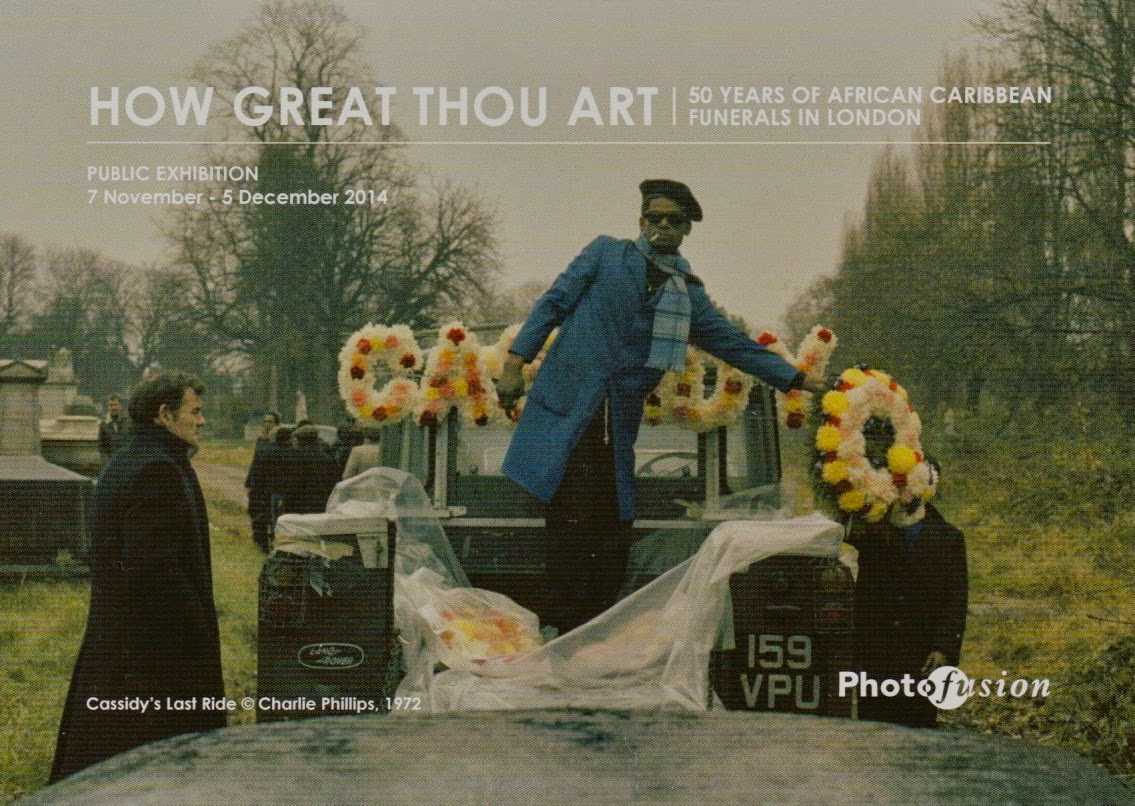
How Great Thou Art: last chance to see amazing Charlie Phillips exhibition at Photofusion


How Great Thou Art: 50 years of African Caribbean funerals in London, photographed by Charlie Phillips. An exhibition at  Photofusion, Brixton

Another evening in Brixton to treasure: at the Library, listening to the 70-year-old photographer, Charlie Phillips, talking about his latest exhibition, How Great Thou Art: 50 years of African Caribbean funerals in London.

This exhibition, held at the Photofusion Gallery just round the corner in Electric Lane, focuses on  the funeral traditions of West Indians living in London from the mid-1950s right up to now. Two rooms of  beautiful photos and videos vividly and beautifully capture these living and changing traditions, which mix up African, Caribbean, Christian and West African religious customs.
The powerful resonance  and documentary value of those images was reflected in the crowd of people who filled out the upstairs hall at Brixton Library on a wet Wednesday evening to hear the master talk.

The show is only on 'til this Friday, December 5th - so get along there quickly!

Apparently the photos had been languishing in boxes in Charlie Phillips' house, until the Photofusion people - co-curators of this exhibition, Lizzy King and Eddie Otchere – came across them and realised their importance and quality. "I had retired" Charlie complains. "I wanted to look after my allotment." But the next six months was spent going though over 5,000 negatives, hours of video and  creating both a book and an exhibition out of the results. As a result, his allotments suffered a bit: "Sorry, it's  not going to be such a good crop this year".

Charlie Phillips,  a well-known Ladbroke Grove character with a taste in sharp suits and hats, has that aura of celebrity - not the cheap PR-manufactured type, but the genuine, hard-earned article. This is  something he shares with many of the great characters in his photos, these people who've put up with so much over decades and still smile and laugh and know how to party, but also how to parry when ever necessary.

Tonight he's in a white jacket, buttoned precariously over a tight dark shirt and brilliant orange tie, his white hair and moustache and mischievous, warm eyes flashing behind glasses giving him the look of a seasoned comic actor.

 The exhibition title comes from the hymn that for Charlie sums up all the funerals he's been to - it is that hymn, so dirge-like in the dull voices of an English congregation, that takes on new life and vigour and meaning when sung by generations of Jamaicans beside an open grave in Kensal Green cemetery.

He tells us his story - how, from being an altar-boy he grew into a rebellious teenager, hanging out with the youth at the shabeens and blues parties in the Notting Hill area,  how he got hits first camera (a Kodak Retina)  from one of the black Amercian GIs who brought their precious blues and jazz and R & B discs to these parties, helping to spawn the London sound-system tradition as well.

Charlie was entirely self-taught, and he did his own processing and printing using equipment bought on the proceeds of a paper-round. He would wait until all the rest of the household were asleep before using the bathroom as his darkroom.

But it was when he went to the funeral of Kelso Cochrane, the 32-year-old  Antiguan murdered by Teddy boys in Golborne Road in 1959, that the power of these these events really struck him and he took his first funeral "snaps" (as he insists on calling all his photos).

Over the next four decades Charlie became a must-have guest at the funeral of the great and the good and the bad and the ordinary families of African  Caribbean descent all over London.

The photos - which you can see until at Photofusion's small gallery up on the first floor of the Brixton MArket buildings - capture the joy as well as the grief of these vents. Everyone speaking tonight - which included the professor Michael McMillan and writer Empressjai - emphasised how the West Indian funerals pick up on the West African belief that the spirit does not die, but has to move on - it's the job of everyone at these funeral to help that spirit on its way, hence "the good send off". Hence the opening of windows at the wake or the Nine Nights (the night before the burial when the spirit is said to leave the body), even in the depths of a London winter.

"It's not all peace and love", he adds. Quite often a old family tensions  burst out at such events, there are fights, scuffles even over the coffin .

The photos show not just the big burial processions, but also the wakes - and especially the  crucial "Nine Night", that last night of the wake before the burial, when music and dance and drink and what have you often take upper hand.

There's some great photos there of these events - as well as some more recent videos, including one showing another professor, Gus John, giving a traditional libation at the funeral of the All Saints Road activist, Frank Critchlow, who ran the famous Mangrove restaurant and bar back in the 60s and 70s.

That libation speech was so good, you have to see it, especially when the guy sits down to take a few sips of the libation gin bottle. It illustrates one of the  big themes of this evening's talk - the way old African traditions have survived any amount of battering by the white missionaries. Their lasting contribution, on the other hand, is the hymn.

We had an expert, Dr Michael McMillan, talking about these traditions - and he made the point very clear that these "Black death cultures" are actually about life - the spirit that lives on, to join all those other spirits, good and bad, which get on with their business all around us all the time - the duppies and the jumbles and the djinns and the sprites,  the spirits of place, of the earth and the sky.

Dr McMillan noted that most of the cemetery chapels in London were far too small for a proper West Indian funeral,  hence the massive wakes and receptions before and after that event. The burial itself is different - relatives  don't just drop a few crumbs of earth onto the coffin, they cover it  and fill completely. But only after the deceased's favourites things have been sprinkled over the grave - maybe some flowers, some jewellery or clothing, some records or some rum or perhaps some ganja.

He picked out the  great images of a funeral wreath in the shapes of a giant pack of Rizlas, and another as a Singer Sewing machine - "Our traditions have single handedly revived London's floristry business!" -  and also noted how these echoed the Ghanaian tradition of burying people in coffins which reflect their occupation. A boat-shaped casket for a fisherman, a Mercedes Benz for a taxi-driver.

What a great evening this was - but Charlie had some regrets, as becomes clear in the more recent photos in the exhibition. He doesn't really like the way the younger generations have allowed the funeral traditions to become a bit diluted - how they often choose Frank Sinatra's "My Way" or even the "Simply the Best" as the theme music. And how there's now so much emphasis on bling and colour-co-ordinated clothing.

But as others noted, including Empressjai and Dr McMillan - the tradition is alive and changing, new traditions are being created. The evening ended with a big discussion on this issue, the changing trsiditions of different generation, with many people chipping in with their thoughts and their memories.


Friday, 21 November 2014

Faith in Clapham restored by Radio 4 and John Agard

Just when it seemed this district was hopelessly engulfed in dirty money and booze-swilling, Maserati-driving  rich kids, came a timely reminder on (of all things ) Desert Island  Discs, of what Clapham used to stand for.

The guest this week was poet John Agard, and the presenter gently persuaded him to recite one of his best-known poems, the 1986 satire on academic views of poetry, Listen Mr Oxford Don.

Agard didn't need much persuading and spoke the lines with as much passion and precision as he did nearly 30 years ago:

Me not no Oxford don 
me a simple immigrant
from Clapham Common
I didn't graduate
I immigrate 

Back in '86. of course, Clapham was still a truly mixed-up place, but the yuppies were already flooding in. 

Oddly enough I din't think Agard ever lived in this area. When he first came to the UK in 1977 he settled in Shropshire, and I think he's stayed there. The Clapham reference harks back to the arrival of the Windrush era immigrants, many of whom were temporarily housed in the deep shelter near Clapham South Tube station - in fact, on the Common, less than a mile from the church where the Clapham Sect met 150 years  previously.

 The full story is here on the History Today site.