 |
| The front room of the Soseki Museum in London. That harsh fluorescent strip lighting is definitely not 1901 vintage… |
Strange, but true, that for the past 30 years I've lived two doors away from a tiny museum dedicated to a novelist whose books I've enjoyed. I always wanted to visit this museum, but never quite got around to it, for all sorts of stupid reasons. Until last month.
Yes, finally I rounded up the courage to add my fingerprints to that battered but well-labelled buzzer outside number 80 The Chase, Clapham, and gained access to one of London's smallest, least known and least visited museums - the
Soseki Museum in London.
And I've spent the last four weeks kicking myself for not visiting before, and for being so foolish. And yet, in a way, not visiting the museum I so much wanted to visit was quite a Sosekian thing. Why? Well, you need to read a bit of the man himself.
Natsume Soseki is usually described as one of Japan's most revered authors, and yet he is hardly known at all in the UK. Translations of some of his books are in print, and from the few that I have read (I Am A Cat, The Three Cornered World, The Tower of London) , they repay any initial difficulty you may find in reading them.
There's a diffidence, a cloak of humility that conceals his extremely sharp perceptions of life around him. He also has a wonderful habit of mocking himself, and - against all expectation - has the rare ability to make me laugh out loud, time and again. Yet he can evoke deep sadness as well. Rarely have the petty frustrations of a constrained life in a modest London suburb been conveyed with such precision. You can get a good taste of all this in a collection of the short essays and stories written during his brief stay in five different, all rather squalid lodgings,
The Tower of London. I think it's a good starting point, and the Peter Owen edition has a fascinating introduction by the translator, Damian Flanagan.
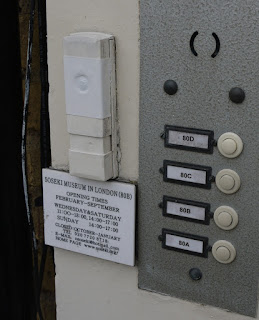 |
A slightly worse-for-wear Entryphone buzzer
lets you into the Soseki Museum: why did it take
me nearly 30 years to press that button?
|
It's a good idea to read a bit before you visit this museum, which is really more like a shrine. It was created and is still funded by a fan, the academic Ikuo Tsunematsu
, who bought the first floor two-bedroom flat it occupies. The museum is now run by Mr Tsunematsu's wife, Yoshiko, who is a charming, friendly and ever-helpful curator. She'll answer as many or as few questions as you care to ask.
The museum is directly opposite the house - number 81 - that Soseki actually lived in for the final, deeply troubled 16 months of his stay in England.
It's quite hard, in deeply gentrified 21st century Clapham, to imagine that the well-scrubbed, polished and immensely expensive four-floor family home on which the Soseki Blue Plaque is affixed was once a modest, rather gloomy boarding house.
But the museum is in the much scruffier old block opposite, a real bit of late Victorian jerrybuilding. I know this from bitter experience: I live in the same crumbling hulk.
Once you are buzzed in, you pass through a cluttered ground-floor hallway, high ceiling, cheap landlord's carpeting on the stairs, bicycles and pushchairs up against the wall, and then suddenly you enter a different world.
All the other flats in this block (apart, I should say, from mine) have been expensively done-up to 21st century yuppie tastes. The Soseki museum, however, is distinctly 20th century, although it's far from a recreation of the sort of decor Soseki himself would have endured in Clapham in 1901.
You pay your £4 entry fee, and are left to wander around, through rooms lined with old photos and prints and copies of documents, all relating to Soseki's time in London and the various people he met, and the places - such as Thomas Carlyle's house in Chelsea - that he visited.
There's a great collection of books and magazines, based mainly on Soseki's own collection (though most of these are not the original copies he owned).
In the back bedroom there's a good library of Soseki's publications in Japanese and English, as well as the many scholarly works devoted to his literature.
There's not much in the way of personal belongings or artefacts. But it doesn't matter: the air in the place belongs to Natsume Soseki, and once you start breathing it the world outside becomes a little darker, and stranger.
There's a very imposing bust of the man, a recent work by a Japanese artist, which presides over the library. This is surrounded by contemporary Japanese editions of some of his novels and poetry, with utterly gorgeous cover art.
He looks quite severe in this portrait: very much the late 19th century gentleman of the Meiji era.
I suppose Soseki can seem almost like our stereotype of a rather timid, socially-anxious, naive Japanese visitor from that era, when Japan was working hard to drag itself into the "modern world", of which London seemed at that point, to be the capital.
 |
A portrait bust of Soseki by Hana Taharasako (2010) flanked by some
beautiful recent editions of his work. |
He seems a very quiet, restrained writer - the opposite of a Murakami, perhaps. But he does have the occasional flight into deepest, strangest fantasy, as in the title piece of that collection.
His writing seems to me to get under the skin of ordinary life, and then make us realise just how strange our ordinary lives really are.
If he's known at all in England, it's for this brief, generally miserable two-year residence in London, and what he wrote about this host nation.
One quote in particular:
"The two years I spent in London were the most unpleasant years in my life. Among English gentlemen I lived in misery, like a poor dog that had strayed among a pack of wolves."
But then Soseki is hardly famous for his cheerful take on the world around him. The opening paragraph of one of his most celebrated and poetic works,
The Three-Cornered World, concludes with the line:
"It is not a very agreeable place to live in, this world of ours".
There's also the suggestion that Soseki was clinically depressed by the end of his time in London, and contemporary reports that his landlady, Miss Leale, and her other lodgers showed a great deal of concern and kindness towards this poor, lonely Japanese scholar.
At the time he was unknown, a poorly-paid academic on a government scholarship, here to deepen his understanding of English literature. His stipend was so measly that he couldn't, as he had hoped, afford to study at Cambridge University. Instead he retreated to a series of cheap lodging houses in gloomy London suburbs - Clapham being the final straw - and did some gentle exploring, and a great deal of book-buying.

But he also had some interesting times. His visits to the Shakespeare scholar, W J Craig, at UCL, and
Thomas Carlyle's House in Chelsea, seemed to inspire him. His account of trying and failing to learn to ride a bicycle on the local streets are hilarious.
Some of his visionary walks through the unfriendly city make you think that Soseki was not just a great Japanese novelist, but also a precursor of some of the fundamental movements of 20th century art and literature - the surrealists, the flaneurs, and even the psycho-geographers of the later 20th century. Echoes can be detected in the writings of many big names, from Virginia Woolf right up to Iain Sinclair.
Soon after I moved into this area, there was a story in the local paper. Some self-appointed guardians of local amenities and history had blocked plans to erect a statue of the writer on Clapham Common, way back. I think that was quite soon after the museum opened.
Whatever the reasons for the ultimate rejection, it seemed to me to be a mean-minded
response to a proposal that was offered with only the very best of intentions. But it made me want to read his work.
It's hard to imagine that any such memorial could detract from this distinctly unlovely tract of south London common land. (There is said to be a file of correspondence relating to this, between the City of Shinjuku, Lambeth Council and Clapham Antiquarian Society, in the
Lambeth Archives. I'm going to try to dig it out when I have a chance).
About 10 years later - I think it was in 2002 - Soseki finally got some local recognition with the
unveiling of an
English Heritage Blue Plaque next to the first floor window on number 81 The Chase.
I happened to be in that day and saw the ceremony as it took place. Quite a few dignitaries turned up, including I think the Japanese ambassador, who presumably pulled the cord (or whatever it is you do), as well as the Lambeth mayor, etc. There were a few TV crews, presumably from Japanese broadcasters, as I never saw anything on UK tv.
Since then, the museum has been visited by a constant stream of Japanese tourists, whom I often notice from my lonely eyrie. They come in couples, or little groups, usually but not always middle-aged, some lone student types, couples in anoraks. They often seem bemused: how could their great national treasure have lived in such a dull street, they must be thinking. It's not even picturesquely scruffy any more.
They usually find the blue plaque on number 81 first, photograph it, then find the front door of 80.
Visitors have apparently included former prime minister of Japan and even - at least according to
this article in The Japan Times - the crown prince Naruhito. The article also explains why the museum is to close: the declining trickle of visitors is simply no longer enough to sustain a flat which must, after all, now be worth about half a million. They probably paid around £35,000 for it back in the early 1980s.
 |
Soseki pilgrims reach their goal, 81 The
Chase. The museum is directly opposite
this house |
Odd, that in an era when Japanese culture is increasingly popular in the UK - whether the novels of Haruki Murakami, the animated movies of the Studio Ghibli, or all the various shades of manga - that this touching tribute to one of the nation's biggest literary names cannot find a new backer. But maybe there are other plans.
Meanwhile, Clapham will become even drearier, and with even less in it to detain anyone with any interest in anything other than jogging, physical jerks on the common, dog-walking, sport, food, showing off their wealth, royalty, cramming onto the Northern Line for the plum job in the city, revving up the Maserati or Aston Martin, and expensive boozing.
Meanwhile, for a more literary, highly thought-provoking account of a visit to this museum,
read this fascinating entry on Dougal McNeill's blog,
Nae Hauf-way Hoose .
Oh and by the way. Maybe the residents of this street - who seem to be so keen to hold expensive parties to honour people even richer themselves - should take note that on December 9th, 2016, we might be observing the 100th anniversary of Soseki's death. Perhaps a time to reconsider that statue?
More photos from the Soseki museum
 |
| Hundreds of framed photos line the walls, including these (in the entrance hall - note the 1970s Entryphone) of visits to the museum by various dignitaries over the past two decades. |
 |
| Another shot of the Blue Plaque unveiling on a suitably miserable day early in 2002 |
 |
Last but not least: the delightful curator of the Soseki Museum in London, Yoshi,
who has deep knowledge of the author and his time in London, and will patiently answer even
dumbest of questions from clueless neighbours like myself. |


