About Me

"Use every man after his desert, and who should 'scape whipping?"
Showing posts with label Natsume Soseki. Show all posts

Wednesday, 16 October 2019

Angela Carter makes it four Blue Plaques in one Clapham street ....but are they all what they seem?

Breaking months of silence to report a nugget of old news from this blighted corner of the blighted city. English Heritage has at last slapped one of their Blue Plaques on the house where the writer Angela Carter lived for the final 16 years of her life, at 107 The Chase, Clapham.
Those plastic-looking venetian blinds were certainly not there
when Angela Carter owned this house in Clapham. So
far as I remember most of the house of was painted deep
blood red.

This was reported in the Guardian on 11 September, but not in many other papers. I wonder who turned up to do the honours - and whether the plaque was covered with those rather camp little curtains on a drawstring, as happened at the unveiling of Natsume Soseki's plaque a decade ago, a few houses up in the same street.

I'm not sure where Angela Carter's work now stands in the literary world, but I do know that she meant a great deal to me. To anyone who had been turned on to the subversive delights of 'alternative' fiction and poetry in the late '60s, largely thanks to Penguin Books, Carter's fiery works were irresistible.

I read one of her early novels, The Magic Toyshop, on the top deck of the 68 bus, all the way from South Croydon Bus Garage to exotic Chalk Farm and what seemed the impossibly sophisticated world of NW3 hippie-dom.

En route the bus rumbled up and down the roller-coaster hills of south London - Beaulieu Hill, West Norwood, Tulse Hill,  Herne Hill and Camberwell. There was a specific corner on Norwood Road, SE24, opposite Brockwell park, which in the early November dusk seemed to me the perfect location of this story.

That area grew in imagination: I would dream about cycling to this Magic Toyshop. In my dream,  there was always a magic second-hand bookshop next door which also sold the best flapjack. And Brocks fireworks.

When, 25 years later I moved into a rickety 3rd floor flat in Clapham, I had no idea the author of that book lived in the same postal district.

Now I turn to her journalism more than her fiction. There's a great collection of her non-fiction writing called Shaking A Leg, which includes an article "D'you mean South?," written for New Society magazine in 1977. It's about South London in general and Clapham in particular, and says more about gentrification than anything else I have read. Although the process we see now is so much more aggressive,  more arrogant and selfish, it is essentially the same. And yet she clearly still loved living where she did live.

All this was the subject of an earlier post on this blog, written when the house where Natsume Soseki lodged for the last few months of his unhappy but productive stay in London got its plaque. Carter must have known Soseki lived a few houses up the street, but I don't think she ever references him.

For along time there was a tiny but fascinating Soseki Museum in a flat directly opposite this house. Sadly it closed, and the flat it occupied was sold, two years ago. I wrote about it here.

Nor (so far as I know) does Angela Carter ever mention Dorothy Dene, the artist's model and actress who lived for a while at 103 The Chase. Two doors and a hundred years apart: Dorothy Dene was for some years muse-in-chief to the Victorian painter, Frederic Lord Leighton (whose fancifully Arabesque house in Kensington is much as he left it, there for the visiting).

Notice the same brickwork and the same property-developer-approved grey
blinds two houses along from Angela Carter. I think Dorothy and her
employer/admired Lord Leighton would have favoured velvet curtains.
She stayed in Clapham for part of the 1880s, before Leighton helped her move to an altogether more respectable address in Kensington, from which she could more readily launch herself into the West End theatrical world.

There's a Blue Plaque on Dorothy Dene's  house as well - that's three in a row for this side of The Chase. It's only a Clapham Heritage platter, and not the full English Heritage monty. But, it looks the same. And there's an interesting essay on her life on the Clapham Society website.

There's a fourth, rather less convincing blue plaque in this now quite repulsively wealthy street, with its electric gates and Fort Knox front doors; of brickwork sand-blasted to a smooth blandness; plus paved-over front gardens to provide squatting space for an obese Range Rover or two.

This rather dubious memorial is at the southern end of The Chase, where it meets Clapham Common. On the side wall of a house there's one Blue roundel and two brown oblong plaques. They all commemorate street parties held to mark recent royal events - weddings etc. None of them is official: they do not even have the authority of a local history society.

All well and good, if you must show off your adoration of the family Windsor. Almost everyone who visits here comments on these plaques. The basic thing they ask is, how come you are you living in a street of monarchists? Who put those plaques there, and why?

They are mentioned by film-maker and author Adam Scovell in an excellent article on his blog Celluloid Wickerman,  "Wanders: Angel Carter's House". This was written a couple of years before the plaque arrived. His disappointment builds as he approaches his destination via the South Circular and a Clapham Common infested with people keeping fit in lycra. Seeing these bogus plaques at the end of Carter's street is another blow to his mental image of Carter's mythical south London habitat:

"It was a realisation that the road had changed, that it was now the antithesis of any of Carter’s visions in its gaudy celebration of monarchy. Walking on, the cars became expensive and the houses either empty or rammed with envy-inducing rooms of books."

I am afraid he would find even more expensive cars but fewer rooms crammed with books, in this street in October 2019.

It's embarrassing. I just wish someone had had a street party for Castro or Che or Karl Marx (or even  Groucho). Then maybe we could have a Red Plaque. Surely Lambeth council - once famously Red itself - would allow the balance?

Maybe Angela Carter, who looked forward to seeing a "Red Dawn over Clapham" - but sadly never did – might have agreed on this one.


Saturday, 10 December 2016

Soseki centenary passes unmarked as Clapham museum closes

Waste disposal trucks load up with the display cases from the Soseki in London Museum. Looks
 like Clapham has lost another of its already pitifully short list of interesting places to visit.

Last week - on Friday December 9 in fact - it was the hundredth anniversary of the death of one of Japan's most revered novelists, Natsume Soseki. Unsurprisingly, this date went  unmarked in the Clapham street where the famous writer lived during 1901-2.

In fact, it's sadder than that. Ironically, just a few weeks before the centenary date, the small museum dedicated to Soseki at 80b The Chase was apparently dismantled, and is now closed for good.

Earlier this year, the owners of the Soseki Museum in London announced they would be closing down in 2017 because of the increasing costs of keeping it open.

Then, on a cold bright afternoon early in November, a couple of bright yellow rubbish trucks parkked up outside the block. Soon, the workmen were bringing large glass-fronted display cabinets and huge sheets of plate glass out of number 80, and tossing them into the back of the trucks. You could hear the glass shattering.
Part of the Soseki museum's immaculately displayed collection
of the author's published works - now sadly dispersed.

The trucks sped away, and a "for sale" sign went up outside. At the same time a first-floor 2-bed flat in this block went on the market for well over half a million pounds: was it 80b?

Unsure whether this was actually the last gasp of the museum, I checked the doorbell. The notice bext to the buzzer giving opening times had gone. No answers from the buzzer. I rang the museum's phone number. The line was dead, gone.

Of course the museum always did close down for the winter. But all the evidence now suggests it has closed for the last time. All that is left in this street to commemorate the fact that great Japanese writer lived here is the English Heritage Blue Plaque on number 89, opposite the museum, where Soseki actually lodged.

Oh, and the Victorian pilar box which Soseki tourists always seem to find fascinating.

A few months back, I visited this obscure museum that shared the same building I've lived in for the past three decades (see: Catch it while you can: Clapham's Soseki museum). It displayed a small but fascinating collection of photos, books, documents and artefacts relating to  Soseki, and also sold some of his works in translation.  The curator was also a great source of info on Japanese literature in general.

I think the museum was purely private project, funded by a Japanese scholar and businessman long resident in London. All credit to him for opening this museum, and for keeping it going for so long. I can't imagine the £4 entry fee covered much of the costs.

Natsume Soseki museum closing down
The entrance area of the Museum included this display of photos of various
distinguished (mainly Japanese) visitors it had welcomed over the three
decades of its existence
Of course the museum was much better known in Tokyo than in London, and every summer there was a regular trickle of Soseki pilgrims from Japan crossing the Common and wandering down the street in search of the museum. Pointing it out to elderly Japanese tourists was a regular and pleasurable duty. Just another strange aspect of life in this borough that has now gone. Life is that little bit flatter as a result.

Despite his importance in the development of modern Japanese literature, and despite his creatively fertile if very miserable stay in London, Soseki is still hardly known in this country. A few years ago Penguin re-issued a few of his best-known titles in  their Classics series, but these are rarely stocked in any but the most specialist bookshops.

Clapham library held just one of his novels; typically, I found a better selection in Peckham Library, not even in the same borough! (Clapham is in Lambeth, Peckham in Southwark).

If anyone ever actually reads this entry, I imagine the reaction to it would be a simple"so what?" - and certainly the loss of a very small and eccentric museum is hardly a big deal in a world so full of tragedy, death and suffering. Personally I think Soseki has a lot to teach us about ourselves, and I think a much bigger audience could enjoy his work, if they knew about it and could access good translations.

Above all I think the closure is sadly symptomatic of what is happening across London and all of southern England. Realising the maximum value of property is paramount; god forbid that anything as airy-fairy as culture and memory should stand in it way.


Saturday, 1 October 2016

The Soseki statue that never was: a tale of two suburbs

Japanese author Natsume Soseki. This grave, diffident, hyper-sensitive soul spent many hours wandering on Clapham
Common, at the end of a street he was living in, unhappily. It might have seemed fitting to have a statue there to
memorialise those formative experiences of a great novelist. No such luck. You can see this nice 2010 bronze at the Soseki Museum in Clapham - but only until 2017, when the museum closes due to lack of funding.
A recent visit to the Natsume Soseki in London Museum reminded me of a row that blew up a quarter of a century ago relating to this deeply revered Japanese author, soon after I first moved into the area. This was the sad case of the Soseki memorial statue that never was.

It was a story of mutual cultural misunderstandings, of groaning bureaucracy, particularly on the British side, stirred up by a bunch of self-appointed guardians of local amenities, with (oh, surely I am not mistaken?) a nasty little dash of bad old English racial prejudice or xenophobia stirred into the mix.

It began in the early 1980s, when Japanese scholar and businessman Ikuo 'Sammy' Tsunematsu created the a museum in London dedicated to the Japanese author Natsume Soseki, which I wrote about last month. At around the same time he got support for the idea of erecting a statue to Soseki on Clapham Common, a short distance from the flat in which he spent the final 16 months of an unhappy but creatively crucial time in London.

No sooner was the idea out than the combined forces of local worthies, the Tory opposition on the council and the establishment (in the shape of its most deadly weapon, Whitehall bureaucracy), conspired to derail it.

At the time I was so annoyed by the opposition to the statue that I wrote to a local paper. The letter was never published but I am still puzzled by the animosity that the plan to erect a statue of a Japanese author on Clapham Common aroused. So puzzled that a few weeks back I visited the Lambeth Archives in the former Minet Library building on Knatchbull Road, to remind myself of the roots of this Anglo-Japanese co-operation pact that was never consummated.

I say "former" library - in fact, as you enter the Archives, you can see the dormant public library through the windows,  intact and abandoned, books still on shelves, a sort of Marie Celeste of a once much loved local library, a resting place and a refuge.

But thank god the Archive is still operating, and there are friendly staff on hand to help me unravel another little bit of the Soseki in London story - though this is actually about a non-event, and something that happened - sorry, didn't happen -  about 70 years after the great Japanese novelist's death.

I'd found the archive reference online and quoted the reference numbers. Within minutes I was sitting at a table with two neatly laced-up bundles of papers in front of me. I carefully untied the bow and began to go through hundreds of carbon copies, artists' impressions, architect's drawings and photocopies; letters, memos, telegrams, newspaper articles, the lot.

Not being a proper historian, I whizzed through these docs, looking for stories. What follows may not be a precise chronological account, but I hope it captures the spirit of that strange episode.

The idea was first mooted in public, so far as I can tell, at a conference on Soseki held in London in about 1986. It was at the Park Lane Hotel, and among the participants was the noted British poet, translator and Japanese literature expert, Anthony Thwaite.

The idea was fleshed out, and a suitable memorial with statue was designed in Japan. The municipality of Shinjuku, where Soseki was born, were involved and backed the idea, and Lambeth Council was approached for permission.

At the time Lambeth was keen to extend its town twinning programme, and it seems it jumped on this request as a good opportunity to build up a relationship with Shinjuku - which includes the commercial district and transport hub of Tokyo.

So Lambeth quickly gave its approval in priniciple to these plans. Little did it know that an exceedingly long and drawn out struggle was to follow, almost six years of it in all.

The first item I looked at was a set of drawings of the first version of the proposed statue. It depicted a life-size bronze statue of Soseki standing on a stone plinth of almost the same height, with a large bronze relief inscription set into the stone.

This was to be surrounded by a circle of stone benches, the whole thing covering an area of around 10 by 8 metres, to be built on the strip of the Common directly facing the southern end of The Chase.

This was the proposal that was agreed in principle by the Lambeth Amenities committee, but as soon as the agreement was made public, in June 1988,  there was uproar. Opponents of the scheme on the Council were soon joined by the conservationist groups, the Friends of Clapham Common and the The Clapham Antiquarian Society. The local press jumped on the story with glee - what an opportunity to run plenty of nudge-nudge, wink-wink, schoolboyish headlines.

The Evening Standard of 24 June 1988 had a field day: the "left-wing councillors" of Mrs Thatcher's least favourite London Borough had "red faces", it claimed, once they realised they were trying to twin Lambeth with the "famous red-light district of Tokyo".

It couldn't resist the seaside postcard approach: "Too much Eastern promise" ran one headline. Inevitably it got a quote from Lambeth's most famous madame, Cynthia Payne of Streatham.

Lambeth was not initially too bothered by this ridicule ( this was the era of constant attack on the so-called "loony left" politicians of the GLC). The joke was on the press, given how they seemed ignorant of the fact that Shinjuku was the location of  a wealthy and powerful commercial district at the time far outstripping the City of London.

The council regarded the whole plan, including the Soseki monument, as "a tangible demonstration of Lambeth's commitment to and celebration of  the cultural and ethnic diversity of our population".

Soon after this the plans were put out for public consultation.  There were 13 objections to the original proposal, with most of the complaints focusing on the inappropriate size of the memorial. Some were concerned the statue would  be a magnet for vandalism, others wondered whether certain British authors were not more deserving of a memorial here. (OK why not? Wouldn't it be lovely to have statues of Graham Greene, Pamela Hansford Johnson and Angela Carter as well? We could even have a literary sculpture park).

The anti-Japanese feeling sparked by the treatment of British p-o-w's during World War Two was also there, still bubbling away.

As a result, the Shinjuku team put together a revised and scaled down proposal. But although the new memorial was much smaller, it still provoked a storm of complaints. The Evening Standard excelled itself with the October 4 1989 headline, "Clapham fights the Japanese". In the story the Clapham Society was said to be "preparing to repel a Japanese invasion". The memorial was described as a "ponderous monstrosity" likely to be defaced.

The Minet archives contain a great deal of correspondence between Lambeth council and its equivalents in Shinjuku, all very friendly and civil if rather stilted and often deadly slow. The mayor of Shinjuku, Katsutada Yamamoto,  paid two visits to Lambeth during this time, and he was always eager to praise the beauty of the trees on the Common, comparing them with the beauty of the cherry blossom season in Japan.

He was keen to stress that the statue should  enhance the "beauty of Clapham": it would not be on a grand scale like Nelson's column, but "not so small as to be hidden by the summer shrubbery".

The monument, he said, would become "A lasting symbol of UK- Japanese goodwill and friendship".

Despite these attempts to address the criticisms of the first proposed statue, the complaints did not go away. English Heritage said that while it did not categorically oppose the plan, nor did it wholly approve: it felt the statue was "just too big" and suggested one of its own blue plaques on the house where Soseki stayed would be a more fitting memorial.

The Hon Secretary of the Clapham Antiquarian Society was also a tireless campaigner against the "unwanted memorial".

"I can find no evidence that London played an important part in his life," he wrote. "In fact, quite the opposite, he hated it while he was living here."

Well, yes, perhaps he did. He was certainly depressed for much of his short time in London. But there are plenty of literary experts who maintain that it was the difficult London experience that made all the difference to Soseki's writing style, and set him on the course for greatness. You only have to read his few short pieces set in London to see how his imagination had been sparked by the place. See Soseki's The Tower of London.

Another local luminary, James Watson of the Clapham Society, wrote: "The Common is common land, not the suburb of a foreign city of which the people of Lambeth know little or nothing".

Yes, perhaps his assumption was right, but it seems odd to use ignorance as a good reason for not doing something to alleviate it.  Surely this was an opportunity to allow the people of Lambeth to learn a little bit about this distant land, so different and yet in some ways so similar to our own?

So the debate rumbled on, letters and telegrams and phone calls went back and forth, more official visits were arranged. 1988 became 1989, and then on 18 December the council approved the revised scheme. However the case was referred to the Department for the Environment and it still needed the Secretary of State's seal of approval. And this was not forthcoming.

On February 20 1990 the mayor Lambeth advised his peer in Shinjuku to get the Japanese ambassador in London to appeal directly to Chris Patten.

Events moved on at the ultra-slow pace known only to bureaucratic officials who - if not under instruction to kill a project by the slowest possible method - at least appear to be. Reasons for and against the statue continued to be traded throughout that year and the next.

One letter from a distinguished local resident to the Department of the Environment offered the only genuinely aesthetic objection to the monument that I could find: Mr Norman Marsh, CBE, said that the proposed statue looked like something designed for "a late Victorian or Edwardian cemetery".
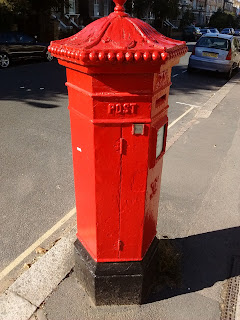
As used by Natsume Soseki
Still in use - the Victorian cast-iron post box
50 yards up the street from where Soseki
lived, now a part of the Soseki in London
mythology
Maybe he was right. Who knows. A new enquiry began early in 1992, by which time there had been a mayoral election in Shinjuku. All changed, suddenly. There was a new mayor, and it was his sad duty to inform his Lambeth equivalent that it now seemed that funding was "unlikely to be forthcoming".

And then, yes, both Lambeth and Shinjuku authorities designed it was best to call it a day.

So ends the story of the Soseki statue, although you can see a fine portrait bust of the man in the museum at 80 The Chase.

Also, as is clear whenever a large coach of Japanese students pulls up outside, they have other ways of remebering the great writer. Often I have seen groups of students and even schoolchildren walk up the road to the late Victorian post-box. Many selfies are taken. This is the same box into which Soseki posted his many letters home, 114 years ago.

Then there's the English Heritage blue plaque. The occupants of that (now incredibly expensive) house must chuckle at the way their first floor windows are so often photographed in the summer months. Or maybe they don't notice.

Soseki himself, we can be sure, would have been greatly amused by the whole business.


* As a postscript, it was good to see that the local business website thisisclapham.co.uk has included Soseki in its promotional hoardings up by Clapham Common tube. Perhaps they could help press for a proper celebration of the centenary of his death later this year....?


Friday, 29 July 2016

Catch it while you can: Clapham's Soseki Museum to close in 2017

The front room of the Soseki Museum in London. That harsh fluorescent strip lighting is definitely not 1901 vintage…
Strange, but true, that for the past 30 years I've lived two doors away from a tiny museum dedicated to a  novelist whose books I've enjoyed. I always wanted to visit this museum, but never quite got around to it, for all sorts of stupid reasons. Until last month.

Yes, finally I rounded up the courage to add my fingerprints to that battered but well-labelled buzzer outside number 80 The Chase, Clapham, and gained access to one of London's smallest, least known and least visited museums - the Soseki Museum in London.

And I've spent the last four weeks kicking myself for not visiting before, and for being so foolish. And yet, in a way, not visiting the museum I so much wanted to visit was quite a Sosekian thing. Why? Well, you need to read a bit of the man himself.

Natsume Soseki is usually described as one of Japan's most revered authors, and yet he is hardly known at all in the UK. Translations  of some of his books are in print, and from the few that I have read (I Am A Cat, The Three Cornered World, The Tower of London) ,  they repay any initial difficulty you may find in reading them.

There's a diffidence, a cloak of humility that conceals his extremely sharp perceptions of life around him.  He also has a wonderful habit of mocking himself, and - against all expectation - has the rare ability to make me laugh out loud, time and again. Yet he can evoke deep sadness as well. Rarely have the petty frustrations of a constrained life in a modest London suburb been conveyed with such precision.  You can get a good taste of all this in a collection of the short essays and stories written during his brief stay in five different, all rather squalid lodgings, The Tower of London. I think it's a good starting point, and the Peter Owen edition has a fascinating introduction by the translator, Damian Flanagan.
A slightly worse-for-wear Entryphone buzzer
lets you into the Soseki Museum: why did it take
me nearly 30 years to press that button?


It's a good idea to read a bit before you visit this museum, which is really more like a shrine. It was created and is still funded by a fan, the academic Ikuo Tsunematsu, who bought the first floor two-bedroom flat it occupies. The museum is now run by Mr Tsunematsu's wife, Yoshiko, who is a charming, friendly and ever-helpful curator. She'll answer as many or as few questions as you care to ask.

The museum is directly opposite the house - number 81 - that Soseki actually lived in for the final, deeply troubled 16 months of his stay in England.

It's quite hard, in deeply gentrified 21st century Clapham, to imagine that the well-scrubbed,  polished and immensely expensive four-floor family home on which the Soseki Blue Plaque is affixed was once a modest, rather gloomy boarding house.

But the museum is in the much scruffier old block opposite, a real bit of late Victorian jerrybuilding. I know this from bitter experience: I live in the same crumbling hulk.

Once you are buzzed in, you pass through a cluttered ground-floor hallway, high ceiling, cheap landlord's carpeting on the stairs, bicycles and pushchairs up against the wall, and then suddenly you enter a different world.

All the other flats in this block (apart, I should say, from mine) have been expensively done-up to 21st century yuppie tastes. The Soseki museum, however, is distinctly 20th century, although it's far from a recreation of the sort of decor Soseki himself would have endured in Clapham in 1901.

You pay your £4 entry fee, and are left to wander around, through rooms lined with old photos and prints and copies of documents, all relating to Soseki's time in London and the various people he met, and the places - such as Thomas Carlyle's house in Chelsea - that he visited.

There's a great collection of books and magazines, based mainly on Soseki's own collection (though most of these are not the original copies he owned).

In the back bedroom there's a good library of Soseki's publications in Japanese and English, as well as the many scholarly works devoted to his literature.

There's not much in the way of personal belongings or artefacts. But it doesn't matter: the air in the place belongs to Natsume Soseki, and once you start breathing it the world outside becomes a little darker, and stranger.

There's a very imposing bust of the man, a recent work by a Japanese artist, which presides over the library. This is surrounded by contemporary Japanese editions of some of his novels and poetry, with utterly gorgeous cover art.

He looks quite severe in this portrait: very much the late 19th century gentleman of the Meiji era.
I suppose Soseki can seem almost like our stereotype of a rather timid, socially-anxious, naive Japanese visitor from that era, when Japan was working hard to drag itself into the "modern world", of which London seemed  at that  point, to be the capital.
A portrait bust of Soseki by Hana Taharasako (2010) flanked by some
beautiful recent editions of his work.

He seems a very quiet, restrained writer - the opposite of a  Murakami, perhaps. But he does have the occasional flight into deepest, strangest fantasy, as in the title piece of that collection.

His writing seems to me to get under the skin of ordinary life, and then make us realise just how strange our ordinary lives really are.

If he's known at all in England, it's for this brief, generally miserable two-year residence in London, and what he wrote about this host nation.

One quote in particular: "The two years I spent in London were the most unpleasant years in my life. Among English gentlemen I lived in misery, like a poor dog that had strayed among a pack of wolves."

But then Soseki is hardly famous for his cheerful take on the world around him. The opening paragraph of one of his most celebrated and poetic works, The Three-Cornered World, concludes with the line: "It is not a very agreeable place to live in, this world of ours".

There's also the suggestion that Soseki was clinically depressed by the end of his time in London, and contemporary reports that his landlady, Miss Leale, and her other lodgers showed a great deal of concern and kindness towards this poor, lonely Japanese scholar.

At the time he was unknown, a poorly-paid academic on a government scholarship, here to deepen his understanding of English literature. His stipend was so measly that he couldn't, as he had hoped, afford to study at Cambridge University. Instead he retreated to a series of cheap lodging houses in gloomy London suburbs - Clapham being the final straw - and did some gentle exploring, and a great deal of book-buying.

But he also had some interesting times. His visits to the Shakespeare scholar, W J Craig, at UCL, and Thomas Carlyle's House in Chelsea, seemed to inspire him. His account of trying and failing to learn to ride a bicycle on the local streets are hilarious.

Some of his visionary walks through the unfriendly city make you think that Soseki was not just a great Japanese novelist, but also a precursor of some of the fundamental movements of 20th century art and literature - the surrealists, the flaneurs, and even the psycho-geographers of the later  20th century. Echoes can be detected in the writings of many big names, from Virginia Woolf right up to Iain Sinclair.

Soon after I moved into this area, there was a story in the local paper. Some self-appointed guardians of local amenities and history had blocked plans to erect a statue of the writer on Clapham Common, way back. I think that was quite soon after the museum opened.

 Whatever the reasons for the ultimate rejection,  it seemed to me to be a mean-minded
response to a proposal that was offered with only the very best of intentions. But it made me want to read his work.

It's hard to imagine that any such memorial could detract from this distinctly unlovely tract of south London common land. (There is said to be a file of correspondence relating to this, between the City of Shinjuku, Lambeth Council and Clapham Antiquarian Society, in the Lambeth Archives. I'm going to try to dig it out when I have a chance).

About 10 years later - I think it was in 2002 - Soseki finally got some local recognition with the

unveiling of an English Heritage Blue Plaque next to the first floor window on number 81 The Chase.

I happened to be in that day and saw the ceremony as it took place. Quite a few dignitaries turned up, including I think the Japanese ambassador, who presumably pulled the cord (or whatever it is you do), as well as the Lambeth mayor, etc. There were a few TV crews, presumably from Japanese broadcasters, as I never saw anything on UK tv.


Since then, the museum has been visited by a constant stream of Japanese tourists, whom I often notice from my lonely eyrie. They come in couples, or little groups, usually but not always middle-aged, some lone student types, couples in anoraks. They often seem bemused: how could their great national treasure have lived in such a dull street, they must be thinking. It's not even picturesquely scruffy any more.

They usually find the blue plaque on number 81 first, photograph it, then find the front door of 80.

Visitors have apparently included former prime minister of Japan and even  - at least according to this article in The Japan Times - the crown prince Naruhito. The article also explains why the museum is to close: the declining trickle of visitors is simply no longer enough to sustain a flat which must, after all, now be worth about half a million. They probably paid around £35,000 for it back in the early 1980s.

Soseki pilgrims reach their goal, 81 The
Chase. The museum is directly opposite
this house
Odd, that in an era when Japanese culture is increasingly popular in the UK - whether the novels of Haruki Murakami, the animated movies of the Studio Ghibli, or all the various shades of manga - that this touching tribute to one of the nation's biggest literary names cannot find a new backer. But maybe there are other plans.

Meanwhile, Clapham will become even drearier, and with even less in it to detain anyone with any interest in anything other than jogging, physical jerks on the common, dog-walking, sport, food, showing off  their wealth, royalty, cramming onto the Northern Line for the plum job in the city, revving up the Maserati or Aston Martin, and expensive boozing.

Meanwhile, for a more literary, highly thought-provoking account of a visit to this museum, read this fascinating entry on Dougal McNeill's blog, Nae Hauf-way Hoose .

Oh and by the way. Maybe the residents of this street - who seem to be so keen to hold expensive parties to honour people even richer themselves - should take note that on December 9th, 2016, we might be observing the 100th anniversary of Soseki's death. Perhaps a time to reconsider that statue?

More photos from the Soseki museum


Hundreds of framed photos line the walls, including these (in the entrance hall - note the 1970s Entryphone)  of visits to the museum by various dignitaries over the past two decades. 


Another shot of the Blue Plaque unveiling on a suitably miserable day early in 2002

Last but not least: the delightful curator of the Soseki Museum in London, Yoshi,
who has deep knowledge of the author and his time in London, and will patiently answer even
dumbest of questions from clueless neighbours like myself.

Tuesday, 14 June 2016

Clapham, now! Too much ordure, too many toff-fests

Oh no, hang on this must be a mistake. It can't be what it seems to be.

Something came through the front door last week.

My street is an an odd street. Have you read "Capital" by John Lanchester? If you have you might latch on to this strangeness.

This street has some of the more expensive property in this very expensive bit of south London. The SW4 bit, formerly known as "Cxxxxxm".

Like many of these "most exclusive and luxurious" areas, it is basically a bit of Victorian speculative jerry-building over a few muddy acres of the Battersea and north Surrey marshlands, the Wandle basin and its surrounding dung-fields.

Lots of collapsing old buildings, lots of mud, dirt, dog muck, dumped infested mattresses, festering bomb-craters, used condoms, burned out Rage Rovers, you name it.

A valley of used disposable nappies, and a plateau paved with well-filled dogshit bags.

A pizza box filled with yuppie vomit. I named it.

Lots of three or four storey houses, each one costing £2 to £3million, and that's before the lads have scooped out another house underneath, a basement paradise with bubbling water-features and extra garage space or whatever it is they do down there, in the deep mud.

Something came thru my front door. It wasn't a plump buff package of dog shit this time.

No, nor even human shit. I know that's what you wanted it to be, but you lose this time.

Well, around here you wonder. These streets are paved with filthy lucre. Last week I narrowly missed seeing a young lady poohing behind a parked BMW suv. Her drunken, well-dressed friend was on watch-out and when I appeared around the corner, she signalled for me not to proceed, but to cross the road.  Good advice.

Next morning I passed said BMW and said pooh - large, humanoid, stinking - was still in situ.

This is Cxxxxxm. Now.

You'll do it next time, and I know your name. And your address, by the way. But I haven't got a dog.

ANYWAY…..It was something worse!

It was an invitation, like I said, an invitation to a party.

A "street party".

Only £15 a ticket! Well it included some lunch, soft drinks, a dog show and so on...

So, as I was saying. This road or street has certain aspirations, it seems, certain pretensions shall we say. It thinks it is, it believes itself to be ….to be a bit better than the  rest, or so it thinks.

You might not be surprised to learn that this street party was sponsored by an Estate Agent and was held to celebrate a royal birthday.

Now, I'm a strict roundhead, I have no interest whatsoever in the Windsor family, who have always struck me as just as dull as my own family and almost as sad. If those with a different view want to celebrate this birthday, then fine, that's up to them. But this is the third royal-themed street party in this street in the past decade, for Thunderclap's sake!

I mean, why this street? I've never seen any of the royals around here, why do we keep on kow-towing to the old dears? (Mind you the old ones are preferable to their children and grandchildren, don't you agree? OK, maybe not.)

Later this year there's another anniversary which might be a more interesting excuse for a party. Of course it will be too cold and dark for a street party by then, but maybe a genteel house party.

In December it will be the 100th anniversary of the death of the great Japanese writer, Natsume Soseki.

He lived in this street for his last few miserable months in London, early in the 20th century. He put up with the prejudice and stupidity of the local Brits, and he put up with cold, the wind, the rain, the ugliness, the filthy food, the hideous manners of the locals, just because he adored English literature and  history, and had a sort of reverence for a London of the imagination.

His subsequent writing added to that image of London …. but also set him on the path to becoming one of the most famous Japanese novelists of his time, maybe Japan's first real modern novelist. And it seems his unhappy few months Clapham was a catalyst for all this.

Thank god this street has something in its past, to make up for the embarrassment of the here and now. A house wrapped in pink, for heaven's sake. Well, maybe it's a good joke…yes, let's take the positive view.


Tuesday, 29 April 2014

The Chase: Clapham's street of no shame

Each day I come home across the northern corner of Clapham Common, then turn right into my street.

Over the road are the beautiful walled gardens of Trinity Hospice, wonderful at any time of year, but especially so in spring, with its abundant wisteria and blossoming trees. This hospice - rightly venerated across the city - still operates according to the policies of its founders, that is - offering a place to anyone i need within its catchment area, regardless of anything else, wealth included.

If only the rest of this street, my street, where I have lived since 1985, could adhere to such policies.

Up on the wall to your left as you turn the corner from Northside into The Chase are two plaques.  Not genuine blue plaques denoting former residents of historical significance. No, these are a less impressive blue, one mid-blue, one dark, but they are not the real thing, not real London Blue Plaques.

Instead,  they are privatised plaques, essentially boasts, commemorating two street parties held in this road, one for the queen's 60th anniversary of accession to the throne,  possibly, and the other for the royal family wedding, a year or so later.

I can't remember the exact dates but I do remember the rather off-putting invitations, stuffed through our front doors back then. They invited us all to join in honouring said royals at "street parties".

 The Chase would be closed to traffic and the residents were invited to buy tickets for a feast in honour of, well I suppose the Queen herself, and ... I can''t remember who the others were - possibly Charles' son's wedding to Ms K. Middleton?

I have no interest in  England's royal family. They seem in some cases to be rather silly, annoying people, I am never sure why they are given the opportunity to comment so often. I do not generally believe them when they speak, it seems like they are actors, voicing someone else's lines.

 I'm sure they'd have similar or even stronger feelings about me. You can't really hate them, they are too bland.  The ones I loathe are the media arse-lickers who seem to think we all want them to plaster photos of these dreary folk all over the front pages of newspapers, and all over every TV news bulletin.

So, I have to admit, it rather annoys me every day, seeing these plaques commemorating these events which gave a few well-heeled households in this street the chance to advertise their patriotism and their connections and their good taste in catering to each other. It is still, in this country, a matter of who you know, or worse still, where you went to school or university.

But why did they have to stick these plates on the wall? It is the equivalent of me putting huge photos of Castro or Che Guevara or even poor old Ken Livingstone over my windows.

I wish I had a similar wall onto which I could screw plaques reflecting my own political views. Living on the top floor of a decaying chunk of jerry-built housing - one the luftwaffe should have put out of its misery, but narrowly missed - I do not.

I wish I had had the nerve to organise a street party  to mark the 25th anniversary of the death of this street's one truly great recent resident, Angela Carter. That might be something good: but I'm sure her many friends and fans and family me members will do something good, in 2017, for this great author.

It happens that there is a genuine Blue Plaque on a house in this street, directly opposite where I live. It marks the spot where the Japanese novelist, Natsume Soseki, spent a couple of extremely unhappy and uncomfortable years in London in a miserable Clapham boarding house. That house is now worth approximately £2.5 million. Or perhaps much more...

I doubt if many people will visit this part of Clapham to see where some wealthy residents glugged a lot of champagne in honour of the royals on those days. By contrast, almost every day through the summer, taxis and minibuses stop outside 80 The Chase to disgorge Japansese tourists, young and old, here to pay tribute to Japan's answer to Dickens or Henry James, and to visit the small museum in the flat at no 80b.

Maybe a Japanese themed street party would tick all our boxes?

Meanwhile, another "only in The Chase" sighting today - one of those home-made posters asking people to pick up their dog's shit. Only in this case, it came with a bag of Bob Marten's poo-bags, just in case the shames owners had forgotten to bring their own.

Hurrah!


Sunday, 11 November 2012

Angela Carter , a street in Clapham, and a homesick Japanese novelist

It's almost 30 years since I moved to this street. It was January 1985 - a very cold January. My father had just died, I was recovering from the funeral and all that fallout, and at exactly the same time I realised I was living in the same street as one of my favourite writers.

Clapham was a dirt cheap place to lodge
 when Soseki came here in the 1900s.
Two of the many often bewildered
 Japanese literary pilgrims photograph
 his Blue Plaque.
I remember going to buy a Sunday paper. I got back to my new  front door and realised, with a strangely un-panicked realisation, that I had forgotten my keys. There was snow blowing all around, settling lightly now. I was simply thrilled to have a new flat in what seemed to me at the time, a rather lovely street, wide and lined with beautiful, gaunt trees. And I no longer had a father.

Luckily the house was in scaffolding. I scaled the three or four ladders, I climbed over the parapet onto the roof, and  slithered down a drainpipe onto my own roof terrace and in through the bathroom window (I am too fat to do that now).

I made some coffee and started reading this plump bundle of newsprint. In the colour supplement, Ian McEwan was writing about visiting Angela Carter. As I read it I realised he was describing my own street. How the  terraced houses crowded together as if for mutual protection as they approached the social border of Wandsworth Road. How hers was one of those last houses before the badlands of the Battersea marshes and their sprawling estates.

How her famous visitors sauntered down the road, looking at house numbers, wondering, where on earth does she live?

I encountered her a few times in the newsagents, but I was a fan, awestruck, struck dumb, mumbling nonsense. "Hi. Keep well, it's freezing out there ...", etc.  Never daring to say how much I loved her writing.

After that I was always watching. I was so proud to have such a wonderful near neighbour. I found out all I could about her, and soon realised she was (like me) an aboriginal south Londoner.  She had even worked as a junior reporter for the Croydon Advertiser (I tried to get work experience there, they sent me away).

This amazing woman with her commanding presence, that face,  that beaming smile, the extraordinary cloud of grey hair, and then - not , as I remember, so long after, her child, the baby in the pushchair, the shy man who I imagined was her husband....

Soon after this, I discovered that another well-known writer had lived even closer. The Japanese novelist, Natsume Sōseki, had been sent to London as a young man, and had found miserable lodgings - about six doors up from where Angela Carter lived. Opposite  the house where he endured a foul
English winter is a small museum devoted to his works.  In the summer,  Soseki fans (usually middle-aged Japanese couples, or younger, often solitary, students) would arrive in The Chase to visit the museum, and to photograph the blue plaque. Often, I would see them looking puzzled,  and think, should I volunteer some information? Offer them tea? Then think, well, they will soon find what they seek - and the last thing they want is inadequate help from some bumbling, clumsy Englishman.

The Blue Plaque was added about five years ago, a crumb of comfort to those Soseki followers whose plans to erect a statue of the writer on Clapham Common had been thrown out after a particularly mean-minded and xenophobic campaign by the so-called "Friends of Clapham Common".

Angela Carter lived in Japan in her 20s, and I assume she was well aware of this connection. But was it a coincidence that she moved  into this street? As much as Soseki loathed London, and especially loathed Clapham, so Angela Carter seemed to feel at home here.

I wonder how she'd feel now, about this street, dominated as it is by super-rich city types with their Range Rovers and Aston Martins, their royal connections, their street parties for the queen's jubilee and the wedding of william and kate. I wish she was still around to ask, because now, having shed that vile false modesty and shyness of the hobbledehoy, I would ask her too.