About Me

"Use every man after his desert, and who should 'scape whipping?"

Thursday, 30 July 2015

Paolozzi's Tottenham Court Road mosaics to be given a new life in Edinburgh

Gone are the days when weary Northern or Central  Line passengers would be greeted with these beautiful mosaics as they rode the escalators at Tottenham Court Road tube station. But soon you should be able to see Eduardo Paolozzi's work in  his home city, Edinburgh.
Good news in the Architect's Journal this week for all of us who miss the Eduardo Paolozzi mosaics that covered the walls, tunnels and escalator shafts of Tottenham Court Road tube station in London .

These artworks, which date back to a refurbishment of the station in the early 1970s,  have all now been stripped out of the station as part of the Crossrail refurbishment and expansion scheme, not without much debate. Now it seems at least part of this much-loved work is to have a new home - in Edinburgh, where Paolozzi was born, and where he went to art school in the 1940s.

The AJ story is a fascinating read: apparently the remains of the mosaics are now being stored at the London Transport Museum, which has its own depot in Acton. It seems that some of them - the mosaics around the arches at the top of the main escalators - will be restored and re-used in a new construction project at Edinburgh University's Art Collection.

It was always a lovely surprise to me to see these glimmering mosaics as you ascended out of the gloomy depths of the Northern Line. Those grand classical arches around the escalator well, encrusted with Paolozzi's coloured tiles, looked like they belonged in some grand byzantine Church, or even San Marco in Venice.

Apparently we might have to wait a few years before the restored mosaics are on view again - but it will be worth the wait.

Here are a few of the mosaics that you might be able to see again - but there's a wonderful photo archive of the mosaics in place on the previously mentioned London Transport Museum website.

Eduardo Paolozzi mosaics at Tottenham Court Road station, Photo: Bill HicksEduardo Paolozzi mosaics at Tottenham Court Road station, Photo: Bill Hicks

Eduardo Paolozzi mosaics at Tottenham Court Road station, Photo: Bill Hicks


Eduardo Paolozzi mosaics at Tottenham Court Road station, Photo: Bill Hicks

Eduardo Paolozzi mosaics at Tottenham Court Road station, Photo: Bill Hicks


Sunday, 26 July 2015

Why Camberwell is the fairest of them all: sweet music and scorched grass in SE5


Dawn Penn at the Camberwell Fair, July 25 2015
My cool ruler: Dawn Penn instructs the crowd on the finer points of  deep roots reggae at the 2015 Camberwell Fair - a revival of an ancient festival that, oh now it is so obvious,  has been badly missed for 160 years
Gutted to have missed the Lambeth Country Show two weeks back, I set off on Saturday for the first Camberwell Fair for 160 years, hoping it might restore a little bit of south London summer joy to a severely depleted soul (mine).

Not many of us can remember the last fair on Camberwell Green, as it was in 1855. If it was anything like as good as today's, you wonder why the hell it didn't keep going. In fact maybe that's the reason - if it was anywhere near as much fun as this eight hour feast of music, food, arts and crafts, dance and (ok) a little bit of drinking and what not - then you can imagine only too well why the authorities of the day might have wanted to put a cap on it.

Today's event on that well-trodden wedge of grass in SE5 had a bit of a magical feel. Much as everyone loves the annual feast of reggae music, cider and farmyard attractions that the London Borough of Lambeth puts on in Brockwell Park, it has almost become a victim of its own success, with pressure each year to cut it back or charge for entry.

The moment Camberwell Green became
skank central…our lovely crowd goes
ska-crazy for the double-up-tempo beat of
ChainSka Brassica
This event in the neighbouring borough eventually had the support of Southwark council (well, it had to really, didn't it?) - but the movers behind it were not council people but local community groups, arts people, musicians.

 As a new venture it had that lovely risky feeling - and everyone there, I'm sure, felt that way, that we were all incredibly lucky to be there, and to witness for example, the reggae legend Dawn Penn singing her heart out for a crowd of a few hundred extremely happy people in the late afternoon sun.

Yes, Dawn Penn - and yes, she sang You Don't Love Me, and yes she was in great form, and backed by a great band (Black Slate International) who'd been levitating the crowd for the previous hour.

And this was just one of the stages - somehow they'd fitted two sound stages as well as dozens of craft and food and community stalls into the space as well as a big beer bar, a farmers' market and a distinctly tropical feeling rainbow forest cocktail bar, built of corrugated metal around a big old chestnut tree.

Arriving at 4pm I joined a long queue to get in. The half-hour shuffle towards the gates was fine as we could hear a high energy Balkan dance band, The Turbans, whipping up the crowd within. Sadly we'd already missed two of the early acts - the Afro-Colombian folk band, Papyera, and a Congolese band, Kasai Masai.

Walking across the Green to the toward the main Wormfood Stage, you pass a stall covered in art and fabrics, and there's a large sketch of the London skyline as seen from Peckham covering several panels of board. This is the preliminary drawing for a proposed massive mural that two artists, Georgia Bosson and Cecily Vessey, are hoping to paint in central Peckham to draw attention to the way blocks of luxury flats are ruining south London's views. This is part of the Peckham Vision campaign - something we sorely needed but did not have the community spirit to get in the Nine Elms-Vauxhall area.

Dawn was the one I came to see, along with Afrobeat master and former Egypt 80 member (and thus Fela Kuti sideman), Dele Sosimi, whose tight, fiery and yet academically precise Afrobeat show ended the day triumphantly.

In between there was a revelation for anyone who had not so far encountered a band of local boys calling themselves ChainSka Brassica.  Members of this very young-looking nine-piece band took control, ordering people to the stage from all over the Green, getting them up off their arses. Dominated by super-tight rhythm and horn sections and with a suitably belligerent lead singer (who, it turned out, was really a sensitive soul), this band clearly meant business and quickly impressed anyone doubting their credentials.

Their songs were sharp, funny and with some good hard-biting New Cross style lyrics, and whenever they shifted into ska gear, the whole crowd's knees were pumping the air - honestly! 

What a great band. Even the inter-song banter was good. "Camberwell! Am I going to get you skanking tonight!"

And oh yes they did. Just as Dele Sosimi's band got plenty of people trying to copy the great man's oh-so-fluid rump movements, so ChainSka boys got several hundred pairs of trainer-clad feet pumping into the parched turf of Camberwell Green.

For part of the show I was standing behind a group of Capoeira experts who were brilliant movers to all the different musical styles - but even they seemed to be exhausted by 60 minutes of moon stomping knees-up.

What a great event, though. It had that magical ingredient - it was an experiment, and had been put together by the sheer love, guts, energy and enthusiasm a of local artists and promoters, notably Wormfood London. It felt like a  privilege to be there. It was a privilege. By the end of the evening I was regretting that day back in 1985 when I turned down a lovely flat in Dagmar Road for the stupid place I bought in Clapham. Mind you I often regret turning down an even lovelier flat in New Cross just as badly.

ANyway, a great day, and  you can be sure there's several thousand people now hoping they can turn this into a regular annual event.

With apologies to an almost forgotten art-rock band from just up the road, where do we want to be?

"Camberwell!"

 When do we want to be there?

 "Now!"

Ska band ChainSka Brassica at the 2015 Camberwell Fair
Local band ChainSka Brassica brew up storm of ska for the nutty boys and girls and London SE5

Camberwell Fair 2015 - the Community Stage
And at this beautifully-decorated tent at the north end of the Green there was a whole alternative programme of djs, rappers, spoken-word artists, and singers and poets on the Community Stage: if only we'd had time to see them all!
Camberwell Fair 2015 - cocktail bar
Between acts, plenty of time to get refreshing cocktails at this lovely rainbow forest bar
Dele Sosimi's afrobeat band at the Camberwell Fair, London SE5, July 2015
Dele Sosimi and band get a very willing crowd into a deep Nigerian afrobeat groove


Camberwell Fair, London SE5, July 25 2015 :

Camberwell Fair, London SE5, July 25 2015 :


Camberwell Fair, London SE5, July 25 2015 : signposts


Wednesday, 22 July 2015

Tower Hamlets halts Norton Folgate redevelopment plans: at last, a local authority that is willing to stand against greed

Great news on the  Architects' Journal website this morning - Tower Hamlets' councillors have voted down the application to redevelop a huge swathe of the area between Shoreditch and Spitalfields, "against the advice of their own planning officers".

OK, so the opposition to the British Land backed scheme had some high profile supporters, and the campaign was led very professionally by the Spitalfields Historic Buildings Trust and historian Dan Cruickshank - but even so, this is a beautiful example of how the power and greed of  property developers can be successfully opposed if people are strong,  well-enough organised and sufficiently stubborn.

Looking at the  scheme, it seems amazing it ever got as far as this - given that Norton Folgate is officially a conservation area.

But you only have to read the account, on the Spitalfields Life site, of an earlier, 1977 attempt to flatten the area around Elder Street to see how desperate the developers are to get their hands on this area

If they really need more office space, please, let them build even taller towers in the centre of the city, an area which can not be made to look any worse with its curious assortment of "statement" skyscrapers.

Anyway, read AJ's excellent article - everything you need to know is there. And then read the story in the Hackney Citizen, celebrating the victory but ending with the dark warning that British Land "will be back". Especially as it seems they have the full support of the owners of the land, none other than the City of London Corporation itself.

Wednesday, 15 July 2015

The Troubadour to be sold because locals want to sleep? Please tell me this is a July fools' day joke…..

I read a story in (what else?) the Evening Standard that made my blood freeze, then boil again.

First I see the headline, deep into the paper on page 22: Sound of silence: coffee shop where Paul Simon, Dylan and Hendrix sang up for sale.

It's immediately clear they're talking about The Troubadour, the coffee shop on the Old Brompton Road in Earls Court which has the most famous basement in London. It is, literally, the place where much of the music, folk, folk-rock, psychedelic - which defined the 60s and 70s was helped out into the world, before it flourished.

I was too young to know the place in its heyday but went there in the 70s, more or less as tourist, even though at the time I was living five minute's walk away in Beaufort Street. I was in complete awe of the place and of its regular clientele, who all seemed impossibly cool and wonderful to me, the suburban oik who'd fallen lucky and was mixing with a group of older people who'd been involved in their scene from the outset.

So now, 40 years on, it's up for sale: the vendors, who've kept the flame burning as brightly as they could for the past 17 years, say it is no longer viable. It's not just the £150,000 pa rent - more disgraceful  than that, even, is the fact that Kensington & Chelsea council has approved a 9pm noise abatement order on the garden area.

Now, checking out the Troubadour's twitter and Facebook feeds, it seems they're trying to calm our fears: they say their hoping new owners will given them the funding to continue offering a full program of live music. But to me it's this 9pm curfew thing that just seems outrageous - this is Earls Court, not Stoke Poges!

Current owner Simon Thornhill told the Standard that it was the latter that had "killed" them: "Before, people wanted to live in a vibrant area with a lot going on, now it's like they want to live in a dormitory zone".

Exactly: but why are these people allowed to have any sway in the argument? It was bad enough when they tried this one on the Ministry of Sound at the Elephant and Castle. That nightclub had been a massive success for about 20 years when developers decided they'd like to build luxury apartments next door. Luckily, the club was owned by a guy who had some clout in the establishment and the threat was removed.

You'd think, therefore , that the Troubadour would have twice the moral and cultural capital with which to snub such a ludicrous idea, that they have to hush down after  9 o'clock, for god's sake! And yet the council went with the money.

What happened to the rights of the existing population?

I read this story while listening to a debate on the future of BBC licence fee funding. It made me think: I would pay double the current licence fee happily for what I get from BBC Radios 4, London, 3, 2, 1, and 6 in that order (I like BBC TV as well, or a lot of it, but unfortunately my TV aerial is not really up to the digital signal which seems very flaky).

Anyway, double the licence fee and give the BBC a new remit - to rescue culturally significant performance spaces like the Troubadour, and similar clubs all around the UK, and use them for recording live performances. Remember when the BBC used to own half of Shepherd's Bush? Let's go back to that, with theatres, cinemas, recording studios, etc, back in public ownership. WHat a dream!

But whatever happens, don't , please, turn the Troubadour into a Costa.

Tuesday, 14 July 2015

Rejoice - the Nine Elms Vauxhall Partnership Open Days begin today: yay!

The Nine Elms development by night, from the south west
And here it is by day (a couple of months ago…there's even less view now!)
Oh joy unparalleled, we are to have a chance to ask questions about the Battersea-Nine Elms - Vauxhall developments at two open days this week!

Yes, those lovely folk who are nibbling away at the chimneys of Battersea Power Station, and erecting a sort of Berlin Wall of apartment blocks along the southern banks of the Thames from Chelsea to Vauxhall bridges, are giving local residents the chance to hear how their lives are about to be made even more blissful.

I adore the Nine Elms website, especially this bit which makes the very fair point that "We're the most central part of London that nobody knows about … yet!"

Yes, indeed, take that "yet", Robert Elms! Put it in your big BBC Radio London pipe and smoke it!

Oh lord, for sure, we are all nobodies, we live here, but nobody knows about us or how close we are to Parliament!

It's great to know that the multi-national team who are re-developing this big strip of brown fields land are slugging it out in our corner.

Anyway that's enough cynicism for this week.  Later today I shall be heading for the ROSE Community Centre off Stewart's Road for a chance to look at models of the finished development, and to hear about job opportunities - and talk to some of the folk involved in building this new utopia on the  Battersea marshlands.

Nine Elms Vauxhall Partnership Open Days
Tuesday July 14, 2015  3pm - 8pm
Wednesday July 15, 2015 8am - 6pm
ROSE Community Centre, Ascalon Street, London SW8 4DJ
www.nineelmslondon.com/opendays


Monday, 13 July 2015

A tale of Clapham Public Library and a bunch of neo-realist partisans

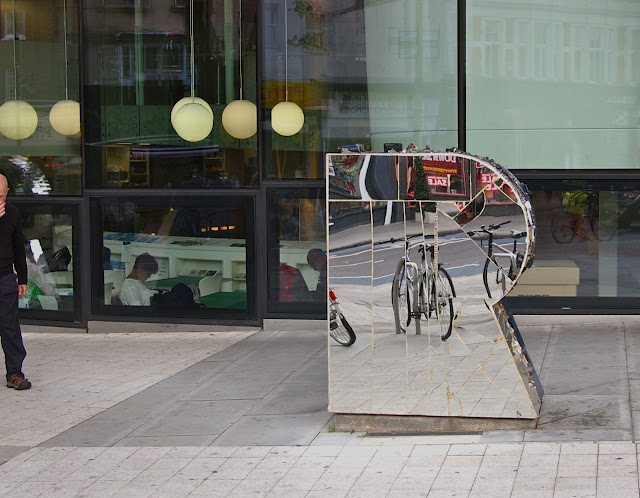
Clapham Library, plus Andrew Logan's mirrored R
The new Clapham Public Library: that mirrored "R" is part of the word  "LIBRarY", a massive sculpture made for
the site by the amazing Andrew Logan
It might not be the Bodleian, but Clapham Public Library does a remarkably good job at catering for the ridiculously wide tastes and demands of locals. As well as covering all the essentials (computers, wi-fi, dvds, storytelling, etc, as well as those old paper things, books) it also still has enough elasticity in its acquisitions policy to allow that occasional moment of discovery. A new author to love, an unthought-of literary connection, a sudden blinding light thrown on something only dimly understood.

This has happened to me several times over the past three decades, but it seems to be happening even more now that the library is in its smart new premises.

Cheerfully mocking my default pessimism, the library has grown into its trendy new building very well. I have to admit that re-development has really worked here - you get a new library, and a load of new flats (most of them definitely not affordable though). You also get a much-needed performance space in the old library building on North Side, now known as the Omnibus Arts Centre.

You have to wonder if the spiral ramp feature - a very, very distant echo of the Samuel R Guggenheim museum in New York - is really much more than an architect showing off . The limited seating and study areas are nearly always packed - which is certainly better than their being empty, who could not agree?

The Library shares the first three floors of an apartment block on Clapham High Street with an NHS GP surgery/health centre (the Mary Seacole centre). The building looks like it was designed by someone who'd just flicked through a modern classics picture book and seen the NYC Guggenheim on one page, and Frank Gehry's "dancing house" apartment block in Nove Mesto, Prague, on another. There are obvious, if much simplified, references to both buildings - Gehry's wonky windows outside, Frank Lloyd Wright's spiral inside.

Well, why the hell not? It's a lot less ghastly than most of the new apartment blocks in London, especially all the ones going up along the south bank of  the river.  Anyway, the real point of this was to remind myself of various lucky finds on the spiralling shelves of this strange tower.

The beautiful serendipity of a good public library worked a treat for me about a month ago. I had just returned Marguerite Yourcenar's The Memoirs of Hadrian (a book I'd promised my dad I would read a few weeks before he died, in 1984, and didn't pick up again til this May, and now I know why he loved it).

Looking for something to fill the big reading void this wonderful book left me with,  I saw a new translation of a novel by an Italian author of the 1940s about the resistance. I'd never heard to the book nor its author, so I had lots of reasons to pick it up, especially as I could not find the book I really wanted ( Francoise Sagan's Bonjour Tristesse, another paperback on my father's bookshelf, and one which always seemed rather salacious and therefore all the more attractive).

So I borrowed this Italian book - A Private Affair, by Beppe Fenoglio - and read it in a couple of days. It was one of those books which acted like literary superglue. I could not tear myself away from its pages. And, even in its (very good) translation, it was as delightful to read as a good strong red wine from Piedmont is to drink. It made me think of those other Italians of the neo-realist school, Moravia yes, but especially Cesare Pavese, and the film-makers Rosselini, de Sica etc, as well as  Primo Levi and Italo Calvino and Natalia Ginsburg, and yet its author was clearly out on his own.

Fenoglio's novel, which was not published until after his death (aged only 40) in 1964,  had a very different feel. This was much more internal, it was  the personal rather than the political which drove this narrative, one very man's slogging away at his life, which just happens to have turned him into a freedom fighter existing in the hills above his home town, longing for the spring, and longing for his lover, whom he fears he has lost to his best friend, another partisan, who is fighting in another branch of the local resistance.

Like all the best books this one grew in my imagination in the weeks after I returned it. Meanhwile I was reading another library find - the beautiful  This Is How You Lose Her by Junot Díaz, all about about a young Dominican boy living in New Jersey and dealing with his family and the various young women he meets and loves and loses over an indeterminate period. It's a hilarious and very sad and you learn a fair bit of colloquial Dominican-Spanish argot in the process of reading it.

At the same time I'd borrowed another Italian novel, a new Penguin Modern Classics edition of Italo Calvino's first novel, Il sentiero dei nidi di ragno - which translates neatly as The Path to the Spider's Nests. This edition contained Calvino's 1964 preface in which he provides a deeply personal overview of  the novel and how it stood in relation to the work of his contemporaries, the neo-realists, who
Penguin edition of The Path to the Spiders' Nests by Italo Calvino, borrowed from Clapham Public Library
between them helped to define the politics and culture of post-war Italy.

He reflects on the way a literary movement became almost a creed, and how in reissuing the novel over a decade later he'd wanted to re-visit the great tangle of literary, political, ideological and sexual politics that infected the movement, much as it did with the post-war writers and film-makers in France.

And then he points to a novel of the Italian resistance that remained unpublished until 1964 (the date of Calvino's revision of this novel). It was of course Beppe Fenoglio's book, which was, he says, "the novel that we had all dreamed of, when no-one had expected it any more".

He adds that , "Only now, thanks to Fenoglio, can we say that cycle is complete, only now can we be certain that such a cycle existed, the cycle that goes from The Path to the Spiders' Nests to Una questione privata." This book, he said, was  also "a more authentic portrayal of the  Resistance than has ever been in print, preserved with a great clarity  over many years by a faithful memory, and retaining all its moral values (which are all the stronger for being under-stated) as well as its emotions and frenzies".

Some praise: but I'd never have read either novel if someone at Clapham library had not stuck them in front of my nose, or at least not until I entered another phase of Italophilia, if ever that happens.


Sunday, 12 July 2015

Quick! Get down to Josephine Avenue's Urban Art festival - a visual feast with a party atmosphere

Local artist Matt Crump and some of his wonderful, intricate digital collages at the Urban Art Festival in Josephine Avenue, Brixton. Some of his work uses 3D - hence the specs on the young connoisseur, left.
If you live where I do, and you want decent community events, you go two miles east to Brixton, where this weekend Josephine Avenue is holding its annual Urban Art festival, just off Brixton Hill,

In fact this is the fourteenth year of this unique combination of street party, urban graffiti artist's spray-in and open-air art show. Forget Affordable Art, Bayswater Road and The RA Summer show - this is where you'll see (and, if you like, buy) new art from over 200 painters, print-makers, mixed-media artists, photographers and craftspeople, eat some delicious home-cooked food and drink a beer or coffee in someone's front garden, and chat.

Kevin McMayo with some of his gorgeous
paintings at the 14th annual Urban Art festival
in Brixton's Josephine Avenue
Having cycled up and down this lovely street at least once a week over many years, I'm ashamed to say this was the first time I've been around on the right weekend for the event.

I went for  a quick look and stayed for more than three hours. I spoke to as many of the artists as I could,  and I enjoyed the whole thing enormously. I've never felt more included in any public event. The people living in this very beautiful, very green crescent half way up the Brixton hill have the good fortune to live in one of the most delightful streets in south London, and they have the generosity to share it with everyone.

Many the artists are local, others  come from far away to join in this unique event.  Photographer and mixed-media artist, Estelle Vincent, had come up from Bournemouth to exhibit her beautiful images of Beirut, London, Bournemouth, Hastings and elsewhere.

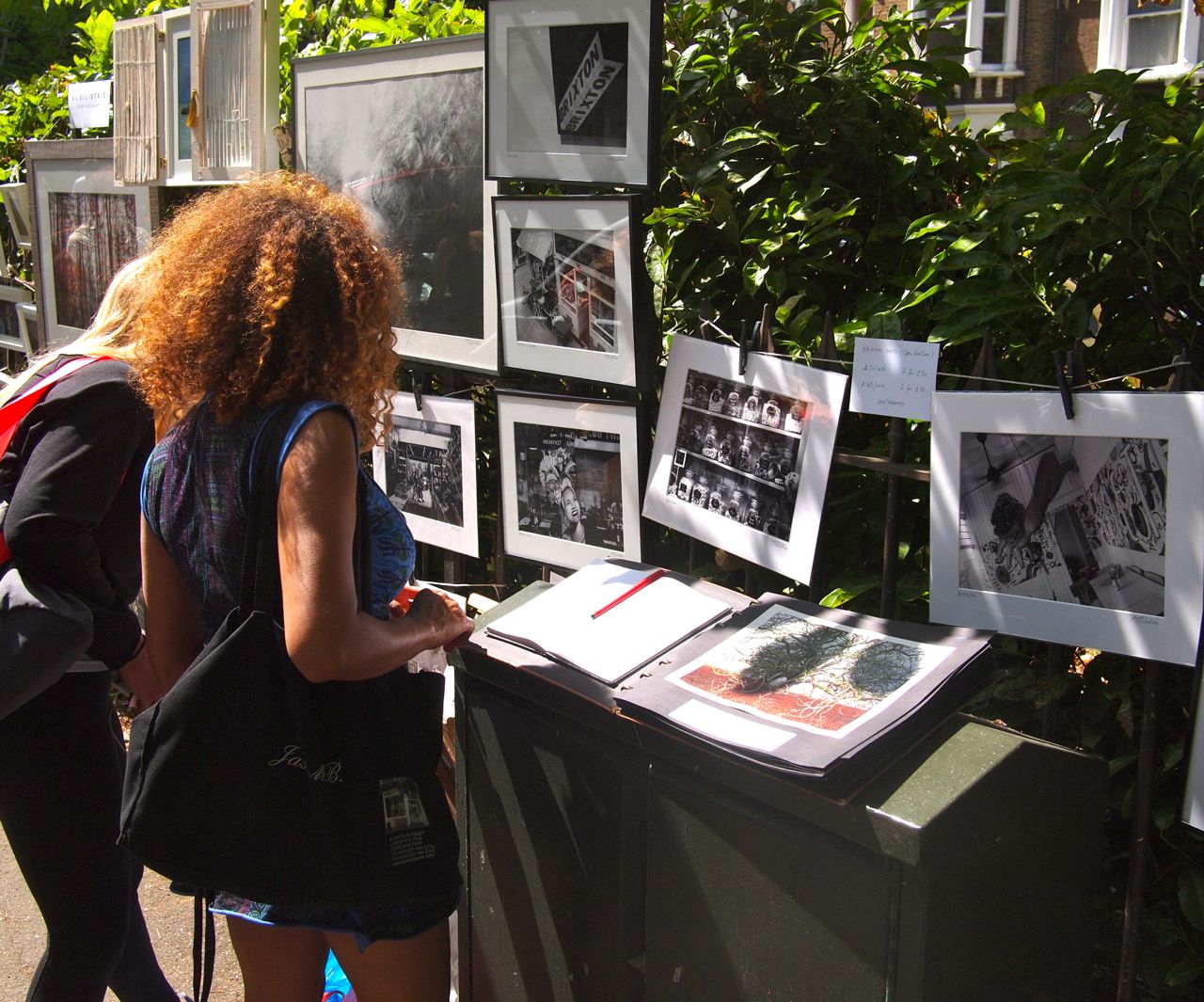
Another photographer with an amazing double-exposure technique was A J Silistrie, who was also showing some gritty local street shots in black and white.

And I loved the street photography of Francesca Brecciaroli, that wonderful shot up to peoples' feet crossing a glass panel in New York.

Others, like Matt Crump, who specialises in strange, sometimes 3D prints made from hundreds and even thousands of separate scans of old book and magazine illustrations, have become more and more local over the years of the event.
Akeisha Walters with some of her
 beautiful prints

The work of two artists in particular seemed to burn with brilliant colour in the strong sunshine of the first day.

Akeisha Walters' small digital prints had a mesmeric, stylised look, somewhere between ancient Egyptian  paintings and 1920s fashion illustrations - glorious in the sunshine, they'd certainly be a tonic in the more normal London gloom.

Nearby Kevin  McMayo was exhibiting his large, gorgeous oil paintings, memories of the luxuriant greens and golds of Trinidad, on this day enhanced by the darker deep greens of Josephine Avenue's Lime trees in sunshine.

There were so many more excellent artists there, I wish I'd had more time (and every)  to speak to more, I hope some of the images that follow might whet your appetite.

The event was even more amazing when you realise that only a week ago Leander Road, which leads off Josephine Ave, held its own street party last week - and that was also open to all and crammed with outsiders, hungry for some street music and  dance action.

Always thought this was a desirable and magical corner of South London - now I know for sure. It runs until 6pm today so get along there and browse and buy!

Dazzled by the art in Josephine Avenue


Prints by Akeisha Walters at Josephine Avenue Urban Art festival, July 2015

Street artists, Art on a Brixton Street - Josephine Avenue's annual Urban Art festival, July 2015

Art on a Brixton Street - Josephine Avenue's annual Urban Art festival, July 2015


Art on a Brixton Street - Josephine Avenue's annual Urban Art festival, July 2015Art on a Brixton Street - Josephine Avenue's annual Urban Art festival, July 2015

WOrk by A J Silistrie at Josephine Avenue's annual Urban Art festival, July 2015

Street artists, Josephine Avenue's annual Urban Art festival, July 2015


Cyanotypes on show at Josephine Avenue's annual Urban Art festival, July 2015

Hi-rise apartment blocks anatomised at Josephine Avenue's annual Urban Art festival, July 2015


Kevin  McMayo and his paintings, at Josephine Avenue's annual Urban Art festival, July 2015