Another evening in Brixton to treasure: at the Library, listening to the 70-year-old photographer, Charlie Phillips, talking about his
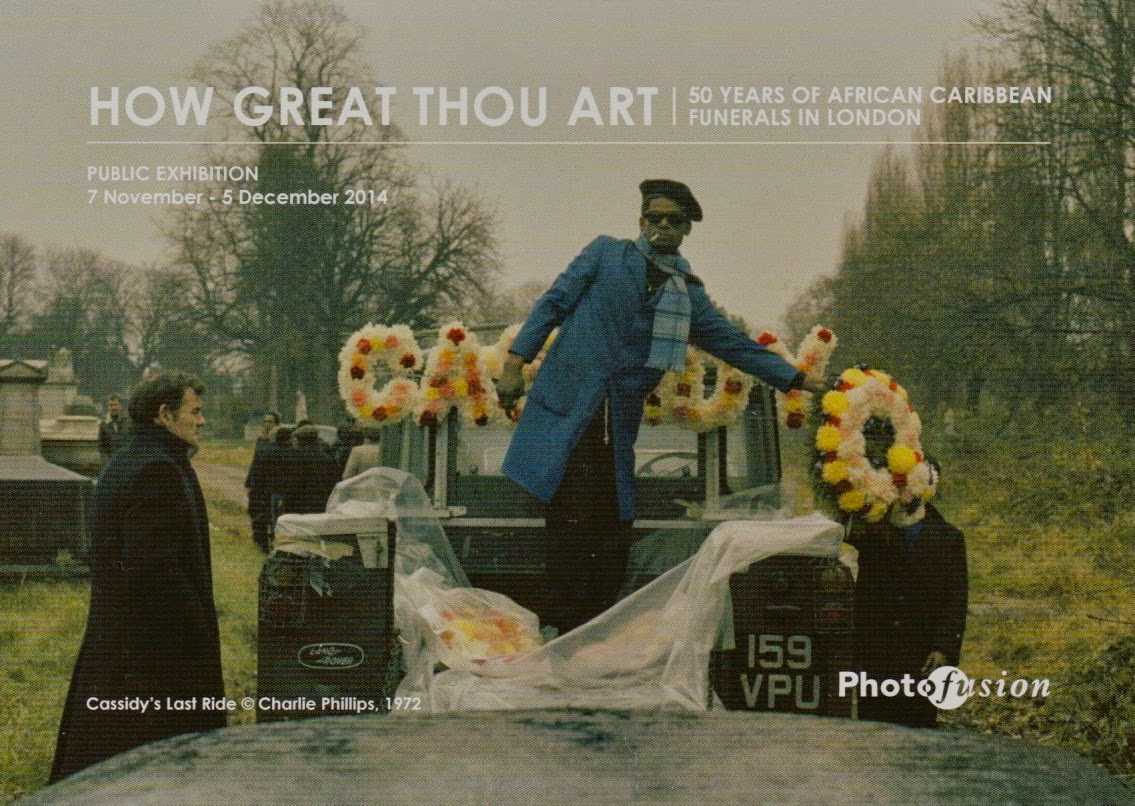
latest exhibition, How Great Thou Art: 50 years of African Caribbean funerals in London.
This exhibition, held at the
Photofusion Gallery just round the corner in Electric Lane, focuses on the funeral traditions of West Indians living in London from the mid-1950s right up to now. Two rooms of beautiful photos and videos vividly and beautifully capture these living and changing traditions, which mix up African, Caribbean, Christian and West African religious customs.
The powerful resonance and documentary value of those images was reflected in the crowd of people who filled out the upstairs hall at Brixton Library on a wet Wednesday evening to hear the master talk.
The show is only on 'til this Friday, December 5th - so get along there quickly!
Apparently the photos had been languishing in boxes in Charlie Phillips' house, until the Photofusion people - co-curators of this exhibition, Lizzy King and Eddie Otchere – came across them and realised their importance and quality. "I had retired" Charlie complains. "I wanted to look after my allotment." But the next six months was spent going though over 5,000 negatives, hours of video and creating both a book and an exhibition out of the results. As a result, his allotments suffered a bit: "Sorry, it's not going to be such a good crop this year".
Charlie Phillips, a well-known Ladbroke Grove character with a taste in sharp suits and hats, has that aura of celebrity - not the cheap PR-manufactured type, but the genuine, hard-earned article. This is something he shares with many of the great characters in his photos, these people who've put up with so much over decades and still smile and laugh and know how to party, but also how to parry when ever necessary.
Tonight he's in a white jacket, buttoned precariously over a tight dark shirt and brilliant orange tie, his white hair and moustache and mischievous, warm eyes flashing behind glasses giving him the look of a seasoned comic actor.
The exhibition title comes from the hymn that for Charlie sums up all the funerals he's been to - it is that hymn, so dirge-like in the dull voices of an English congregation, that takes on new life and vigour and meaning when sung by generations of Jamaicans beside an open grave in Kensal Green cemetery.
He tells us his story - how, from being an altar-boy he grew into a rebellious teenager, hanging out with the youth at the shabeens and blues parties in the Notting Hill area, how he got hits first camera (a Kodak Retina) from one of the black Amercian GIs who brought their precious blues and jazz and R & B discs to these parties, helping to spawn the London sound-system tradition as well.
Charlie was entirely self-taught, and he did his own processing and printing using equipment bought on the proceeds of a paper-round. He would wait until all the rest of the household were asleep before using the bathroom as his darkroom.
But it was when he went to the funeral of
Kelso Cochrane, the 32-year-old Antiguan murdered by Teddy boys in Golborne Road in 1959, that the power of these these events really struck him and he took his first funeral "snaps" (as he insists on calling all his photos).
Over the next four decades Charlie became a must-have guest at the funeral of the great and the good and the bad and the ordinary families of African Caribbean descent all over London.
The photos - which you can see until at Photofusion's small gallery up on the first floor of the Brixton MArket buildings - capture the joy as well as the grief of these vents. Everyone speaking tonight - which included the professor Michael McMillan and writer Empressjai - emphasised how the West Indian funerals pick up on the West African belief that the spirit does not die, but has to move on - it's the job of everyone at these funeral to help that spirit on its way, hence "the good send off". Hence the opening of windows at the wake or the
Nine Nights (the night before the burial when the spirit is said to leave the body), even in the depths of a London winter.
"It's not all peace and love", he adds. Quite often a old family tensions burst out at such events, there are fights, scuffles even over the coffin .
The photos show not just the big burial processions, but also the wakes - and especially the crucial "Nine Night", that last night of the wake before the burial, when music and dance and drink and what have you often take upper hand.
There's some great photos there of these events - as well as some more recent videos, including one showing another professor, Gus John, giving a traditional libation at the funeral of the All Saints Road activist, Frank Critchlow, who ran the famous Mangrove restaurant and bar back in the 60s and 70s.
That libation speech was so good, you have to see it, especially when the guy sits down to take a few sips of the libation gin bottle. It illustrates one of the big themes of this evening's talk - the way old African traditions have survived any amount of battering by the white missionaries. Their lasting contribution, on the other hand, is the hymn.
We had an expert, Dr Michael McMillan, talking about these traditions - and he made the point very clear that these "Black death cultures" are actually about life - the spirit that lives on, to join all those other spirits, good and bad, which get on with their business all around us all the time - the duppies and the jumbles and the djinns and the sprites, the spirits of place, of the earth and the sky.
Dr McMillan noted that most of the cemetery chapels in London were far too small for a proper West Indian funeral, hence the massive wakes and receptions before and after that event. The burial itself is different - relatives don't just drop a few crumbs of earth onto the coffin, they cover it and fill completely. But only after the deceased's favourites things have been sprinkled over the grave - maybe some flowers, some jewellery or clothing, some records or some rum or perhaps some ganja.
He picked out the great images of a funeral wreath in the shapes of a giant pack of Rizlas, and another as a Singer Sewing machine - "Our traditions have single handedly revived London's floristry business!" - and also noted how these echoed the Ghanaian tradition of burying people in coffins which reflect their occupation. A boat-shaped casket for a fisherman, a Mercedes Benz for a taxi-driver.
What a great evening this was - but Charlie had some regrets, as becomes clear in the more recent photos in the exhibition. He doesn't really like the way the younger generations have allowed the funeral traditions to become a bit diluted - how they often choose Frank Sinatra's "My Way" or even the "Simply the Best" as the theme music. And how there's now so much emphasis on bling and colour-co-ordinated clothing.
But as others noted, including Empressjai and Dr McMillan - the tradition is alive and changing, new traditions are being created. The evening ended with a big discussion on this issue, the changing trsiditions of different generation, with many people chipping in with their thoughts and their memories.