About Me

"Use every man after his desert, and who should 'scape whipping?"
Showing posts with label Brixton. Show all posts

Monday, 15 February 2021

Eleven years on: where the hell did it all go wrong?

The lost murals of Mauleverer Road
Mauleverer Road, SW2, January 2021: remembering a lost paradise.

At the end of its tenth year, this old blog is still spinning, much to its creator's surprise. Maybe not  at quite its youthful 33 and a third rpm, but at least at one story per season. 

So after a prolonged winter interlude,  it's time to take stock. The question hovering just above this acrylic as opposed to woollen hat is: Why bother?

The first postings appeared in February 2010, when I had the unlikely job of teaching web-based journalism to undergraduates. It seemed a good idea to have a blog of my own to practise on, before I attempted to show them how to do it. Poor dears.

The blog began with a post about the difficulty of finding stories that anyone else would want to read. I think that was also my first big mistake - no-one is interested in the agonies of would-be writers, except perhaps other failing writers.

The second post described my joy at finding the community/arts radio station Resonance FM, just as I crested that hill on the M11 as you drive south back into London, and see all those distant towers.

The  eclecticism of that station on 104 fm leeched itself into the fabric of this blog. I started to write about the things I enjoyed, such as vinyl LPs, tape, 35mm film, print as opposed to Kindle,  bikes, charity shops, cheap cafes, live music in pubs and dodgy bars, crumbling houses and so on.

The absurdity of the project (original title, Old Bill's Analogue Blog) just made it more necessary to do. Write abut things I valued most, with the realisation that they were all under various forms of threat (except, ironically, vinyl records, which were suddenly the height of fashion).

Over the next decade, the blog became peppered with outbursts about the impact of the most insidious weapon of social change - gentrification - on all the most desirable aspects of life in a city. 

The many attendant insults to the senses that gentrification inflicts: ridiculously expensive bars and restaurants and "artisan" outlets replacing useful shops; the cramming of every residential street with massive, ugly, noisy, expensive cars (worst of all, the increasingly vile SUVs); the inevitable driving away of older communities, replacing them with a brash, young(ish), wealthy and seemingly rather selfish monoculture. 

So, what's changed? Have three (to me equally) catastrophic events - austerity, Brexit and pandemic - made gentrifiers hide in their expensively created cellars? 

Sadly not. They are just digging bigger, deeper cellars. 

I'm going to use this and the next few posts to check back on some of the places and events written about in recent years, starting with a shocker in 2015 that was an eye-opener: the destruction of the Mauleverer Road mural in Brixton.


This story still smoulders in the memory. Those wonderful painted walls of the old brewery were a highlight of the backroad cycle route from here to to the old Lambeth College on Brixton Hill, where I was taking a course. 

These paintings of a tropical garden of Eden, fountains, luscious plants, trees, even a stable  with beautiful horses, transformed what would otherwise be a perfectly normal south London residential street. 

Read the original posts for more on the creation of these murals. The story since then has been just as dismal as expected. Having destroyed the art, the developers appeared to leave the site fallow for about three years. Some plywood hoardings went up, and at one point a few planters were added with some sad plants withering and uncared for. 

Peaking through the  shutters, you could see a massive hole in the ground, which at one point seems to be full of water. 

Finally, building got going, and now the development is complete. Go and take a look if you want to see how clever modern architects and builders are: they have created a carbon copy (no, a 3d-printer style copy) of the Victorian terraced house opposite. Except that these are stripped all character. It looks as though it could be an ironic and cynical response to Turner Prize winner Rachel Whiteread, who cast the inside of an old house just before it was demolished for redevelopment in Mile End. 

There's also a near-identical terrace of new four-bedroom Victorian style houses on the other side of the site, fronting on Mandrell Road.

Nearly all of the houses have To Let or For Sale boards up. You can snap one of these four-bed, three bathroom clones up for a mere £1.44million. And as the estate agent's blurb points out, you are within easy reach of "The Village", Market Row, the Ritzy and other attractions of an area which is not actually named in this blurb (Brixton).

So, there you go - you lose a life-enhancing piece of public art but you gain strangely unreal seeming copies of your own house. You almost wonder if the occupants will be as immaculate as these buildings - like those computer-generated smart, smiling young people who populate architects' impressions of all new developments. 

The far end of Mauleverer Road was redeveloped in the 1980s, and it's fascinating to see the totally different styles of domestic architecture. 

My jaundiced view of the new houses was challenged last time I cycled through, when a group of cheerful young people were unloading their stuff from a big van and were clearly moving in. 

A lovely new home for someone, in a fascinating area of London. And at least they will be looking out at the real Victorian houses over the road. 

Over the next few weeks (or months) the plan is to revisit plenty of old places and topics this blog snooped around over the past decade. They might include:

  • The Tearooms des Artistes (RIP)
  • Peter the Greek's Lock-up treasure shop (RIP)
  • Lambeth Libraries (lost and found)
  • Nine Elms disease (there's no vaccine)
  • Er...lots of other things, with a south London bias.

Look on the bright side, it might never happen.


Friday, 20 July 2018

Note to Brixton graffiti writers: thanks, nice...but we've too many yups here already

Some useful signposting on the overground rail bridge in Brixton High Street...trouble is they all tend to go right, straight to
the Pop Brixton container park....
That new bit of graffiti on Brixton's high-level rail bridge made a nice little photo-story for the Brixton Buzz site.

The writing is on the bridge. It reads: "Clapham that way, you 2D Flat White Tepid Colonialist Yuppy Wanker". There's an arrow pointing west down the Overground line towards the next stop: Clapham High Street.

Yes, it's fun, it's funny, it's to the point. Clapham was thoroughly yuppified back in the 80s - and that strange breed still prevails in much of SW4. But please, I've lived in the bloody area for longer than is reasonable, and the last thing we need is more of the buggers!

In reality the Yuppie has changed a bit since the 80s. Maybe the truest 2018 successor to the yup is the hipster with their artisanal this, their authentic that; the obsession with everything being just so. And of course they would not be seen dead in this postcode: strictly east and southeast London, please...

Vaguely hipsterish people I've met like to mock SW4: it's either Cla'am or Crapham. Probably the least fashionable place in all of London, from the viewpoint of Hackney Wick or Peckham Rye.

What used to be the yuppiest bits of SW4 are now colonised by corporate types - families with live-in au pairs and even chauffeurs living in huge houses. They are much, much richer than thou, antiquated Golf GTi driving yuppy of Peter York fame!

But keeping an Attenborough-ish, threatened species eye on the place, it's clear there are still millennial versions of real 80s-style Sloaney yups in Clapham, with a few differences. 1980s yuppies bought their crappy flats; the 2018 versions have to rent. They tend to share flats in the slightly cheaper parts of the area. Here they often mix with another strand of the young professional type: sports-mad Aussies, Kiwis and South Africans who for some reason still seem to love SW4. Probably it's the proximity of wide-open space on which to play games with strange shaped balls and frisbees.

The first hot weekends of the summer are prime-time for yuppie-spotting
How consoling it is that the young flock to our great open spaces at the first
real sniff of summer: May 19 2018, Clapham Common...
Every bright morning, every evening, the Common is a nightmare of grunting and sweating types, trying so noisily hard to get in trim like their bronzed Australasian neighbours.

But the core breed, yuppie lethargica, are most visible on the first really warm weekends of summer when they come out en masse and sit their well-fed, pastel-coloured-tailored-shorts-clad bottoms down on that little triangle of the Common nearest to the Old Town shops.
Sadly, they know nothing of re-cycling or even taking their litter (Prosecco bottles, etc) away with them. All the rubbish bins will be overflowing with over-stuffed orange Sainsburys carrier bags by early evening.

....but how sad that they so often neglect to take their rubbish
with them.
The richest ones (who live in the more expensive new builds in Old Town), will show off their powerful sports cars, often annoyingly revving the engines for no good reason at traffic lights. That really is wanker behaviour.

Yet, as one commenter on the Brixton Buzz story says, Clapham is actually a bit shit: it was always a byword for the "ordinary" suburb, ie mediocre, drab, stuffy. And it always will be.

It's not really a place, it's a collection of tube stations. It has no real centre: it's defined, if by anything, by a dirty open space - Clapham Common. The better bits to the north are either Stockwell borders or Battersea-Nine Elms borders. The better bits to the west around Lavender Hill are Battersea. The southern bits improve when they become Balham.

There are a couple of visibly smug areas - Clapham Old Town, Abbeville Road - that typify that first wave of well-heeled yuppiedom. Many of that first wave moved a bit west and south when they shacked up and had kids: hence Nappy Valley (really Battersea again, by Northcote Road, wrecking what was once a decent street market).

But there's a lot more to the social fabric of this district than the stereotype would have you believe. There's still a lot of social housing, and there are still a few hanging-on 1970s boho types, who, as we all now know, were actually the first essential phase of re-gentrification.

This blog has tried to throw some light on the social history of the area. But no-one, in recent years, has done more to reveal the many layers and deep and diverse roots of Clapham residents than the Jim Grover , who has had five acclaimed exhibitions in quick succession, all focusing on the area and the people who live, work and play here.
A fine example of a "Front Room" display cabinet, a rarity
now, but these took pride of place in many West Indian family
homes in south London back in the 60s. From Clapham-based
photographer Jim Grover's recent Windrush Generation
exhibition at the Oxo Gallery, London SE1.
photographer

His most recent show was Windrush: A Portrait of a Generation, a celebration of the West Indians who arrived in this part of south London 70 years ago. He got to know some of the original Windrush passengers and their children and grandchildren at his local church; as with all his work, he earned the trust of the people he wanted to portray before getting out his camera.

Other exhibitions have focused on the long-established Café Delight at Clapham North and its varied clientele; the double life (daytime and night-time) of much-maligned Clapham High Street; and the work of a priest at the church in Clapham Park Estate. It is already an impressive body of work that shows this area in a very different light to the media stereotype.

It's work like Jim Grover's, patient, painstaking, that truly reveals the complexity of a neighbourhood, of communities; lives that are led, families that flourish...others that do not. 

But thanks anyway graffiti people for reminding me of the way home. As for being a yuppie, well maybe 40 years ago. 2D? Well I guess I know what it means: bland, dull, fake. Flat, yes, flat white. But am neither smooth nor sane enough: I'm more like 5D. Flat-white? I prefer espresso. Tepid? Yeah, OK. Colonialist? Well, had to live somewhere. At least I got out out of Dalston just in time so that the real Dalstonites could move in. Wanker? Obviously.


Wednesday, 29 November 2017

Akasha at The Bread and Roses - bringing the love magick back to SW4


For every entry  published on this blog, another 10 or 12 are left to rot in the drafts folder. But I'm going to publish this one, because this semi-local band playing at a local pub gave me more pleasure in one brief free gig than I've had at any music venue in years.

Among dozens of unpublished blog pieces gatheirng dust in the vaults of this site are several about gigs at The Bread and Roses pub in Clapham Manor Street. It sometimes feels like an unappreciated SW4 treasure, this trades-union-run pub.  I've several times been to their free music nights to find the audience almost outnumbered by band members.

But not last Saturday evening, which belonged to a band from the Brixton area named Akasha,  whose performance left me eager for more, buzzing with that strange energy you get from great music - and also kicking myself for not having followed their every gig for the past 20 years or so. There was a good crowd, and at least half were dancing wildly by the end - well, some of us were at least shuffling from foot to foot.

Akasha (a name they share with a few others, being the sanskrit word for "air" or  "aether") started in  1994 as a duo, Charlie Casey and Damian Hand, but have now grown into the seven -piece band which crammed the small pub stage last week.

The band was a pioneer of  jazzy, electronics-infused, spaced-out hip-hop fusion style which was emerging back in the early 1990s, and became the signature sound of the highly influential Wall of Sound label.  Some called it trip-hop...but the music was much too diverse and agile to get trapped in such a name.

The two originals - Casey on guitar, vocals and MacBook Pro,  Damian Hands a sort of new-age Roland Kirk on all manner of reeds and deeds and woodwinds - were backed up by a rock-steady demon of a drummer, a fabulously 70s-looking keyboards player, and solid trumpet, bass and alto sax players.

The sound system wasn't really up to such an adventurous band - and it took about half an hour of the engineer traipsing between stage and mixing desk to get things right. But once they got going, the gates to a new musical heaven opened in the skies over southwest London. Well, that's how it seemed to me, and I wasn't even on anything, apart from Guinness.

Akasha's music is catchy, exciting, incredibly danceable, unpredictable and mind-blowing at times, risk-taking (or so it seems); and it has that magic ingredient - wit. No wonder they were such a big influence on loads of their more commercially-minded label-mates (whatever happened to the Propellerheads?)

No wonder that so many big names wanted to work with them - and many did, notably Neneh Cherry, the true godmother to all this jazz-hip-hop-punk-funk crossover stuff. I've never got over seeing  her fronting Rip Rig & Panic under the Westway back in about 1983. And also Sarah Cracknell of St Etienne and the guy from Faithless - Maxi Jazz - who, coming from a similar milieu, had all the worldly success that eluded this band. But Akasha has the sort of success that others long  for - they're still loved and respected by their original fans, and winning new followers with every set they play, worldwide.

This night, Akasha played plenty of their old favourites, ratching up the involuntary dance factor with each number. I listened very hard when they played a song about their musical influences - but the vocals were drowned a bit by the poor PA. At a guess I'd say they would go for James Brown, Miles Davis, maybe Charlie Parker, Roland Kirk, maybe the Sugarhill Gang, maybe Curtis Mayfield or maybe Stockhausen? Herbie Hancock? Coltrane? Gil Scott Heron?

So, will have to go to next gig and hope they play it again. Also, buy the CDs. Next gig? One of the band said they were playing the Railway Tavern in Tulse Hill sometime soon. I think. Go!

Thursday, 11 May 2017

Two films, two Brixtons, many gentrifications

Went to Ritzy to see A Moving Image, the new film about gentrification in Brixton. Emerged 75 minutes later without much new light on the topic and rather disappointed. Another, very different two-part film, coming at the same topic from a different angle, was far more evocative of at least two of Brixton's dispersed communities. This film, For What We Are About To Lose - was coincidentally the centrepiece of a small exhibition in Brixton Library, next door to the Ritzy.

Talk about keeping it local!

A Moving Image started with a strangely low-key sequence of a young woman emerging from Brixton Tube station into the street with a smart wheelie suitcase. The underground arrival in Brixton is surely one of the great full-on London experiences, but it seemed underwhelming here. Maybe deliberately, as this young woman was supposed to be returning to Brixton after a few years out east in the artistic community of Shoreditch. Maybe Brixton seemed rather unthrilling to her, what with her memories of an even livelier high street of the early 2000s.

 If so it underlined not only the problem of gentrification, but also  the whole concept of the movie, which was constantly struggling against itself.

On her return to her home patch, this young mixed-race woman, Nina,  played by Tanya Fear, stays in an enormous and ridiculously fashionable loft apartment owned by a friend of a friend. She explores the area, wandering the streets with her top-end digital SLR, filming what she sees.

She has debates with her equally smart girlfriend who agrees to help with her "project". At first she doesn't know what she wants the project to be but when she gets mixed up in a Reclaim Brixton demo she decides that's her subject - gentrification. Not a documentary, mind you, but an art piece, a piece of art.

One great moment in the film only works if you see the film in this cinema: during the demo we see the Ritzy strikers calling for boycott of the Picturehouse group cinemas until they're all paid the living wage. It was one of the few moments in the film that triggered some cheering in the audience.

It takes a while to dawn on Nina that she is part of the gentrification, even though her friends keep telling her, and interviewees make it clear. It's as clear as day to the audience, because the dear girl is wearing a totally different designer outfit in every take, and speaks the lingo of the casually moneyed hipsterish young.

She befriends a young black guy who is meant to be part of the community but he's also an "artist" and the art and music he makes is a truly terrible. The villain of the piece is a young and very successful white actor who falls for the girl and has bought a flat in formerly-squatted Rushcroft Road - you know the buildings - as a "good investment". He's a villain, sure, but he's also, as we learn later on,  a working class lad from Bermondsey made good, whose own family have been driven away from their old neighbourhood. One of the admirable things about this film is that it shows just how complicated this gentrifcation busines is.

In the course of making her art, Nina interviews a few people, and these are the highlights of the film; the bloke from Peckham is especially entertaining. The black members of a local community group are suspicious of her motives and one of their members cruelly tells her that her project "doesn't mean shit".

By the end of the film you can't help but agree with him. It was really much more about Nina's internal struggles with depression (rather clumsily revealed by the discovery of a strip of anti-depressants) and her romantic life.  Maybe it was me, but  the scene where she makes the white boy actor dance with her was very odd: were we supposed to be entertained or what?

The other main character in the film is Big Ben, a mysterious, homeless black busker and ranter who acts as a sort of conscience of the movie. She films him a lot, and perhaps he should be the real subject of her movie. But as soon as she realises this he dies. There's a nice scene where she dreams he's in her flat and sitting on her bed, and then he disappears in a ball of blinding light.

 So, perhaps that's it: the revelation that the true soul of Brixton has already departed.

The interviews with anti-gentrification people from New York and Berlin popped into the film were intriguing; it's only when you go to the community bit of this film's website you realise these videos are part of a bigger project to collect voices from threatened communities around the world.

In other words, the director of A Moving Image, Shola Amoo, is trying to do exactly what Nina is doing: he is Nina, and suddenly it all sort of makes sense.

All in all, a film's a curate's egg; it's intriguing and ambitious, but also annoying, and it seems that some opportunities are wasted. But, if you've never visited Brixton you at least get some moody rooftop views; but not enough, even of this, for my liking.

Still, you have to commend the director for attempting such a complex project, and the film has had plenty of good reviews in the media, so please don't take my criticisms too seriously ( I know that won't happen!)

The other film, For What We Are About To Lose, is a very well-crafted example of the traditional documentary style, with many interviews intercut with archive photos and some lovely footage of Brixton in the 50, 60s, 70s and 80s.

It was made by the Clapham Film Unit, and is in two parts. The first 20 minutes covers the history of the Carlton Mansions squat from the 70s to the final evictions of 2014; the second half looks at Somerleyton Road community. Together the short films are a precious record of what was once the true heart of Brixton, that little bit where Coldharbour Lane crosses Railton and Atlantic Roads, which is now undergoing transformation as part of the Somerleyton Road redevelopment scheme.

You might say that the Carlton Mansions film is only representative of a small fraction of the old Brixton community, the squatters, and that would be true. "Maybe we were all misfits," says one of the  first occupants.  Former squatters are interviewed inside the astonishing and huge buildings where they made their homes and workshops and studios. There were poignant moments, and also painful memories.

One of the original squatters, Dale, reveals how they were actually invited into the building by Lambeth Council, which at the time ran progressive short-life housing schemes, helping people set up housing co-ops and handing out grants to make the places habitable. Dale also worked with Brian Barnes on the famous Nuclear Dawn mural on the huge side wall of the mansions - a mural which is still there but rapidly disappearing under new graffiti.

 Another guy talked about how they had to secure and guard their squat because Brixton was such a "difficult place" in the 80s. It was not only sex, drugs, and rock and roll. There were hard times, hard winters, fights, a suicide, rows. But also a lot of creativity, and we hear from several successful artists and makers who got their first big break in the Mansions.

The Somerleyton Road part of the doc is only 10 minutes or so but an utterly joyous film. Some former residents are brought together in a community centre on Railton Road, and they talk about their lives back in Somerleyton Road back in the 60s and 70s - even before the Barrier Block went up.

There are some wonderful memories of blues parties, some fantastic old footage of Brixton market, and even an impromptu performance of by former members of a lover's rock group, who reminisce about the excitement of seeing Jamaican DJ Peter Metro at a Somerleyton blues before letting on they were part of a group of  five women who took over the stage from him...."we were not deejays but sing-jays, we took a broadway melody and we ride the rhythm...."

One woman at the end sums up the process which is sometimes referred to as social cleansing: "It seems like a plot. They sell your house, move you into a block of flats. Why are we knocking wonderful buildings down to build atrocious things like that?  To me it was like a con. That was the beginning of the change."

You must watch these films! Catch them on the Clapham Film unit website now; there's also a very good, well illustrated free booklet about the films; copies were available in Brixton library, last time I was there.


Sunday, 13 November 2016

Busking reggae sax player triggers Brixton tube station epiphany

Miss Megoo and her sax on a cold November evening, Brixton tube station, London SW2

Approaching Brixton tube station early on a cold, dark November evening, the sublime rhythms and
haunting saxophone melody of some early Jamaican reggae warmed the air. You could even see people's walking pace change to get into step with the beats coming out of a small portable speaker-amp.

The sax melody was provided by one of the many talented buskers this location is famous for - and in this case I was almost certain I knew who she was. A tall, slender young woman of Japanese appearance, in a beautiful full-length striped and tiered silk dress, matching silk scarf, her jet-black hair pulled back tight in a bun, and secured with a huge crimson flower on the right side of her head, swaying to the music, playing what looks like an old, much-loved alto sax, the case open on the floor in front of her feet.

If you like ska or reggae and live in London you will almost definitely recognise this striking young woman - she's unmistakably the sax player who joined The Trojans onstage at Gaz Mayall's set at the Notting Hill Carnival, who's a key member of the wonderful south London ska band, The Top Cats, and a truly big name in the international reggae/ska world.

And here she is - I was 98 per cent certain it was her, that is Megumi Mesaku - busking outside Brixton tube station on a cold November evening.

She's already something of a legend. She's played sax with many of the great names of Jamaican music, and many of the greats of jazz, soul and funk too. They include Max Romeo, Maceo Parker, Rico Rodriguez, Dennis Alcapone, Laurel Aitken, and numerous other big names from the ska and reggae world, young and old.

So is this really Megumi, busking? I am 99 per cent sure it is. Look at her. One hundred percent certain. But I was too shy and stupid to ask.

It's still rush hour at 7.30pm around here, crowds surge out of the station as each new train arrives, and her music always catches a few of the people as they leave, detaining them, some just stand and smile and nod, some  are swaying, but only one person is really dancing. A young black woman with shining eyes, she's already been taken over by this gorgeously fluid music and is using the whole pavement outside the station as her dancefloor, deftly avoiding the commuters as they swarm around her.

The sax player - yes, it has to be Megumi, also known as "MissMegoo" - has that characteristic
modesty, always smiling in response to any applause, always acknowledging any donation, there, alone with her mini-sound-system, filling the air with promises of warmth and love and a better future.

She's playing lots of reggae and ska classics, but also some old soul and R & B numbers. At one point I could've sworn she even played some Glenn Miller.

So that was it - the epiphany thing, it was the sort of very much wanted antidote to weeks and months of gloom and fear and anger, from Brexit through to Trump. A tonic, a reminder of what we could be.

A realisation how grateful we should all be to all the people who come here from other continents and countries.

Here was a Japanese woman playing her interpretations of the music of the Jamaican ghetto outside a tube station in one of the most racially-mixed areas of London. All happening, just like that, perfectly normal.

Anyway, if that was you, Miss Megumi, thanks for providing some light in the gloom.  You are surely one of this city's many musical treasures.


Saturday, 12 November 2016

Cultural chat in the Library as Clapham remembers Smiley

Smiley and Me was another of Lambeth's excellent programme of Black History Month events - and this time it was dealing with quite recent history, focusing on a time  (the late 70s and early 80s) when this area was on the frontline of a new style of home-grown reggae music, London's answer to the Jamaican dancehall toasters and DJs.

Here's the book - a rip-roaring read if ever there
was one, the true story of a pair of likely lads making
it big in the London reggae music scene of the
1980s. That cover pic, showing Smiley (left) and Asher,
looks like a phot but in fact is an astonishing painting
by their friend and former Saxon Sound System
fellow artist, Peter King.
The new generation of young DJs and MCs emerged from the big council estates running from Battersea to Lewisham, via Clapham, Stockwell, Brixton and Peckham.

They attached themselves to the big established sound systems of the time - but they'd also moved on from the Rasta-influenced roots reggae of their elders. Their lyrics were sharper, still socially conscious, more directly relevant to life on the streets and in the estates of inner-city London. These lyricists were often witty, often challenging, and nearly always in competition with rival sound-systems.

A handful of these homegrown proto-rappers broke through to become mainstream pop stars. Among them were Lewisham's Maxi Priest,  Papa Levi and Tippa Irie from Brixton  – and Smiley Culture and his constant friend, co-conspirator, and sparring partner Asher Senator, both from the Stockwell-Clapham area.

One of the top lyricists of that era's musical innovation, Asher Senator was recently at the Clapham Library to talk (and rap) about his new book, which tells the story of his enduring friendship and musical partnership with Smiley.

The book, Smiley and Me, tells Asher's version of the fascinating, exciting, hilarious and finally tragic story of the Stockwell school kid, David Emmanuel, who became Smiley Culture, tasted international fame and stardom with his two hit records, Cockney Translation and Police Officer, but then ran out of luck in a big and painful way. It's a handsome, nearly 400-page, well illustrated book published by Vitow (Voice in the Open Wilderness) Media - which is, aptly, also based on the Clapham-Stockwell borders.

 I say "talk" - this was Asher Senator, the man famous for fast chatting in a continuous rhyming style. As you might expect, he'd brought a big 2016 version of a ghetto blaster with him, and told at least half the story on his mic, in exactly the style of those early-80s tracks he and Smiley used to light up London's dancehall nights with.

The book is truly thrilling memoir, the pace is quick and the stories come thick and fast. It's written from the point of view of a gifted lyricist and performer who was a sort of Boswell to Smiley's Dr Johnson, or maybe Dr Watson to some skanking Sherlock. Asher, although a star MC in his own right, was always slightly in the shadows cast by his more fame-and-fortune-seeking friend.

As the blurb says, it pulls no punches, describing in some fairly grisly detail the downward spiral that seemed to set in after Smiley got mixed up with some heavy-duty gangsters - initially, it seemed, to frighten off local rivals who resented his success. But that decline went on right up to Smiley's mysterious death in March 2011, during a police investigation at his final home - a house in Warlingham, which is a semi-rural village on the far southern edge of south London. A single stab wound to the heart, which a jury later decided was self-inflicted: what a sad, hideous end for such a talented man.

But this night, Asher concentrated more on the upward years, giving  great readings from some of the earlier chapters of his book. There's a lot of poetry in his writing. The chapter on their first sound system, Buchanan, based at "Lansdowne in Stockwell, Just behind the station" - begins with a eulogy for "Miss Coarsey".

No, she was not some inspirational school teacher. "Miss Coarsey" was the name they gave to their battered old van, which was an essential bit of equipment for any London sound system at the time, used to transport the huge speaker cabinets and amps around the clubs and party venues, along with the crew of DJs, MCs, rappers, techies and hangers-on. Despite needing push starting, Miss Coarsey did not let them down until a vengeful ex-girlfriend set her on fire.

Get a taste of Asher and Smiley on Buchanon here, dating right back to the beginning of their musical careers.

These passages, this music,  reminds me strongly of Franco Rosso's 1980 film, Babylon, covering much of the same territory, just a little earlier.  Only 35 years ago, yet it seems like a different century....well of course it was a different century, a different millennium, a totally different world.

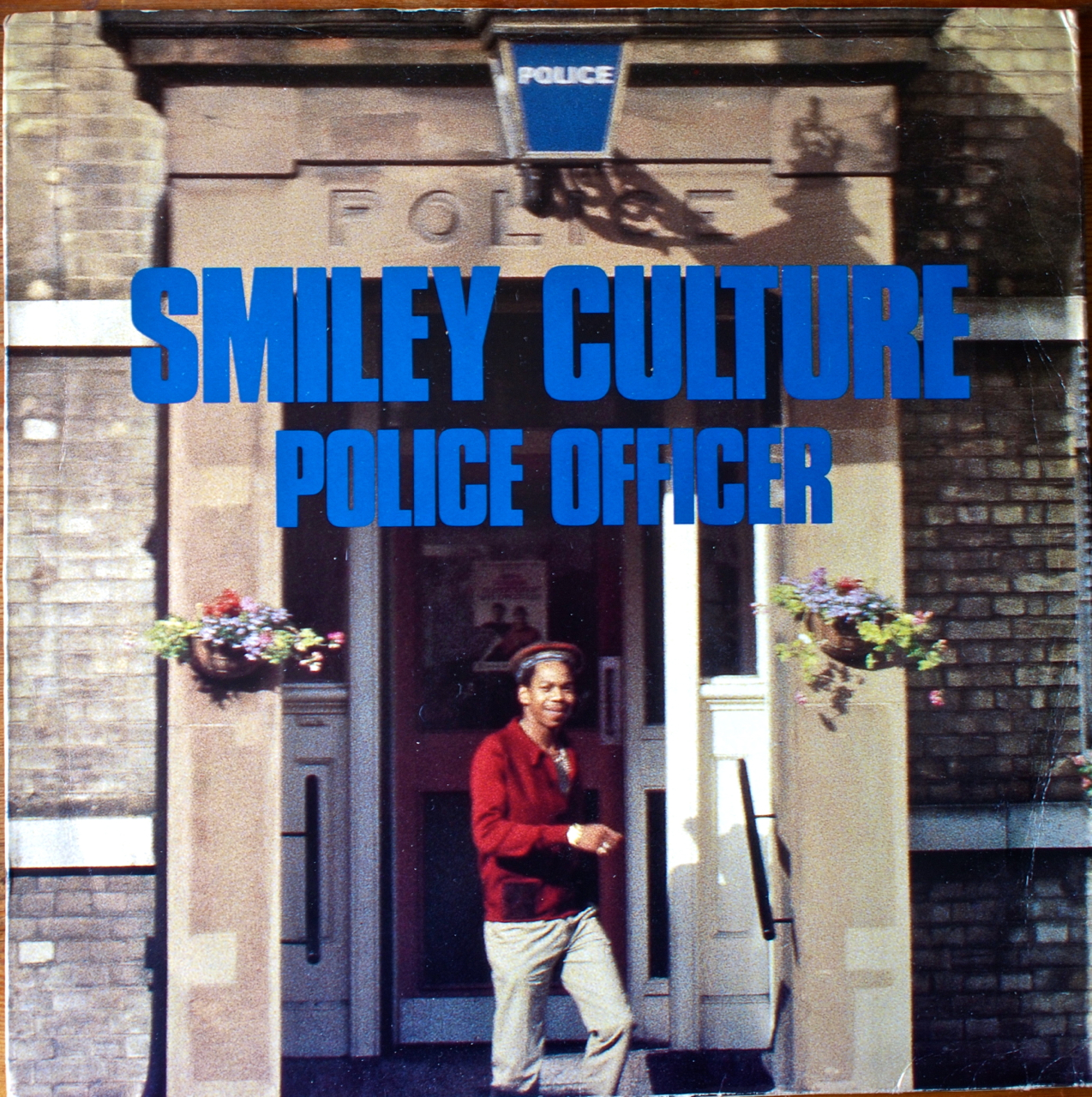
Smiley Culture's 'Police Officer' 12inch 45rpm single, Fashion Records, cover, outside Brixton(?) police station, 1984
Smiley Culture's 'Police Officer', the top-selling 12inch 45rpm single of that
year, released on Battersea-based Fashion Records. Looks like
 the cover was shot outside Brixton(?) police station, 1984
Their breakthrough night at the Four Aces Club in Dalston is a beautiful moment: the first time they ever get paid (a whole fiver for both of them!) for their MC-ing. Note that at this time it is always "they", with Asher and Smiley working like a team - which continued even after Smiley performed on Top of The Pops and became a big star.

The early chapters paint a vivid picture of South London street life in those bleak late 70s winters, through to the 1981 and 85 Brixton riots and beyond.

It's a strange read for anyone like me who lived in the same area at the same time, actually a few streets away from some of their favoured locales.

How often I lay awake a night, hearing the police sirens and helicopters, and wondering what the youth were up to now. As a sort of low-rent yuppie, weaned on a lot of jazz and blues, a little punk and then tons of roots reggae, I was deeply attracted to that scene, even though I might as well have been a million miles away.

The nearest I  got was a few nervy trips down Coldharbour Lane, a few evenings in the Atlantic pub, where with a few other white-boy thrill-seekers and dub-addicts, I payed my local taxes and got to see the young Courtney Pine coming on like a reborn Coltrane.

Meanwhile Asher and Smiley were signed up to Fashion Records, which operated out of the same building (and had the same management) as Dub Vendor, the legendary record shop at the Clapham Junction end of Lavender Hill. As this blog noted previously, Dub Vendor eventually went out of business after it was affected by the fire started during the riots of August 2011.

Nice how he has printed the lyrics on the back cover of this 12 in single....
There is Smiley, and there are the lyrics to Police Officer, helpfully
printed on the back of the cover of the 1984 Fashion Records 12in
single - which became Smiley's biggest -selling hit.
There are so many great and hilarious stories in this book, you have to buy it and  read it for yourself. It has that picaresque drive of a ghetto-based Don Quixote, with Asher as his Sancho Panza. Or maybe the Laurel to his Hardy, or the Butch Cassidy to his Sundance Kid. All those elements are there.

One story I can't resist mentioning happens while they're on tour in Jamaica, taking their London coals back to Kingston's reggae Newcastle.

First night in a hotel, they get a visitor who offers to show them round the sights and nightspots. It's none other than the best of all the new wave of Kingston based dancehall reggae singers and MCs, Barrington Levy - the guy whose carnival anthem, Under Mi Sensi, is a Kingston-style cousin of Police Officer, what with its chat and its dialogue. But which track came first?

Barrington, however, never get the kudos that Smiley has received in the UK for more or less defining a new London dialect. Teachers and academics and top children's writers have all quoted the lyrics of Cockney Translation as being the record which took this form of speech out of the ghetto and into youth culture nationwide. Children's author, poet and teacher Michael Rosen even included Cockney Translation as one of his eight most precious bits of music for the BBC Radio 4 Desert Island Discs programme.

There's immortality for you!

Asher, always the more level headed one, despite having plenty of his own troubles, was the survivor. He's gone on to launch a charity, Code 7 which helps kids in the estates get into the same sort of music business he and Smiley excelled at. Better  to clash with sounds than with guns and knives.

On the night he was a total charmer, and gave his all to the performance of many lyrics, even though it was a ridiculously small but very responsive audience. Also at the event was his publisher, Rickardo Quintyne-Wright of Vitow Media, who is also involved in film production. Read this book and you will soon be thinking, when are they going to make a big-budget movie of this? It has all the elements and more. Let's hope it happens.

Details and where to buy your copy:

Smiley and Me, author Asher Senator, edied by John Masouri, illustrated by Peter King,   published by Voice in the Open Wilderness (ViTow) Publishing; 1st edition (15 Dec. 2015).ISBN-10: 0993511007

Thursday, 10 November 2016

A brief life of Bob in seven songs: radical author stirs up some deep Wailer memories at Brixton Library Black History Month event

Another Black History Month is over,  and you have to admit that Lambeth's events department and the library services organised a really excellent programme of local events. Of dozens of talks, exhibitions,  performances and shows, the event on Wednesday 19 October at Brixton Library was always going to be a big draw: the title, Bob Marley: Roots, Reggae & Revolution - ensured that.

Sure enough by 7pm the seating had all been taken as Bob's totally familiar but always surprising songs kept everyone happy until author Brian Richardson stood up to begin his talk.

Self-effacing from the outset, he joked that he realised most of the audience would probably rather just listen to Marley's music all evening...and of course there's always going to be an element of truth in that. But we also wanted to hear what new things he had to say about such a well-documented modern hero.

Brian Richardson is a prominent activist and campaigner against racism. He's also a practising criminal barrister and - not surprisingly - a deft public speaker. He seemed so modest and self-effacing as he explained the background to his book, and he played the whole event in a very cool and open manner. He straightaway admitted he was indebted to the Booker Prize-winning novel of Marlon James, A Brief History of Seven Killings, for the structure and approach of his book, which chronicles Bob's development against the political turmoil of Jamaica, the USA and the great East-West divide of that era.

In fact he even borrowed a bit of Marlon James' structure for his talk, covering Bob Marley's political and spiritual development in seven songs.

He pointed out how Bob became a musician, a songwriter, an artist - just at the time that the politics and history of newly-independent Jamaica became a microcosm or crucible of all the great global events at the time of decolonisation,  and of the ensuing conflicts, left versus right, rich versus poor, material versus spiritual.

But this was no dry history lecture. As soon as the first song fired up, large parts of the audience were swaying their seats, and just about everyone was smiling. The song was the Wailing Wailers' 1965 hit Simmer Down, which - even so soon after Jamaican independence - showed that the honeymoon was over and that things had got back to normal - poverty, corruption, oppression, violence in the streets.

Over the course of an hour, Brian played six more Marley songs, all of them well-known classics, each capturing a specific phase of the singer's career. We had the obviously political titles sich as Get Up Stand Up,  the reflections on Trenchtown poverty, and his celebration of late 70s London punk meets roots scene in Punky Reggae Party.

That time when The Wailers were more or less in exile in the UK proved to be a rich seam of memories for some of the audience. One guy remembered playing football with Marley in a park, which led on to discussion of the various stories of Bob's toe injury and whether or not it led to his fatal cancer. (Most likely not, is the answer, though it probably didn't help either).

Another audience member was present at the famous open-air One Love Peace concert in Kingston Jamaica, April 22 1978,  when Bob got the two opposing political leaders, Edward Seaga and Michael Manley, to shake hands on stage.

Brian asked if she remembered Peter Tosh's performance earlier at the same event, when, according to some accounts, legend, he gave the two leaders a very critical lecturing, then fired up a giant spliff as a very public display of his opinion of the government's supposed crackdown on ganja smoking. Sadly she couldn't remember - she was very young then, she said. (Other reports suggest it was Jacob Miller who did the most spliff-smoking, but Tosh certainly talked hard politics).

There were other memories of Bob in London, specifically the time when the Wailers performed at a primary school in Peckham, and also of his visits to a Rasta centre in Kennington.

It was this sort of living memory that made the whole event so different. When Brian got onto the Exodus era, with Marley both espousing but also challenging some of the Rastafarian ideas, a big debate broke out. Several very vocal audience members said that  once again - in the light of recent increase in racist attacks in the UK and USA - nothing had changed, and that the only sensible option was to get out of here, take the Black Star Liner back to Ethiopia, re-patriation, to turn their backs on rotten Babylon.

Others disagreed, saying they were here to stay, British citizens, with exactly the same rights as any other, and that this status was not up for negotiation. To an ancient and fairly dumb baldhead like me it was surprising, even sad, that this debate has resurfaced, or bubbled up, gained new heat, what 35 years after the first Brixton riots proved a wake-up call to an essentially racist establishment.

So, it is taking the establishment a veyr long time to get out of bed, and recent events suggest it's eyelids are once again drooping. But what did we see in Brixton just a month before, the Black Lives Matter movement. Have things gone right back to the 60s? Brexit and Trump suggest that's getting dangerously close to reailty.

But this was a great event, and we need more. It was packed out, lively and reasonably mixed in terms of age and ethnicity - though to be honest, seeing how Brixton is now, I'm surprised there weren't more young white hispter types there. We left soon after the speechifying finished at about 9, but according to sources it seems it went on way past official closing time, when debate gave way to music, and everyone turned to dancing. Exactly how any event in the name of Bob Marley  should end.

Bob Marley: Roots, Reggae & Revolution by Brian Richardson, published by Redwords, February 2016, available from the Bookmarks, the socialist bookshop, at £7.99 plus £2.50 postage.


Tuesday, 16 August 2016

Mauleverer Road site still undeveloped a year after destruction of much-loved mural

Mauleverer Road, Brixton, in August 2016: So they take away a highly-regarded mural depicting a sort of urban paradise, and what do they replace it with? The lazy sods can't even be bothered to clear away the rubble. 
Here's another strong reason to dislike property developers: they destroy places that are treasured by local communities, then they leave them to rot for years, maybe waiting for land values to rise. Or maybe they caught a Brexit cold.

Something like this seems to have happened at Mauleverer Road in Brixton, which until last spring was the site of one of the best surviving community murals anywhere in London. When demolition was first threatened a few years back, local residents and the London Mural Preservation Society campaigned to save it.

Here's how it looked 16 months ago - the ghosts of the
ghosts of the dray horses that once slept in the stables
of the Mauleverer Road depot.
This stalled the proerty developers, but only for a year or so. Last April demolition work began. I photographed as much as I could of the mural as it gradually disappeared (and there are hundreds of good pictures online, to preserve the memory of this work).

Last week I went back to see what had taken its place. The answer was not very much, apart from some quite vigorous looking weeds growing on the rubble of a large open space, cleared for building last year.

Well, at least the neighbours across the road don't yet have to stare at another cluster of identikit yuppie townhouses or whatever it was these charming landgrabbers were threatening to throw up in this once fascinating backwater. And they won't yet have to fight over parking spaces with monster black SUVs or get woken at 5.45am by bankers revving their Maseratis up for a quick pre-rush hour dash into the city. Not yet, but it will probably come soon.

And here's another bit - a detail of the woodland scene at the eastern end of this massive mural. Even after 34 years
the quality of this work shines through, don't you think? Now it has been smashed to pieces. For the profit of some
builders and property developer types.


Thursday, 7 July 2016

Daniel Ruiz Tizon is even more available

Here's your chance to own a little bit of something very rare - and something that, as the glittering towers of Nine Elms continue to rise, will soon become as rare as  as an honest broker in the property business.

I'm talking about local, homegrown, SW8 talent, more specifically about a local writer, broadcaster, social commentator, stand-up performer, and podcaster supreme. I'm talking about a bloke who at the annoyingly young age of 42 has gone and published a book.

I'm talking about Daniel Ruiz Tizon, whose weekly radio show used to be a highlight of the Resonance FM schedules, and whose oblique, hilarious and sometimes tragic memoirs of life on the borders of the boroughs of Stockwell, Clapham, Brixton and Kennington have kept a growing band of fans and followers entertained and appalled for a decade or so.

I'm late arrival at the Tizon party and I see his output as  building up into a unique record of  life in communities that are on the verge of disappearing, or being dispersed to the edges of the metropolis, or expelled altogether from this disunited queendom. Daniel was the child of Spanish immigrants who settled in Lambeth in the 1960s. He's one of very few writers in this area fully qualified to talk about social change in the last four decades, and the impact of gentrification. And he does this in a way that is totally original, entirely his own.

Luckily for  us, and for future historians, the man himself has bundled together some of his best and most telling bits of writing, and made a book of it. Ok, it's an e-book, but that's still a book isn't it? It's called Me, Me, Me! - and you can get it for a mere £2.

I've said enough about Daniel, he's much better than I am at writing about himself and his strange but strangely familiar experiences. But, as a non-Kindle owner, I'm really hoping he'll produce a print version of this book, then he really will be Available, even to old sold farts like me.


Saturday, 5 March 2016

Save Lambeth Libraries march defies lousy weather and crazy policies: ALL TEN libraries must be defended!

Can you hear us, Lambeth Council? Can you read? Save Lambeth Libraries marchers outside Tate South Lambeth Library, Saturday March 5 2016.

"No ifs!  No buts!  No Lambeth Library Cuts!"

It was the same chant, on a march with many of the same people, but also plenty of new people, on the same route - from the Central Brixton Tate Library in Windrush Square, to the Tate South Lambeth Library in Vauxhall - for the same cause - as the first Save Lambeth Libraries march back in November.

The weather was even worse today - just as wet and even colder than on that autumn day - but the emotional climate was different. We're less than a month away from the proposed closure of two of the
Best banner of the day? Says it all, really.
borough's best-loved libraries, and despite an 11th hour U-turn on the plans for Tate South Lambeth and Upper Norwood Libraries, the "bookish gym" madness is still very much what Lambeth intends to push through at Herne Hill's Carnegie and the Minet Library on the Brixton-Camberwell border.

We've had four months of protests and action in between, in an imaginative and well orchestrated campaign, but a campaign which for a lot of the time seemed to be meeting a solid grey wall of indifference at the level of Lambeth council.

At some of the meetings, you actually got the feeling they were sniggering at us for our audacity in using time-honoured democratic protest techniques in response to their newish-Labourish cost-cutting Culture 2020 policy and its follow-up, the proposal to turn three branch libraries into fitness or "Healthy Living" centres with a few books, PCs and wi-fi but no trained library staff.

That is, until yesterday, when (somewhat coincidentally? oh surely not!) a partial climbdown, a semi-U-turn was allowed to slip out. As reported so swiftly on the always excellent Brixton Buzz site, Councillor Jane Edbrooke has decided to spare Tate South Lambeth library from the immediate indignity of having its books and staff replaced by gym equipment.

However, the plan to do just this at the wonderful Carnegie and Minet libraries remains - which was why today's protest was so moving. It was all about solidarity, and the overwhelming message was that Lambeth has 10 libraries - that's not enough perhaps, but we have 10 and we're not going to lose even one of those – particularly not to what has now been described as one of the most crackpot schemes in British local government this century.

Yes, a very good point, libraries do need trained staff. Under Lambeth's
plan, there'd be no full-time professional  librarians at the proposed
'bookish-gyms' to be run by Greenwich Leisure Ltd at the Minet and
Carnegie Libraries
It was great that people from the semi-reprieved Tate South Lambeth and Upper Norwood libraries were there on the march to make clear that they were still part of the campaign.

It was great that, again, there were people from Lewisham, Barnet and Wandsworth libraries voicing their support, and calling for a London-wide or nation-wide save libraries campaign to grow out this grassroots movement.

It was good to see local author Will Self (and his dog) telling us not to get too hung up on the nostalgic joy of books , but to protect the spaces that libraries occupy and the access to information that they offer. He made the obvious link between library closures and gentrification, too - though I think the people who will be snapping up those £1m + flats in the Oval Quarter, Brixton, and Vauxhall will be going to much snazzier gyms than those likely to be offered by GLL.

The real point of the whole events was best made by two people - Laura Swaffield, who has been the lynchpin of this whole campaign since it started (well, in truth that's years ago, as Lambeth has often tried to chip away th eLibrary service when budgets are not balancing, it's easy meat).

She made the point, one that cannot be repeated often enough, that these libraries are - morally speaking at least - not the council's to muck around with. They were all given to the community, not the council, by their various benefactors (yes, see how an earlier generation of corporate monsters gained immortality, the Tates and Carnegies).

That's the truth behind the slogan: "Don't steal our libraries!"

Of course Lambeth's lawyers have had no trouble in dealing with that little inconvenience.

The other great speaker was the chair of the Friends of the Carnegie Library in Herne Hill, Jeffery Doorn. He spoke with passion but also  great precision about what this library does for its community.

The notion of this incredibly popular place (busiest children's library in the borough) being turned into a sort of third-rate gym is shocking. It seems amazing that the very people whose well-paid job it is to protect and improve local amenities are blind to this. The whole building screams, Library! Books! Reading! Scholarship! Learning! Stories! Imagination! Soul!

(To get a really good taste of the place, please check out the short video Save Carnegie Library by Kaatje Jones on YouTube).

It really does look like people are going to have to take direct action to stop this place being ransacked or desecrated on April 1.

That was again the shocking realisation - that the ultimate nonsense everyone has been so energetically trying to avoid - not just by protesting but by offering sensible, worked-though alternatives - is now very unlikely to be stopped. It's not actually the money any more. It's more that too many political careers are at stake.

It was a foul day but a beautiful event, and thanks again to all the brilliant people of the Save Lambeth Libraries and Defend the Ten campaign.


Local author Will Self explains why he opposes plans to turn two of Lambeth's public libraries into gyms
with a few books on the side.

Save Lambeth Libraries march, against threat from Lambeth Council to turn two libraries into gyms,  in Brixton, Saturday 5 March 2016

Don't steal our libraries! Please….

 against threat from Lambeth Council to turn two libraries into gyms,  in Brixton, Saturday 5 March 2016


 against threat from Lambeth Council to turn two libraries into gyms,  in Brixton, Saturday 5 March 2016


Tuesday, 16 February 2016

If Spain can afford beautiful public libraries like this one….why can't Lambeth?

This is the children's library - about one eighth
of the total floorspace of the splendid
Biblioteca di Gandia


Gandia, at the southern end of the Spanish province of 
Valencia, is not only the home of the infamous Borja 
family of popes and one saint, it is also where you find 
the best paella in Spain…and one of the best public 
libraries it has ever been my privilege to visit.
Apologies for long silence on this here blog thing. Have been holed up in a quiet and lovely Spanish city, an hour's train ride from the big bad port city of Valencia.

The small city in question is Gandía, and despite being the birthplace of the Borgias (or Borjas, as I have now learned to called them, yes they of the lurid 2011 TV drama starring Jeremy Irons etc), it's an immensely civilised place - at least in the winter, before the tourist hordes arrive.

I'm here to teach English, on a brief training placement paid for by that magnificent institution, the European Union, via an even more admirable, erudite and loveable body known as Erasmus. It's not a holiday: I teach 21 hours a week, in a Catholic secondary school, with classes of up to 40 13 to 18-year old kids. They're very noisy, sometimes a bit cheeky, but essentially they are delightful. It's absolutely worth the sweat we all put into it, on average two hours' prep per one hour teaching.

There's a very welcome lack of that oh yeah teenage "attitude" that I've seen so much of in the UK. Most of these kids are more interested in learning English than in seeming cool. But then to them English (or at least American) is cool, so we have an advantage.

Beautiful, spacious, cool, clean and stuffed with books and
resources and lots of helpful staff. A public library,  Spanish style,
helping to equip its citizens for a tough century ahead.
So, it's not exactly the EU gravy train I'd imagined. The work is exhausting, the accommodation is paid for but basic. I am unpaid but have a subsistence allowance, which covers most of the food and drink and travel.  Food and drink from the local Mas Y Mas supermarket is excellent and excellent value, compared with Tesco - or even Brixton market.

And you can get a good coffee or beer or glass of wine plus a massive tortilla sandwich in any bar, spend an hour using their wi-fi,  and come away with plenty of change form a five euro note.  Plus a smile and as much conversation as you can manage.

If you're lucky, like I was, you might fall into conversation with a photographer who retired here after half a century of astonishing, world changing photojournalism. This guy was German: he fell in love with this area thirty years ago, after a career working in South Africa, photographing Mandela and the ANC.

He also enjoys the café culture, where the unemployed, the migrant, the teachers, the bankers, the ex-pats, the students, aspiring writers, artists,  and the wealthy all meet to drink and talk in the same place.  The local cafe. Good coffee and good food: a simple human right. No-one here would dream of paying more than a euro (75p) for an espresso. They'd laugh at Costa Coffee. A simple human right.

Like a good library.

Where can you do that in so-called sophisticated, metropolitan, multi-cultural London? Here, they split off into cliques and clubs and age-groups. Horrible. So, where in London is my ideal Spanish café?

Tell me, tell, please tell me. And this is provincial Spain.

The apartment looks like it was abandoned in 1971, and even then it was badly in need of new plumbing. There's no internet, a big problem for someone used to doing all my lesson planning online.

So every night, I go out in search of wi-fi, and have visited many interesting and a fair few rowdy bars in this quest. Which brings me to the main point of this entry.

Complaining about this lack of connectivity in the absurdly small staffroom (there'd be a teacher riot if this was in a British school), my charming, always helpful mentor suggest I might try the local Biblioteca.

It's three minutes walk from the school, housed in a beautiful medieval building in a sun-drenched square complete with impossibly tall palm trees. I walk up to the door; it slides open. To the left is a relaxation area, about the size of the main room at Tate South Lambeth; there are comfortable chairs, tables with computers, racks of magazines and newspapers. To the right through another sliding door is the library proper. I pass the desk. Two staff are there to answer all queries. There's a big children's library, and beyond that a courtyard with orange trees, and a small cloister with  and a pemrnanet display of local historical photographs. I begin to learn a bit about Gandia's important role in the SPanish Civil War (this whole region was one of the most strongly anti-Fascist areas , and it was singled out by Franco for some particularly vile treatment.

I wander into the cafe for a cortado and a boccadillo, fresh chewy bread filled with newly-made, warm tortilla. Well stuffed, I go back to the main desk to ask about wi-fi. There's a sign there giving the pass word, and one of the staff points me upstairs. On the first floor is the main adult lending library (again with a floor area about the size of most of Lambeth's branch libraries), as well as a study area
(five groups of four-seater classroom style tables); a computer room (PCs at individual desks lining three walls) and a big music and DVD collection.

On this floor there's also a lecture room.

But there's another floor above housing specialist academic collections, as well as a big collection in the local dialect (Valenciano) and other languages, again with plenty of study space in three rooms.

Above that there's the city archive.

On each floor there are four or five staff at work, working toilets and bathrooms, power points for charging your laptop, stationery to borrow. It's a dream of an ideal public library and it is always busy, but never uncomfortably packed, even though I arrive towards the end of the year's main exam season. Oh yes, because of these exams the library is open up to midnight on weekdays.

As a whole this library brings together aspects of our very own Minet, Carnegie and Tate South Lambeth Libraries in a building that's bigger than the Brixton central library, more spacious, better equipped and better staffed. I'm not sure if the staff here are as knowledgable and friendly as you lot in Lambeth…in fact I doubt if they could be. But they have secure jobs….

Anyway, this place becomes my spiritual home, and I can't help thinking….Gandia is a small city, 80,000 population, and this is not its only library. Most of Spain has been hit far harder by the 2008 economic crash than the UK. I'm not an economist but I see that Spain's GDP per capita is about 29,000 pounds per annum compared with the UK's 44,000 pounds…

…But then we need all that extra cash to buy our ludicrously overpriced apartments, oh and for all the advanced features of our society that, as well know, don't really do much to add to the sum total of human happiness.

So for as long as I can I will enjoy the marble-floored, light, cool spaces of this library. I know that until recently I would have told a SPanish teacher that at least in Lambeth you will find some good local libraries, where you can work, relax, study, meet people. Now, of course, I know that this will not be true for large areas of that borough very soon…unless.

Will be back I hope in time for the next big march. Thanks and love to everyone working so hard to Save Lambeth's wonderful libraries!