About Me

"Use every man after his desert, and who should 'scape whipping?"
Showing posts with label Brixton Library. Show all posts

Thursday, 10 November 2016

A brief life of Bob in seven songs: radical author stirs up some deep Wailer memories at Brixton Library Black History Month event

Another Black History Month is over,  and you have to admit that Lambeth's events department and the library services organised a really excellent programme of local events. Of dozens of talks, exhibitions,  performances and shows, the event on Wednesday 19 October at Brixton Library was always going to be a big draw: the title, Bob Marley: Roots, Reggae & Revolution - ensured that.

Sure enough by 7pm the seating had all been taken as Bob's totally familiar but always surprising songs kept everyone happy until author Brian Richardson stood up to begin his talk.

Self-effacing from the outset, he joked that he realised most of the audience would probably rather just listen to Marley's music all evening...and of course there's always going to be an element of truth in that. But we also wanted to hear what new things he had to say about such a well-documented modern hero.

Brian Richardson is a prominent activist and campaigner against racism. He's also a practising criminal barrister and - not surprisingly - a deft public speaker. He seemed so modest and self-effacing as he explained the background to his book, and he played the whole event in a very cool and open manner. He straightaway admitted he was indebted to the Booker Prize-winning novel of Marlon James, A Brief History of Seven Killings, for the structure and approach of his book, which chronicles Bob's development against the political turmoil of Jamaica, the USA and the great East-West divide of that era.

In fact he even borrowed a bit of Marlon James' structure for his talk, covering Bob Marley's political and spiritual development in seven songs.

He pointed out how Bob became a musician, a songwriter, an artist - just at the time that the politics and history of newly-independent Jamaica became a microcosm or crucible of all the great global events at the time of decolonisation,  and of the ensuing conflicts, left versus right, rich versus poor, material versus spiritual.

But this was no dry history lecture. As soon as the first song fired up, large parts of the audience were swaying their seats, and just about everyone was smiling. The song was the Wailing Wailers' 1965 hit Simmer Down, which - even so soon after Jamaican independence - showed that the honeymoon was over and that things had got back to normal - poverty, corruption, oppression, violence in the streets.

Over the course of an hour, Brian played six more Marley songs, all of them well-known classics, each capturing a specific phase of the singer's career. We had the obviously political titles sich as Get Up Stand Up,  the reflections on Trenchtown poverty, and his celebration of late 70s London punk meets roots scene in Punky Reggae Party.

That time when The Wailers were more or less in exile in the UK proved to be a rich seam of memories for some of the audience. One guy remembered playing football with Marley in a park, which led on to discussion of the various stories of Bob's toe injury and whether or not it led to his fatal cancer. (Most likely not, is the answer, though it probably didn't help either).

Another audience member was present at the famous open-air One Love Peace concert in Kingston Jamaica, April 22 1978,  when Bob got the two opposing political leaders, Edward Seaga and Michael Manley, to shake hands on stage.

Brian asked if she remembered Peter Tosh's performance earlier at the same event, when, according to some accounts, legend, he gave the two leaders a very critical lecturing, then fired up a giant spliff as a very public display of his opinion of the government's supposed crackdown on ganja smoking. Sadly she couldn't remember - she was very young then, she said. (Other reports suggest it was Jacob Miller who did the most spliff-smoking, but Tosh certainly talked hard politics).

There were other memories of Bob in London, specifically the time when the Wailers performed at a primary school in Peckham, and also of his visits to a Rasta centre in Kennington.

It was this sort of living memory that made the whole event so different. When Brian got onto the Exodus era, with Marley both espousing but also challenging some of the Rastafarian ideas, a big debate broke out. Several very vocal audience members said that  once again - in the light of recent increase in racist attacks in the UK and USA - nothing had changed, and that the only sensible option was to get out of here, take the Black Star Liner back to Ethiopia, re-patriation, to turn their backs on rotten Babylon.

Others disagreed, saying they were here to stay, British citizens, with exactly the same rights as any other, and that this status was not up for negotiation. To an ancient and fairly dumb baldhead like me it was surprising, even sad, that this debate has resurfaced, or bubbled up, gained new heat, what 35 years after the first Brixton riots proved a wake-up call to an essentially racist establishment.

So, it is taking the establishment a veyr long time to get out of bed, and recent events suggest it's eyelids are once again drooping. But what did we see in Brixton just a month before, the Black Lives Matter movement. Have things gone right back to the 60s? Brexit and Trump suggest that's getting dangerously close to reailty.

But this was a great event, and we need more. It was packed out, lively and reasonably mixed in terms of age and ethnicity - though to be honest, seeing how Brixton is now, I'm surprised there weren't more young white hispter types there. We left soon after the speechifying finished at about 9, but according to sources it seems it went on way past official closing time, when debate gave way to music, and everyone turned to dancing. Exactly how any event in the name of Bob Marley  should end.

Bob Marley: Roots, Reggae & Revolution by Brian Richardson, published by Redwords, February 2016, available from the Bookmarks, the socialist bookshop, at £7.99 plus £2.50 postage.



Friday, 6 November 2015

Not the place for physical jerks: Lambeth's plans for libraries would get Carnegie spinning in his steely grave

Here's a community hub if you want one - the Carnegie Library on Herne Hill Road. Can you seriously imagine this being turned into a gym?
There's little doubt that the library-building philanthropist Andrew Carnegie will be spinning in his grave over Lambeth Council's policy on public libraries - which basically involves turning the magnificent library he part-funded on Herne Hill Road into a gym with a few books and PCs in the lobby.

Lots of angry words have already been written about this policy, which was sprung on Lambeth residents  in October and now has council approval. Read the response of the Friends of Carnegie Library for a fair summing up of the dissenting view. The scheme, as it stands, would bring in the sporty social entrepreneurs, GLL (Greenwich Leisure Ltd) to run these new "healthy living centres". Fine, if you agree this building should be turned into a gym. But it is a library, always has been, always should be. It was given to the residents of Herne Hill on the condition that it should always be a library.

Tomorrow (Saturday 7 November) there's to be a protest march and demonstration starting at Brixton Library in Windrush Square at 10.30am, and ending at the Tate South Lambeth Library where the councillor who cooked up the scheme, Jane Edbrooke, will be holding a surgery.

The Minet Library in Knatchbull Road, by Myatt's Fields park, would also be turned into what the Brixton Buzz is calling a "bookish gym" under the scheme. In all cases, the  "health and fitness services" will be offered by that same GLL. As for the library bit - well, that would be a sideline, a few  books for your kids to flick through while you pump iron. Worse still, this bit would be run by volunteers. Professional librarians? No, they're just so out of fashion, dear. We want personal trainers, not librarians!

So - not only do they plan to reduce community resources, they're also cutting jobs. Referring to Lambeth's own  Q & A on its so-called  Culture 2020 library plans, we find this: "...it is reasonable to assume that given the level of cuts in revenue this will lead to a reduction of approximately 25 per cent of the current workforce. That would include vacancies remaining unfilled and other staff losses. However the redesigned library services would potentially also be likely to create new job opportunities…"

Apart from being a redundant idea – how many privately-run gyms do we already have in Lambeth? – it's also an outrage from a borough which has always professed to be passionate about education and community. It might have started as a way to raise new funds in the face of savage cuts from central government - but now it seems like an absurd squandering of resources, designed chiefly to alienate library users of each and every ward.
"Anyone who loves and values and uses libraries, or who
has children who use them, should go on this demo. 

Libraries uniquely provide an oasis of quiet and calm for anyone who needs it - whether they be school kids revising for GCSEs or OAPs seeking a little warmth and company. Go to most Lambeth libraries at any time of day, and you'll find most of the desk and table space is taken up - certainly during term-time.

Anyone who loves and values and uses libraries, or who has children who use them, should go on this demo.  In fact everyone should go, because Lambeth's  remaining libraries provide an amazing service which goes way beyond maintaining collections of books, multimedia and periodicals.

On the way to Herne Hill's Carnegie Library
On the way to the library,  a reminder of the affection
this place inspires in the leafy suburb of Herne Hill
But let's get back to the Carnegie Library in  Herne Hill. It's an ornate, Grade 2 listed building, in that 1900s red-brick, municipal arts and crafts style.  Even before you get there you can tell how much this place means to the local community.

It features on the decorative banners strung up (presumably paid for by the council?) on lampposts by hernehill.org, just to remind you where you are.

There's even a sign pointing to the library in the front window of a house round the corner - presumably to help lost Carnegie tourists.

Go inside it's just what you hope your local library will be: a beautiful space, huge windows, a lovely worn-down parquet floor. And books, books, books, books.

Yes, but they also have an exhibition room and they hold all manner of community events and classes - including yoga, pilates and other health-related sessions. At very low prices. Did Lambeth put all this into its pipe and smoke it, before coming up with this frankly crackpot scheme?

Now for Andrew Carnegie himself, the steel magnate, union basher and robber baron. OK, he was a monster capitalist, but later on he did his best to make amends in his philanthropy.

Yoga classes, pilates classes, etc…seems the Herne Hill library already
does plenty for health and fitness in the community...
Herne Hill is one of over 2,000 libraries round the world he wholly or partially funded.  In this case, he gave the council £12,500 in 1902 for building the library, midway between Herne Hill and Denmark Hill stations.

Carnegie was eager that his libraries should remain free to use in perpetuity, and should also adhere to certain standards. His libraries had strict rules, some of which still apply at the biggest of these institutions, the Carnegie Library of Pittsburgh (the city was the centre of his steel business).

There, they warn against any "Disorderly, disruptive or boisterous conduct" and insist that "Customers are expected to maintain an acceptable standard of personal hygiene".

So, perhaps they are being a little exclusive? They are not keen on an influx of sweaty, boisterous types, and they also make it clear that "Shirts and shoes must be worn at all times".

Hmmm.

Again, for the full story of Mr Carnegie's deal with Lambeth back in 1902, go the Friends' website - where you'll see he was also concerned that they should guarantee their ability to maintain this building as a public library, out of public funds, for as long as it bears his name.

Meanwhile, visit these libraries if you can, as often as you can, and come on the demo. But try not to break into too much of a sweat….


Monday, 1 December 2014

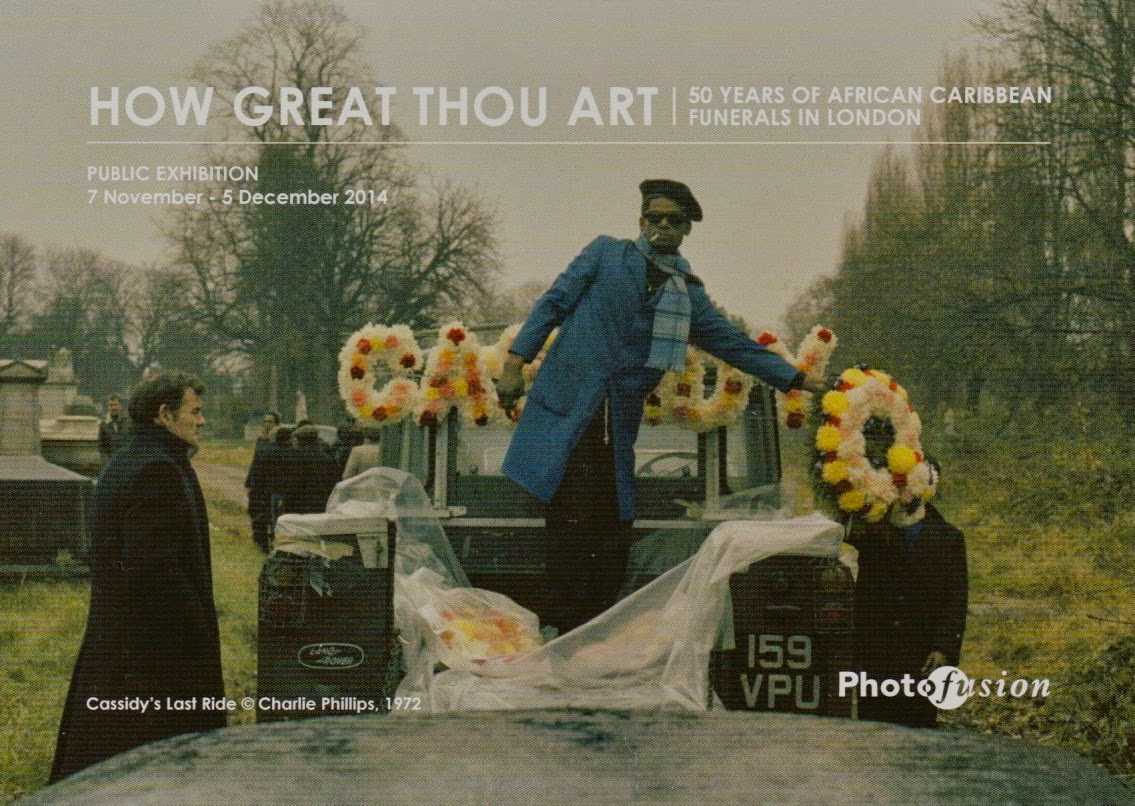
How Great Thou Art: last chance to see amazing Charlie Phillips exhibition at Photofusion


How Great Thou Art: 50 years of African Caribbean funerals in London, photographed by Charlie Phillips. An exhibition at  Photofusion, Brixton

Another evening in Brixton to treasure: at the Library, listening to the 70-year-old photographer, Charlie Phillips, talking about his latest exhibition, How Great Thou Art: 50 years of African Caribbean funerals in London.

This exhibition, held at the Photofusion Gallery just round the corner in Electric Lane, focuses on  the funeral traditions of West Indians living in London from the mid-1950s right up to now. Two rooms of  beautiful photos and videos vividly and beautifully capture these living and changing traditions, which mix up African, Caribbean, Christian and West African religious customs.
The powerful resonance  and documentary value of those images was reflected in the crowd of people who filled out the upstairs hall at Brixton Library on a wet Wednesday evening to hear the master talk.

The show is only on 'til this Friday, December 5th - so get along there quickly!

Apparently the photos had been languishing in boxes in Charlie Phillips' house, until the Photofusion people - co-curators of this exhibition, Lizzy King and Eddie Otchere – came across them and realised their importance and quality. "I had retired" Charlie complains. "I wanted to look after my allotment." But the next six months was spent going though over 5,000 negatives, hours of video and  creating both a book and an exhibition out of the results. As a result, his allotments suffered a bit: "Sorry, it's  not going to be such a good crop this year".

Charlie Phillips,  a well-known Ladbroke Grove character with a taste in sharp suits and hats, has that aura of celebrity - not the cheap PR-manufactured type, but the genuine, hard-earned article. This is  something he shares with many of the great characters in his photos, these people who've put up with so much over decades and still smile and laugh and know how to party, but also how to parry when ever necessary.

Tonight he's in a white jacket, buttoned precariously over a tight dark shirt and brilliant orange tie, his white hair and moustache and mischievous, warm eyes flashing behind glasses giving him the look of a seasoned comic actor.

 The exhibition title comes from the hymn that for Charlie sums up all the funerals he's been to - it is that hymn, so dirge-like in the dull voices of an English congregation, that takes on new life and vigour and meaning when sung by generations of Jamaicans beside an open grave in Kensal Green cemetery.

He tells us his story - how, from being an altar-boy he grew into a rebellious teenager, hanging out with the youth at the shabeens and blues parties in the Notting Hill area,  how he got hits first camera (a Kodak Retina)  from one of the black Amercian GIs who brought their precious blues and jazz and R & B discs to these parties, helping to spawn the London sound-system tradition as well.

Charlie was entirely self-taught, and he did his own processing and printing using equipment bought on the proceeds of a paper-round. He would wait until all the rest of the household were asleep before using the bathroom as his darkroom.

But it was when he went to the funeral of Kelso Cochrane, the 32-year-old  Antiguan murdered by Teddy boys in Golborne Road in 1959, that the power of these these events really struck him and he took his first funeral "snaps" (as he insists on calling all his photos).

Over the next four decades Charlie became a must-have guest at the funeral of the great and the good and the bad and the ordinary families of African  Caribbean descent all over London.

The photos - which you can see until at Photofusion's small gallery up on the first floor of the Brixton MArket buildings - capture the joy as well as the grief of these vents. Everyone speaking tonight - which included the professor Michael McMillan and writer Empressjai - emphasised how the West Indian funerals pick up on the West African belief that the spirit does not die, but has to move on - it's the job of everyone at these funeral to help that spirit on its way, hence "the good send off". Hence the opening of windows at the wake or the Nine Nights (the night before the burial when the spirit is said to leave the body), even in the depths of a London winter.

"It's not all peace and love", he adds. Quite often a old family tensions  burst out at such events, there are fights, scuffles even over the coffin .

The photos show not just the big burial processions, but also the wakes - and especially the  crucial "Nine Night", that last night of the wake before the burial, when music and dance and drink and what have you often take upper hand.

There's some great photos there of these events - as well as some more recent videos, including one showing another professor, Gus John, giving a traditional libation at the funeral of the All Saints Road activist, Frank Critchlow, who ran the famous Mangrove restaurant and bar back in the 60s and 70s.

That libation speech was so good, you have to see it, especially when the guy sits down to take a few sips of the libation gin bottle. It illustrates one of the  big themes of this evening's talk - the way old African traditions have survived any amount of battering by the white missionaries. Their lasting contribution, on the other hand, is the hymn.

We had an expert, Dr Michael McMillan, talking about these traditions - and he made the point very clear that these "Black death cultures" are actually about life - the spirit that lives on, to join all those other spirits, good and bad, which get on with their business all around us all the time - the duppies and the jumbles and the djinns and the sprites,  the spirits of place, of the earth and the sky.

Dr McMillan noted that most of the cemetery chapels in London were far too small for a proper West Indian funeral,  hence the massive wakes and receptions before and after that event. The burial itself is different - relatives  don't just drop a few crumbs of earth onto the coffin, they cover it  and fill completely. But only after the deceased's favourites things have been sprinkled over the grave - maybe some flowers, some jewellery or clothing, some records or some rum or perhaps some ganja.

He picked out the  great images of a funeral wreath in the shapes of a giant pack of Rizlas, and another as a Singer Sewing machine - "Our traditions have single handedly revived London's floristry business!" -  and also noted how these echoed the Ghanaian tradition of burying people in coffins which reflect their occupation. A boat-shaped casket for a fisherman, a Mercedes Benz for a taxi-driver.

What a great evening this was - but Charlie had some regrets, as becomes clear in the more recent photos in the exhibition. He doesn't really like the way the younger generations have allowed the funeral traditions to become a bit diluted - how they often choose Frank Sinatra's "My Way" or even the "Simply the Best" as the theme music. And how there's now so much emphasis on bling and colour-co-ordinated clothing.

But as others noted, including Empressjai and Dr McMillan - the tradition is alive and changing, new traditions are being created. The evening ended with a big discussion on this issue, the changing trsiditions of different generation, with many people chipping in with their thoughts and their memories.