About Me

"Use every man after his desert, and who should 'scape whipping?"
Showing posts with label SW8. Show all posts

Wednesday, 3 March 2021

Developers seek permission to demolish historic Tearooms building

Is this the end for the building that once housed the famous Tearooms des Artistes?

This entry comes quite soon after the last one, which I hope is not too much of shock to my readership. The reasons for this hasty posting will become clear.

Passing the still intact Tearooms building at 697 Wandsworth Road for the thousandth time since lockdown, I noticed something distinctly sinister.

Tied to a signpost there's a laminated notice, stained by rain and rust, but still legible.

It was one of those Lambeth Council Planning Permission notices which, when you see them, you instantly know another beloved local feature will soon disappear to make way for yet another apartment block. 

The notice looked like it had been there for years, so I thought maybe those developers had had second thoughts.

No such luck. I took photos and read it at home, with a sinking heart. You can read the whole thing on the Lambeth Planning Applications database - including around 100 supplementary documents, as well as 8 comments (all in favour). If you don't have the time, here are a few crucial points:

"20/01227/FUL | Redevelopment of the site, involving refurbishment and extension of the existing building at no: 693-695 and replacement of no : 697 with 3 new storey building to create nine residential units (Use Class C3) and the retention of the Public House at no 693-695 at lower and ground floor levels, together with the provision of cycle and refuse stores, landscaping and courtyards. | 693 - 697 Wandsworth Road London SW8 3JF

To make this clear, the application relates to two buildings. 693-695 Wandsworth Road is the big old pub building on the corner of Wandsworth Road and North Street. 

In its final incarnation it was a nightspot, the Artesian Well, a place which specialised in lavish faux-Bohemian decor and (according to a friend, who went once) a clientele including many public school kids from Surrey who were competing for their Duke of Edinburgh's Award in decadence. But maybe this is unfair. It was certainly extremely popular right up its demise in 2014, seen by many as the interesting face of Clapham nightlife, as opposed to the meat-market reputation of the High Street clubs.

The second building, at 697, was the Tearooms des Artistes, a place which was known and loved by many from the early 80s through to its demise in around 2006, when it became a posher and more pricey bar called Lost Society, which lasted another few years. Since 2014 it's been left in the hands of Lowe property guardians, and looks little changed.  Well, at least it is providing some genuinely affordable housing.

I shared some of my own happy memories of this place a few years ago, and was delighted when several others added comments and  links to more info on this lost gem of south London's alternative hospitality spots.  Some great memories emerge, including the fact that the late Marc Bolan's pink Bentley was parked outside for a long period in the 90s. 

I have to thank Baz for some amazing info, including some history he found on the Wayback Machine web archive, which suggests the building went back to the 16th century, when it was a barn on the Clapham Manor estate (any further info on this would be amazing). Baz also built a site for the Tearooms, and some of his extremely evocative photos - can still be seen on the Wayback Machine, here - including bits of the ancient structure. Surely evidence enough to slap of high-grade listing on this building!

One attempt to redevelop was kicked out by Lambeth council in 2015. The new application, from April 2020, still awaits a decision.

The architects for the developer and would-be demolishers, Marston Properties Limited, are dismissive of the old building. It's useful to quote their reasons at length:

"At ground floor the fascia and shop front has been completely replaced with modern fabric of no visual or architectural merit. In the process, a large steel beam was inserted to open up the shopfront which was used as ‘Regional Tyre Services Ltd’ in the 1960s-70s, which has subsequently resulted in structural damage to the façade.

"There are no features of merit internally.

"At most the building makes a neutral contribution to the character of the conservation area. It’s (sic) relationship within the streetscape is awkward; it lacks connection with the terraces to the west and the former Artesian Well to the east. 

3.28 Given the assessment that the building is at best a neutral contributor with many detracting elements (shop front etc.), Heritage Collective concludes that overall the high-quality replacement building as proposed would represent an enhancement of the Conservation Area. 

Even if the Council remains unconvinced in this regard and retains the stance that the building is a positive contributor, its loss as proposed is acknowledged by the Officers to fall within the less than substantial harm category. 

3.29 In such cases a weighing exercise is required setting on the one hand the less than substantial harm and on the other the public benefits that flow from this scheme. In this case the benefits include the redevelopment of a poor quality redundant site, removal and replacement of harmful features, poor quality windows, railings etc., securing a beneficial and long term future for the site, the re-opening of a community facility (the pub), the provision of nine new high quality homes and the delivery of a highly efficient, sustainable new building..."

And so on, and on, and on. Thus do developers nail all opposition to the floor, thrashing them with fine phrases and vacuous arguments.

Not that the quoted "Heritage Collective" is a consultancy, not to be confused with an official heritage body.

Quite what a "neutral contributor" to the conservation area means is unclear to this writer at least. To us, and anyone who once visited the Tearooms at any point through its various phases, from hippyish vegetarian restaurant/wine bar/club to the après clubbing chill down nest of Sunday best in the 90s and 2000s, the sight of this unique place is a blessed reminder of a more interesting Clapham, before the anodyne clumps of tasteful luxury apartments started popping up like weeds.

The application was still active in January this year, when the architects submitted some modifications to their designs. All of these are available to view on the planning archive. According to the website the application expires on April 15. 

It's too late to submit objections, but I do wonder why the wealth of history associated with these buildings seems to be entirely ignored in this application. I wonder if any archaeologists have ever been there to look for some Tudor era oyster shells....
 

Saturday, 12 November 2016

Cultural chat in the Library as Clapham remembers Smiley

Smiley and Me was another of Lambeth's excellent programme of Black History Month events - and this time it was dealing with quite recent history, focusing on a time  (the late 70s and early 80s) when this area was on the frontline of a new style of home-grown reggae music, London's answer to the Jamaican dancehall toasters and DJs.

Here's the book - a rip-roaring read if ever there
was one, the true story of a pair of likely lads making
it big in the London reggae music scene of the
1980s. That cover pic, showing Smiley (left) and Asher,
looks like a phot but in fact is an astonishing painting
by their friend and former Saxon Sound System
fellow artist, Peter King.
The new generation of young DJs and MCs emerged from the big council estates running from Battersea to Lewisham, via Clapham, Stockwell, Brixton and Peckham.

They attached themselves to the big established sound systems of the time - but they'd also moved on from the Rasta-influenced roots reggae of their elders. Their lyrics were sharper, still socially conscious, more directly relevant to life on the streets and in the estates of inner-city London. These lyricists were often witty, often challenging, and nearly always in competition with rival sound-systems.

A handful of these homegrown proto-rappers broke through to become mainstream pop stars. Among them were Lewisham's Maxi Priest,  Papa Levi and Tippa Irie from Brixton  – and Smiley Culture and his constant friend, co-conspirator, and sparring partner Asher Senator, both from the Stockwell-Clapham area.

One of the top lyricists of that era's musical innovation, Asher Senator was recently at the Clapham Library to talk (and rap) about his new book, which tells the story of his enduring friendship and musical partnership with Smiley.

The book, Smiley and Me, tells Asher's version of the fascinating, exciting, hilarious and finally tragic story of the Stockwell school kid, David Emmanuel, who became Smiley Culture, tasted international fame and stardom with his two hit records, Cockney Translation and Police Officer, but then ran out of luck in a big and painful way. It's a handsome, nearly 400-page, well illustrated book published by Vitow (Voice in the Open Wilderness) Media - which is, aptly, also based on the Clapham-Stockwell borders.

 I say "talk" - this was Asher Senator, the man famous for fast chatting in a continuous rhyming style. As you might expect, he'd brought a big 2016 version of a ghetto blaster with him, and told at least half the story on his mic, in exactly the style of those early-80s tracks he and Smiley used to light up London's dancehall nights with.

The book is truly thrilling memoir, the pace is quick and the stories come thick and fast. It's written from the point of view of a gifted lyricist and performer who was a sort of Boswell to Smiley's Dr Johnson, or maybe Dr Watson to some skanking Sherlock. Asher, although a star MC in his own right, was always slightly in the shadows cast by his more fame-and-fortune-seeking friend.

As the blurb says, it pulls no punches, describing in some fairly grisly detail the downward spiral that seemed to set in after Smiley got mixed up with some heavy-duty gangsters - initially, it seemed, to frighten off local rivals who resented his success. But that decline went on right up to Smiley's mysterious death in March 2011, during a police investigation at his final home - a house in Warlingham, which is a semi-rural village on the far southern edge of south London. A single stab wound to the heart, which a jury later decided was self-inflicted: what a sad, hideous end for such a talented man.

But this night, Asher concentrated more on the upward years, giving  great readings from some of the earlier chapters of his book. There's a lot of poetry in his writing. The chapter on their first sound system, Buchanan, based at "Lansdowne in Stockwell, Just behind the station" - begins with a eulogy for "Miss Coarsey".

No, she was not some inspirational school teacher. "Miss Coarsey" was the name they gave to their battered old van, which was an essential bit of equipment for any London sound system at the time, used to transport the huge speaker cabinets and amps around the clubs and party venues, along with the crew of DJs, MCs, rappers, techies and hangers-on. Despite needing push starting, Miss Coarsey did not let them down until a vengeful ex-girlfriend set her on fire.

Get a taste of Asher and Smiley on Buchanon here, dating right back to the beginning of their musical careers.

These passages, this music,  reminds me strongly of Franco Rosso's 1980 film, Babylon, covering much of the same territory, just a little earlier.  Only 35 years ago, yet it seems like a different century....well of course it was a different century, a different millennium, a totally different world.

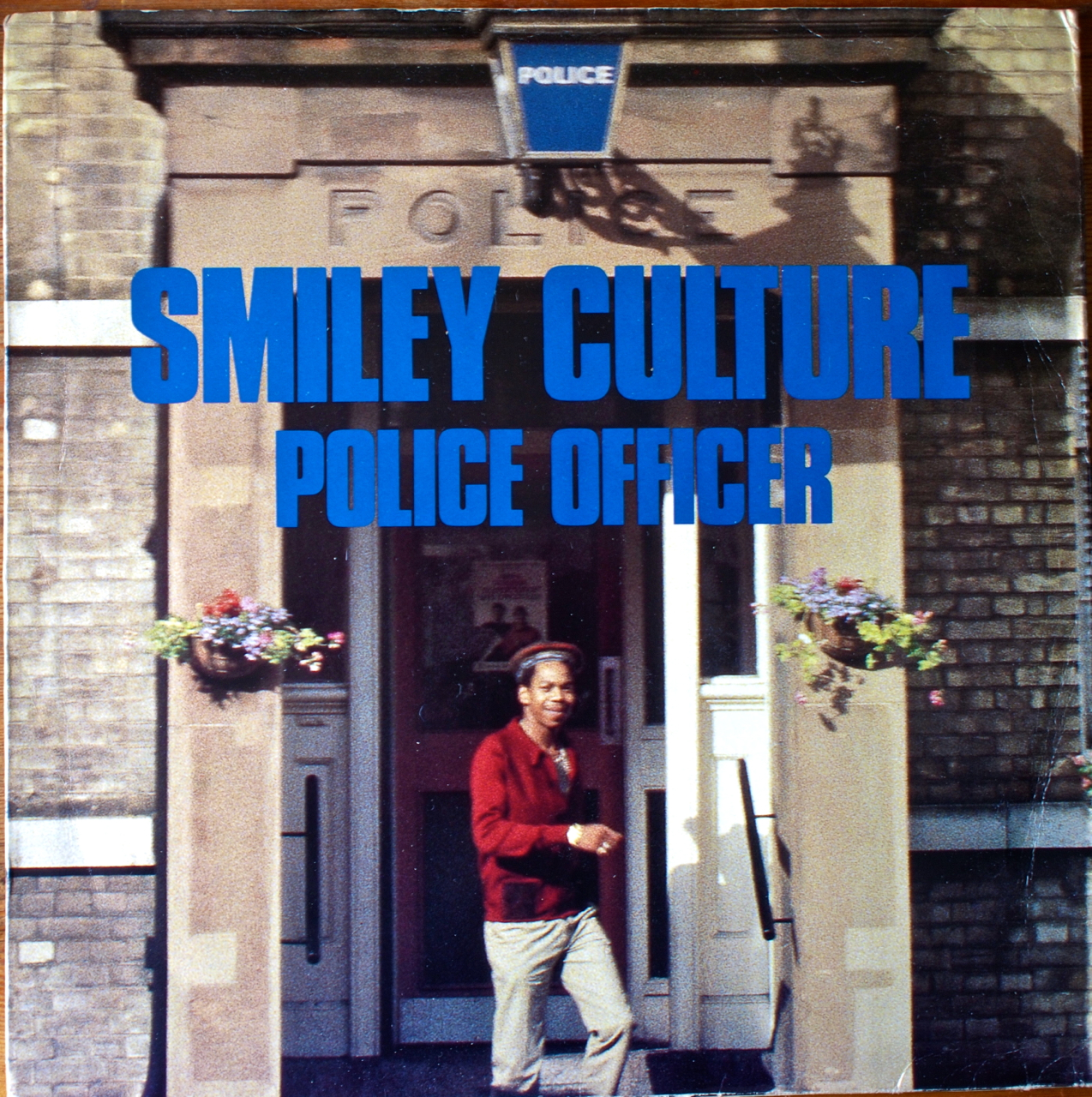
Smiley Culture's 'Police Officer' 12inch 45rpm single, Fashion Records, cover, outside Brixton(?) police station, 1984
Smiley Culture's 'Police Officer', the top-selling 12inch 45rpm single of that
year, released on Battersea-based Fashion Records. Looks like
 the cover was shot outside Brixton(?) police station, 1984
Their breakthrough night at the Four Aces Club in Dalston is a beautiful moment: the first time they ever get paid (a whole fiver for both of them!) for their MC-ing. Note that at this time it is always "they", with Asher and Smiley working like a team - which continued even after Smiley performed on Top of The Pops and became a big star.

The early chapters paint a vivid picture of South London street life in those bleak late 70s winters, through to the 1981 and 85 Brixton riots and beyond.

It's a strange read for anyone like me who lived in the same area at the same time, actually a few streets away from some of their favoured locales.

How often I lay awake a night, hearing the police sirens and helicopters, and wondering what the youth were up to now. As a sort of low-rent yuppie, weaned on a lot of jazz and blues, a little punk and then tons of roots reggae, I was deeply attracted to that scene, even though I might as well have been a million miles away.

The nearest I  got was a few nervy trips down Coldharbour Lane, a few evenings in the Atlantic pub, where with a few other white-boy thrill-seekers and dub-addicts, I payed my local taxes and got to see the young Courtney Pine coming on like a reborn Coltrane.

Meanwhile Asher and Smiley were signed up to Fashion Records, which operated out of the same building (and had the same management) as Dub Vendor, the legendary record shop at the Clapham Junction end of Lavender Hill. As this blog noted previously, Dub Vendor eventually went out of business after it was affected by the fire started during the riots of August 2011.

Nice how he has printed the lyrics on the back cover of this 12 in single....
There is Smiley, and there are the lyrics to Police Officer, helpfully
printed on the back of the cover of the 1984 Fashion Records 12in
single - which became Smiley's biggest -selling hit.
There are so many great and hilarious stories in this book, you have to buy it and  read it for yourself. It has that picaresque drive of a ghetto-based Don Quixote, with Asher as his Sancho Panza. Or maybe the Laurel to his Hardy, or the Butch Cassidy to his Sundance Kid. All those elements are there.

One story I can't resist mentioning happens while they're on tour in Jamaica, taking their London coals back to Kingston's reggae Newcastle.

First night in a hotel, they get a visitor who offers to show them round the sights and nightspots. It's none other than the best of all the new wave of Kingston based dancehall reggae singers and MCs, Barrington Levy - the guy whose carnival anthem, Under Mi Sensi, is a Kingston-style cousin of Police Officer, what with its chat and its dialogue. But which track came first?

Barrington, however, never get the kudos that Smiley has received in the UK for more or less defining a new London dialect. Teachers and academics and top children's writers have all quoted the lyrics of Cockney Translation as being the record which took this form of speech out of the ghetto and into youth culture nationwide. Children's author, poet and teacher Michael Rosen even included Cockney Translation as one of his eight most precious bits of music for the BBC Radio 4 Desert Island Discs programme.

There's immortality for you!

Asher, always the more level headed one, despite having plenty of his own troubles, was the survivor. He's gone on to launch a charity, Code 7 which helps kids in the estates get into the same sort of music business he and Smiley excelled at. Better  to clash with sounds than with guns and knives.

On the night he was a total charmer, and gave his all to the performance of many lyrics, even though it was a ridiculously small but very responsive audience. Also at the event was his publisher, Rickardo Quintyne-Wright of Vitow Media, who is also involved in film production. Read this book and you will soon be thinking, when are they going to make a big-budget movie of this? It has all the elements and more. Let's hope it happens.

Details and where to buy your copy:

Smiley and Me, author Asher Senator, edied by John Masouri, illustrated by Peter King,   published by Voice in the Open Wilderness (ViTow) Publishing; 1st edition (15 Dec. 2015).ISBN-10: 0993511007

Monday, 23 November 2015

Breathless in Nine Elms, more shocked than awed

One Nine Elms development at Nine Elms, Vauxhall, London - a 56 storey tower will be "breath-taking"
Have to agree, it is truly breath-taking. I want my breath back, please!
I am guilty of under-selling the creative skills of  the One Nine Elms developers'  marketing people.

Couple of weeks back, posted a joke item on the slogans on the big fences surrounding the site.

Item showed the words: ONE NINE ELMS: JAW DROPPING

So yesterday I walked past the site again and realised they'd come up with a whole family of two-word adjectival phrases, for example: ONE NINE ELMS: BREATH TAKING

and

ONE NINE ELMS: AWE INSPIRING

Breath-taking? Yes, they're right. The massive amount of pollution caused by the tens of thousands of truck-miles the must've been clocked up as bits of these monster buildings are brought to the site is quite enough to take our breath away, thanks.

All through the summer the air was full of dust and grit. It was truly breath-taking, lung-irritating stuff.

As for awe-inspiring, well the architect's impressions of the finished development rather suggest not. Shocking, maybe, but not much awe.

It looks like a great deal more of  the same old staggered filing-cabinet style apartment towers, rising up to 56 storeys - a bit higher  than the existing St George's Wharf tower. I mean, how could that inspire "awe"? It would need to reach up at least twice that height, up into the clouds, to make anyone used to craning their poor old necks towards the Shard to feel anything other than bored.

I like tall buildings, I just hate bland architecture and towers full of bland "luxury" flats that are designed specifically to inoffensive to any potential buyers, who nearly always are not going to live there but sell them on.

One Nine Elms says it will be offering "Luxurious riverside living". There will also be a "luxury 5-star hotel" to service the apartments (whatever that means). The promotional video is a slick bit of computer animation with the statutory tall blonde lady gliding around an apartment admiring the views…which include the not-too-distant prospect of the Canary Wharf towers, where maybe she works.

Anyway, as those Nine Elms people are so keen on phrases to describe their work, here are a couple more possibles to write in big script up on the fence: daylight-thieving, view-ruining, wind-tunnel-effect-creating, yawn-inducing, stomach-churning…oh, there's plenty more.

But don't get the impression Microgroove33 just loves to snipe and groan: where there's good news, we are ready to blast it out, full volume. And so today it's great to report they have provided a cycle-path of sorts on the otherwise closed northbound side of Wandsworth Road. It's a bit of an obstacle course,  with plenty of cheery blokes in orange waving you through. But it beats trying to dodge the oncoming trucks on the other side.

Saturday, 7 November 2015

Lambeth Libraries demo: true grassroots protest flourishes in the rain


Speakers at Brixton Library at 11am promised us there'd be sunshine when we got to the Tate South Lambeth Library in that bit of the borough known as Little Portugual.

The 600-strong march stretched half-way down Stockwell
Road,  en route for South Lambeth
Their words fired people up wonderfully, making the mile or two's march seem like nothing.  The guy who spoke about the importance of libraries for disabled people was especially good, as was the Green Party councillor for Streatham St Leonards, Scott Ainslie, who said he wouldn't've been here today but for the Edinburgh public libraries that opened his eyes to education and history and politics, back in his youth.

So many of us could have told similar stories. I was bowled over by the warmth of this crowd, and have to thank the lovely team from Upper Norwood Library for the loan of their orange "I love libraries" umbrella. (I will get it back to you soon, promise!)

 They also had a banner, "A library saved my life" which I would happily have carried, but it was definitely a two-person affair.

Among plenty of imaginative banners and placards, the prize must go to the polystyrene tombstone proclaiming, RIP Carnegie Library, 1906 - 2016". It was even entwined with ivy.

This guy led some great chants, wish I could remember all
the words...
Great also that library staff from Barnet (where a strike is planned) and Wandsworth joined the demo.

The organisers reckoned about 600 people marched, and that seems a fair estimate. The police are saying about 100. Judging from photos, it was certainly more than that.

Whatever the true figure, it was more than enough to make an impact, stretching half-way down Stockwell Road. There was plenty of encouragement from the pavements and from passing cars and vans. Even a cabbie tooted his approval.

The crowd was cheerful and the chanting - while not the angriest I've heard - occasionally had some bite. I mean, we're library lovers, much more used to keeping quiet…instead of yelling in unison (and with Unsion at times), the following:

"No ifs,  no buts, no more Lambeth Library Cuts!"

"What do we want?"

"Libraries!"

"When do we want them?"

"Forever!"

And many other much better ones whose words I have already lost….

In fact it was raining even harder in SW8 than it had been in SW2. But it didn't matter a jot. This was a real grassroots protest and as everyone knows, grass thrives on rain.

Almost the end of the road: after a warm welcome from Tate South Lambeth Library staff,  three young marchers went inside to hand a petition over to councillors, who were holding their surgeries.

So, the Lambeth councillors inside failed to come out into the rain to meet us (see more on this in the comments section of Brixton Buzz story).  Sad but not surprising. The time will come, maybe next Tuesday...

The next step: on Tuesday 10 November, there's a public meeting 6.30 pm at the Lilian Bayliss School, 323 Kennington Lane. It's a chance to question elected representatives on the library policy, so should not be missed!

Thursday, 19 March 2015

A little glimpse of paradise on the Wandsworth Road

As so often seems to happen, I switch on the radio and hear, within seconds, someone talking about something that has been cooking away at the back of my mind for years.

As so often seems to happen, I switch on the radio and hear, within seconds, someone talking about something that has been cooking away at the back of my mind for years. Usually it's on BBC Radio London, and even more usually it's on the Robert Elms SHow. As indeed was the case today.

Today, it was hearing someone from the National Trust  talking about an amazing house interior, created entirely by one man in his spare time from a busy job in the Civil Service. I immediately thought they had to be discussing 575 Wandsworth Road - a house I have walked past thousands of times - and which is now owned by the National Trust and is also about to open to the public after years of restoration.

This NT person mentioned a free lecture on the topic to be held later the same day in Twickenham Public Library. Oddly enough, for someone spending more than half his life in SW LOndon, I'd never been to Twickenham town centre before (well I have been through it, but never to it). That day, I was there within  an hour, thanks to SW Trains.

It was an excellent lecture by the NT's conservationists, who helped to bring the house back to life with her discussion of the owner and creator of this place, Khadambi Asalache. Mr Asalache came to London in the 1960s as a student. His multiple talents - poet, novelist, mathematician, philosopher - flowered in the fertile climate of that age, even while he was holding down a full-time day job in the Treasury.

She added that he first spotted the house when travelling to work on the 77 bus - a route that we all know only too well, and still love, even though it's now the 87.

Next day, I more or less run down the road to scope the place out. There's nothing outside to give the slightest clue of the treasures within, nor even a hint the tit's a National Trust property. The place is so fragile that the trust is having to limit visitors, and advance booking is essential. But what a place it is,  to enter the house is to enter one man's dream, a secret dream world of East African artistry, heavily influenced by both indigenous art from Kenya but also the Islamic art of North Africa and Spain, the art of Granada.

He needed a place nearer the office. He bought the house in 1983, and began decorating it to his taste - but persistent damp in the cellar led him to line the walls with fretwork panels which now characterise the whole place. It's a fretwork Alhambra, built in a tiny Victorian terrace on an unglamorous stretch of an unglamorous south London trunk route, and it is magical.

Visit!

Great to hear the NT has employed a musician in residence this year - check out the programme of events on the NT's 575 Wandsworth Road website.


Sunday, 28 July 2013

Nine Elms disease

Each morning I look across London from the balcony at the back of my flat and each morning I see more cranes, and the first bones of skeletal skyscrapers,  sprouting out of the mudflats between me and the river Thames.

 I live at the top of an old house which overlooks, to the north and east,  the former swamps of Battersea and Vauxhall. Until recently there was a pretty clear view across to Westminster and beyond. Now,  where once I saw, in the distance, the towers of Westminster Palace, the Abbey, the dome of St Pauls, and on to the City, I now see the first growth of this latest and so-called  "biggest urban regeneration scheme in Europe".

It starts at Battersea Power Station (which is now brightly floodlit every evening) and it stretches all the way to the monstrosities of St George's Wharf at Vauxhall Bridge.

To judge from a couple of half-completed towers by the river, it's just going to be be much more of the same awful stuff we are getting all along the south bank of the river, from Rotherhithe down to Putney.
Nine Elms, in south west London, the site of one of the biggest urban redevelopment projects in Europe.Stupid, show-off residential towers, with what they say will be a new leisure and business  zone around the old Power Station and a few embassies. For some odd reason the US Govt has decided to relocated its embassy here, from Grosvenor Square.

Given the bleak plastic blandness of the architects' plans so far revealed, I guess the Americans will feel quite art home here - it looks like just another US city with its flashy towers and carefully accounted for green spaces and shopping areas. All planned down to the last square centimetre, no doubt. Becuase each one of those is worth a lot of money.

Looking at the future for this last bit of industrial wasteland within zones1-2, it looks exactly like the
future for every other little bit of free space in London - sell it off as a new quarter, a new residential zone, affordable housing I think so! I should fucking think so, affordable.

Sitting by the concrete works down Silverthorne Road, watching those massive mixer trucks come in, re-fill with the liquid stuff, zoom off round those sharp bends, back onto Queenstown Road, back to the sites of SW8, or where ever else - this old old process, digging up the earth, making new buildings out of the earth. Carrying the earth around, bit by bit. Ant-wise.

Well I'm sure it will all be lovely for those who can afford these affordable flats under the (don't worry, they will be made of lightweight plastics by then) towering chimneys of Battersea.

No danger of those collapsing on you as you go for your 6am jog along the river before getting the new spur of the northern line to your city job.

Bah! Humbug.