About Me

"Use every man after his desert, and who should 'scape whipping?"
Showing posts with label Will Self. Show all posts

Sunday, 22 March 2026

No, I don't have a "smart speaker" at home. And I never will, thanks very much.

What is the four-word sequence most often repeated across all BBC radio stations?

I don't have proof for this, but I'd say the phrase that has struck my eardrums more than any other over the past two years is, "ask your smart speaker..."

This message is repeated so regularly, and with such urgency, across so many stations (I've even heard versions of it on Radio 3 recently) that I can't help feeling someone at the BBC is on extremely good terms with some consumer electronics suppliers.

Why else would they be urging us to use these mysterious products? Surely if we're already listening to BBC local radio, Radio 4, or whatever, you don't need a "smart" anything to find it again? My sad experiences with other "smart" technology (ie, phones) suggests the clever speaker would almost certainly serve up the wrong channel and refuse to find what I really wanted.

I do remember, well over a decade ago, being invited round to drinks with some former neighbours who wanted to show off their latest gadget - a sound system with "Alexa", an early version of this smart speaker craze. The entertainment we would have asking Alexa to find some obscure piece of music, then crying with laughter at the unlikely alternatives it played for us, lasted for roughly the first bottle of wine. And that was it. 

I could not then imagine that, all these years later, I would be driven mad being urged, every half hour or so,  to ask one of these devices to find one of three stations I listen to most often. 

I might of course ask it to find me the most recent edition of Point of View featuring a favourite such as Will Self or A L Kennedy. Would it tell me the BBC scrapped this gem of a programme over a year ago? Never has ten minutes of radio airtime been more intelligently used than in many of those broadcasts. I suppose the speaker would just send me to the well-stocked BBC Sounds archive. But it ain't the same....

Oh well, just another topic for endless grouchiness in this and other outlets. Further miserabilist rants are in the pipeline.

Meanwhile, no. I don't have a smart speaker, and I am determined never to have one.

This post was written in spring 2023, when these blatant plugs for "smart speakers" were already annoying interruptions to listening on some BBC radio stations. One of the main culprits was BBC Radio London, but it's clear the same promos are playing out on local radio all round the UK. 

No doubt the BBC feels it has to promote itself this way because so many more people are using these voice-activated audio devices. Alongside this, more BBC radio content is being re-packaged as "podcasts" for BBC Sounds online.

Has anyone noticed how some presenters are now poking gentle fun at smart speakers?

That's just one of many things I love about the crazy BBC.


Thursday, 29 June 2017

"More bad news from Battersea" - Oh, really? what a massive surprise

Is that some affordable housing going up just to the south of the rebuilt Battersea Power Station? Probably not. The developers have just been given the OK by Wandsworth Council to cut the numbers of affordable homes in the development from 636 to 389. That's a 250 home shortfall on the promised total. Meanwhile some of the poorest people in the borough continue to suffer the disruption, the pollution and the congested roads caused by this absurd development, aimed at an international super-rich market which has already moved on. 

It has been a terrible few weeks for London, but a fascinating time to observe how the London Evening Standard, under the new editor George Osborne, has been covering the successive disasters and tragedies.

No opportunity has been missed to ridicule the prime ministerial qualities of Theresa May. That is entirely as expected. Slightly more surprising is its more cogently critical approach to residential property developers, and this recent headline - "More bad news from Battersea"  - is a case in point.

I've written lots - maybe too much - about the damage this unnecessary and vulgar development is causing, how it is blighting the lives of thousands of local residents from Vauxhall right through to Battersea. I used to prefix these entries with "Nine Elms disease" - but not any more, as that suggests a natural disaster, unavoidable. In fact it's a very human disaster, caused by human greed, and so highly avoidable.

The long-suspected impact on air quality of so much construction work in one area is given added credence by research published last month (see: South Bank construction boom sends London air pollution soaring, London Evening Standard, May 8 2017). There's also the noise, the congestion caused by endless roadworks and closures and the convoys of ready-mix trucks doing the circuits from Silverthorne Road to Vauxhall and back again. The chewed-up streets, the spilling of pebbles so dangerous to the eyes of cyclists, the way these bulky vehicles dominate the road space, just as the new buildings colonise the sky above us.

Now parts of the development are nearing completion, we get an influx of estate agents with their stupid pennants fluttering outside their "marketing suites". Of course they had some bad news too: in March 2016, well before the EU referendum, demand for the sky-high-priced flats (aka safety deposit boxes in the sky) fell back and prices slumped by 20 per cent and more. Demand is said to have recovered a bit since then due to the weaker pound, but it's still far from the 2015 level.

And this week there's further damning news about this place, again reported in the Standard: the developers now want to cut the number of "affordable" flats from 636 to 389, just 9 per cent of the total. This is because their profit expectations have fallen and they need to prop them up - presumably to keep shareholders happy.

They say the other 250 affordable properties could still be built later on - depending on the future state of the market.

Meanwhile they are still using the fact they have rescued a crumbling national icon - Battersea Power Station - as justification for their greed. Well, they might have rebuilt the chimneys very nicely, but unfortunately the whole building is now walled in by such massive banks of apartment blocks that its impact on the surrounding urban environment is totally lost.

The building of high-rise residential towers has gained a painful new topicality since the Grenfell Tower  fire. Last week the people building and buying apartments in the new "luxury" developments were the target of an excoriating attack by novelist Will Self, on BBC Radio 4's A Point of View.

Self, who lives in the Stockwell area, was audibly trembling with rage throughout his 10-minute talk. But he never let the anger get the better of the precision of his speech. Architecture, he said, was unique among the arts in that it had a direct social impact - and thus a moral dimension.

He saved some of his most deliciously withering language for the Nine Elms development: "The very sight of these infantile-looking structures being doodled into being now turns my stomach" he said.

The majority of  these new residential towers, he said, were "as ugly as they are bad, enshrining as they do not the civic virtue of providing housing for people on low incomes, but the corporate vice of profit maximisation".

Well said, Will Self!


Saturday, 5 March 2016

Save Lambeth Libraries march defies lousy weather and crazy policies: ALL TEN libraries must be defended!

Can you hear us, Lambeth Council? Can you read? Save Lambeth Libraries marchers outside Tate South Lambeth Library, Saturday March 5 2016.

"No ifs!  No buts!  No Lambeth Library Cuts!"

It was the same chant, on a march with many of the same people, but also plenty of new people, on the same route - from the Central Brixton Tate Library in Windrush Square, to the Tate South Lambeth Library in Vauxhall - for the same cause - as the first Save Lambeth Libraries march back in November.

The weather was even worse today - just as wet and even colder than on that autumn day - but the emotional climate was different. We're less than a month away from the proposed closure of two of the
Best banner of the day? Says it all, really.
borough's best-loved libraries, and despite an 11th hour U-turn on the plans for Tate South Lambeth and Upper Norwood Libraries, the "bookish gym" madness is still very much what Lambeth intends to push through at Herne Hill's Carnegie and the Minet Library on the Brixton-Camberwell border.

We've had four months of protests and action in between, in an imaginative and well orchestrated campaign, but a campaign which for a lot of the time seemed to be meeting a solid grey wall of indifference at the level of Lambeth council.

At some of the meetings, you actually got the feeling they were sniggering at us for our audacity in using time-honoured democratic protest techniques in response to their newish-Labourish cost-cutting Culture 2020 policy and its follow-up, the proposal to turn three branch libraries into fitness or "Healthy Living" centres with a few books, PCs and wi-fi but no trained library staff.

That is, until yesterday, when (somewhat coincidentally? oh surely not!) a partial climbdown, a semi-U-turn was allowed to slip out. As reported so swiftly on the always excellent Brixton Buzz site, Councillor Jane Edbrooke has decided to spare Tate South Lambeth library from the immediate indignity of having its books and staff replaced by gym equipment.

However, the plan to do just this at the wonderful Carnegie and Minet libraries remains - which was why today's protest was so moving. It was all about solidarity, and the overwhelming message was that Lambeth has 10 libraries - that's not enough perhaps, but we have 10 and we're not going to lose even one of those – particularly not to what has now been described as one of the most crackpot schemes in British local government this century.

Yes, a very good point, libraries do need trained staff. Under Lambeth's
plan, there'd be no full-time professional  librarians at the proposed
'bookish-gyms' to be run by Greenwich Leisure Ltd at the Minet and
Carnegie Libraries
It was great that people from the semi-reprieved Tate South Lambeth and Upper Norwood libraries were there on the march to make clear that they were still part of the campaign.

It was great that, again, there were people from Lewisham, Barnet and Wandsworth libraries voicing their support, and calling for a London-wide or nation-wide save libraries campaign to grow out this grassroots movement.

It was good to see local author Will Self (and his dog) telling us not to get too hung up on the nostalgic joy of books , but to protect the spaces that libraries occupy and the access to information that they offer. He made the obvious link between library closures and gentrification, too - though I think the people who will be snapping up those £1m + flats in the Oval Quarter, Brixton, and Vauxhall will be going to much snazzier gyms than those likely to be offered by GLL.

The real point of the whole events was best made by two people - Laura Swaffield, who has been the lynchpin of this whole campaign since it started (well, in truth that's years ago, as Lambeth has often tried to chip away th eLibrary service when budgets are not balancing, it's easy meat).

She made the point, one that cannot be repeated often enough, that these libraries are - morally speaking at least - not the council's to muck around with. They were all given to the community, not the council, by their various benefactors (yes, see how an earlier generation of corporate monsters gained immortality, the Tates and Carnegies).

That's the truth behind the slogan: "Don't steal our libraries!"

Of course Lambeth's lawyers have had no trouble in dealing with that little inconvenience.

The other great speaker was the chair of the Friends of the Carnegie Library in Herne Hill, Jeffery Doorn. He spoke with passion but also  great precision about what this library does for its community.

The notion of this incredibly popular place (busiest children's library in the borough) being turned into a sort of third-rate gym is shocking. It seems amazing that the very people whose well-paid job it is to protect and improve local amenities are blind to this. The whole building screams, Library! Books! Reading! Scholarship! Learning! Stories! Imagination! Soul!

(To get a really good taste of the place, please check out the short video Save Carnegie Library by Kaatje Jones on YouTube).

It really does look like people are going to have to take direct action to stop this place being ransacked or desecrated on April 1.

That was again the shocking realisation - that the ultimate nonsense everyone has been so energetically trying to avoid - not just by protesting but by offering sensible, worked-though alternatives - is now very unlikely to be stopped. It's not actually the money any more. It's more that too many political careers are at stake.

It was a foul day but a beautiful event, and thanks again to all the brilliant people of the Save Lambeth Libraries and Defend the Ten campaign.


Local author Will Self explains why he opposes plans to turn two of Lambeth's public libraries into gyms
with a few books on the side.

Save Lambeth Libraries march, against threat from Lambeth Council to turn two libraries into gyms,  in Brixton, Saturday 5 March 2016

Don't steal our libraries! Please….

 against threat from Lambeth Council to turn two libraries into gyms,  in Brixton, Saturday 5 March 2016


 against threat from Lambeth Council to turn two libraries into gyms,  in Brixton, Saturday 5 March 2016


Monday, 7 September 2015

Note to self: try not to get distracted by Christopher Wren next time

The Old Royal Naval College, Greenwich - the western wing of Sir Christopher Wren and Nicholas Hawksmoor's
masterpiece. A rather non-suburban setting for a festival of London's outer suburbs.
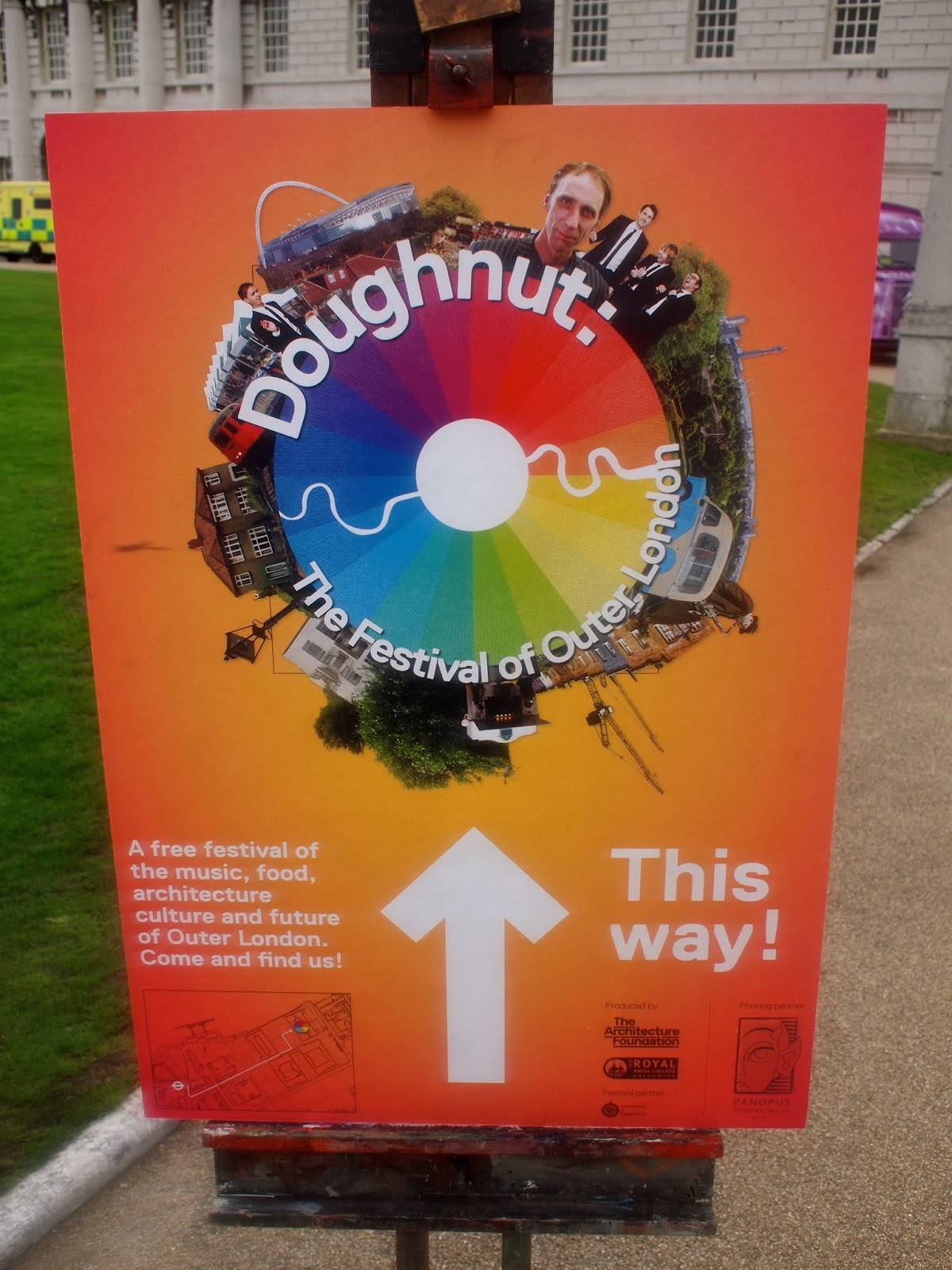
Like I said, one of the highlights of Saturday's Doughnut:The festival of Outer London was to have been Will Self "in conversation with" Hanif Kureshi.

The Buddha of south London suburbia meets the Bard of Stockwell - it was surely an unmissable event. And I went and missed it.

Actually got to Greenwich just too late to catch the earlier debate involving Patrick Wright, which should also have been a corker. But Self & Kureshi weren't on til 5pm so I  thought I'd come back later and see how things were going.

I decided to kill time by revisiting the Old Royal Naval College itself…..well, when I say revisiting I mean, I have always just walked past it on the way  to the Maritime Museum or the park and observatory up the hill.

This time, in the pearlescent light of a leaden August Saturday, Wren's stonework was impossibly, voluptuously, ravishing. I walked around all of the arches and colonnades, each time seeing another vista, and other set of extraordinary perspectives, of framings of unlikely things, such as Canary Wharf or a pulled-pork vendor's van.

This reminds me -- who can tell me, as a vegetarian, exactly what is this pulled pork? It sounds horribly like a teenage-boy euphemism for masturbation.

But it can't be - everywhere you go now they want you to buy some pulled meat product. Pulled by whom, from where to where? And for how long? And why would I want to eat it?

Anyway….Wren detained me. I found myself in the Painted Hall, basically a huge dining room with a painted ceiling about the size of tennis court. Apparently the artist, Sir James Thornhill,  was paid £3 a square yard for this, but only £1 a square yard for the easier bits on the walls. As the totally pained area is about 40,000 sq feet, or 4444 square yards, he ended up  earning more per year over 19 years than I do now, four hundred years and several thousand points of inflation later.

Which is why, when I got back to the Doughnut Festival and realised….that the talks were not…in fact…free…and I was already glutted with all that Wren stuff, and had tried to work out which colour pin I should stick in a map to explain exactly where on Ranmore Common I would choose to bivouac down for a while if I was on the run from H G Wells……

Well, you know, shameful as it is is to admit, I was tired, I had glimpsed the inviting domes of the foot tunnel, that was an experience I needed and it needed it then and there and before you could say claustrophobia I was in Island Gardens, and heading for the DLR.

The DLR you know is the best and cheapest funfair or them park big dipper ride in all th world.
Take the front seats (so long as the "Transit Agent "isn't around to dislodge you) and tighten your seat belts for a white-knuckle ride through 2000 years of economic, social, political, medical, and architectural history, with a lovely plunge into a ghostly tunnel right at the end.

So I checked the tweets when I got back and realised I had indeed missed a corker of a conversation. I feel stupid and guilty and this feeble posting is my confessional. I'm especially sad I missed the bit where Self characterised the outer suburbs as "the spatialisation of patriarchy".

This phrase is both deliciously Selfian - in that it is both wonderfully pretentious but also true. I immediately am cast back…to the age of what, four or five? It's probably a false memory, but it involves walking with my sister or my friends or both down to the nearest railway station each evening at about 6.30


pm and standing at the bottom of the steps leading up to the platforms, waiting for our fathers to come back from their days in the City. When they appeared, one by one, there would be cries of "Daddy! daddy!"

Oh yes. Except of course on those days when your daddy was working late or taking one of his girlfriends to the opera or whatever.

Friday, 4 September 2015

Note to Self: yeah, Croydon is extremely strange, quite sexy, and oddly beautiful

Croydon, south London's Alphaville, former city of the future, reflected in the windows of Croydon Art and Technology College in about 1970. And now it's about to happen all over again….
Lovely to read that the Stockwell bard, Will Self, has discovered the suburbs of my youth.

According to an article in  the Evening Standard, Mr Self is encouraging Londoners to re-connect with the outer suburbs, in his latest role as a patron of something called Doughnut: The Outer London Festival, which takes place at the Old Royal Naval College in Greenwich on Saturday 5 September.

Of course Greenwich is almost as far from central London as Croydon, and yet standing on the hill there surveying the grandeur of its naval past and the  flashy excesses of  Canary Wharf etc across the water, you feel you are right in one of the ventricles of London's dirty old heart.

It's great to hear that Mr Self has discovered the pleasures of  Croydon and the verdant hills of the North Downs beyond. I am also thrilled that he believes outer suburbs such as these "heave and pullulate with sexiness".

I was brought up in an area of South Croydon, known as Purley Oaks. Oddly enough the only wooded area near us was called Purley Beeches. But the trees were real and beautiful, and within a 30 minute walk from our house were the open hills of Riddlesdown and  Kenley, or the thick woods of Shirley and Croham Hurst.

I think these were all useful locations for necessarily alfresco sex, but I cannot produce any evidence for my belief. Or nothing that I am prepared to share here.

In the mid-60s, we young teenagers did not appreciate the fact that we lived in a golden age. We certainly did not appreciate the fact that our neighbourhood gave us easy access, both to the fleshpots of central London, and the healing hills and open country of the Surrey-Kent borders, the downs and the weald.

But we used these amenities very well, and generally enjoyed them without thought, until….well, I was only about 14 when I became aware that my area bore a deep social stigma, that persists to this day.

Even in 1968, Croydon had a poor reputation. It was still in the throes of a complete change of image, from rather stuffy north Surrey commuter town to a new London Borough. Many on the new council dreamt of Croydon playing leading part in Tony Benn's white-hot technology revolution. It would be modern, mod, and even a wee bit swinging, hanging on to swinging coat-tails of London. It started to build what it hoped would be the hottest example of a modern commercial centre.

Buildings we then though of as skyscrpaers went up: the 22-storey Nestlé building seemed ridiculously tall and glamorous.

A big swathe of the Victorian town centre was bulldozed to make way for a four-lane underpass, just like the ones in Leeds or Birmingham. There was a flyover under construction. We would be the motor-city of south London.

And then the cream on the cake - the Fairfield Halls complex, council-owned, better acoustics than most of central London's concert halls, and the site of my musical education. Aged 10 I was taken by my mum to see Duke Ellington at the then-new hall and never fully recovered. I was smitten, hard bitten by his impossibly elegant jazz - here in Croydon, of all places!

Up to our teen years we had unparalleled freedoms. We walked or cycled alone or in gangs around vast areas of north surrey and south London. We took buses and trains, we roamed through bomb sites and ruined buildings, we collected the tail-fins and cartridge cases from 1940s aerial bombardments, we drove beaten-up scoters and mopeds abandoned by our elder brothers on the crumbling runway of recently de-commissioned Croydon airport.

We nicked cigarettes, gin and Cinzano from our parents' drinks canbinets and monopolised their radiograms (or in expectional cases, their hi-fi systems) for our first proper parties.

We had so much freedom - too much, of course there were many casualties - but we also din't have much money, and the things we wanted cost too much.

We were just like kids of 12 to 16 everywhere else in Britain in 1965, 66 and the watershed year for me - 1967.

That year the next lot of new drugs reached the outer suburbs  and it all changed again. We grew our hair long and died our clothes pink and purple. We looked for interesting things to smoke. We started buying the "underground press", mainly Oz and IT (International Times).

I remember reading with shame and anger a snooty review in IT of an Incredible String Band concert at the Fairfield Hall, written by some stoned Ladbroke Grove wit, praising the music but being rather distressed to see "Croydon's lumpy hippies" in the audience.

One of those phrases that gets branded onto one's soul. I like to think of that phrase and then think of Kate Moss, and other less than lumpy products of this borough.

That was the sort of attitude that gave so much force to the 1976 punk movement that burst out of the London suburbs - Croydon and (more famously) neighbouring Bromley producing  many of that first wave. All part of the deep poetry of the outer suburbs that Mr Self recognises.

Punk was our chance to get back at those posh north London kids who'd all got picked to edit the 1969 "Schoolkids' Oz" - what a great career move that was for some of them. Even at the advanced age of 21, many of us took to the teenage punk scene with too much enthusiam, hoping no-one in the crowd at the Greyhound recognised us as the poltroons who were wearing loon pants and tie dies a year earlier.

That was Croydon, then. It might have been Barnet or Basildon or Headingley or any other small town on the edge of big city, a dormitory area for what in those days were called the lower middle classes, with pockets of working class (the council estates) and the occasional wealthier types (but they tended to live in bigger houses out in Shirley).

Yes, I can see why he finds it strange. All those lives being lived without any reference to the edicts of the metropolitan elite, yet only a 20 minute train ride away from them. All that suburban business - the vice, the good works, the charities, the hobbies, the religions.

Is it really going to be sexy again? Even in the 60s its supposed sexiness was soon seen through. Someone likened it to Canberra, Australia's apparently deadly dull capital.

Still, if Will Self says so, I'm not going to argue. I like his novels,  but I love his journalism, his wonderfully lugubrious commentary on the world - he's splendidly multi-faceted. In one facet you might see a dark echo of JG Ballard, in another a bit of Howard Jacobson, a glint of Iain Sinclair over there...and then the one I really appreciate most, where he seems to channel the wry side of Clive James….. oh how we need that sort of intelligence in our media.

There's a slot on Radio 4 after Any Questions, with a rotating cast of opinionated voices. Clive James did it for a while, and he was always the best by miles. I tune in, waiting nervously to hear who's on tonight. If it's WIll Self I cheer, inwardly at least, and drop everything to listen. If it's any of the others, I  groan and go to another station.

So I'm going to go to Greenwich tomorrow and hope to find out exactly why he has such a high opinion of the suburbs of my youth.


Thursday, 18 June 2015

Iain Sinclair hits SW8: the literary equivalent of a papal visit, in my book

Wandsworth Road Overground station: this where I and other  Clapham bumpkins can jump on a train to get to places such as Shoreditch where I can gawp at beautiful young hipsters. But it used to be an even more useful station.
So as promised I get my hands on Iain Sinclair's new book,  London Overground: A Day's Walk Around the Ginger Line,  and immediately commit the unspeakable crime of jumping straight to the bits about my home turf - the stretch of this more orange than ginger line between Denmark Hill and Clapham Junction.

Oh my god, he's walking through Will Self's manor, but by god he does it with style.

I think I did  Sinclair a disservice in the previous entry. His chapter on Angela Carter is superb, unusually warm for  him ( but perhaps he is softening in his late middle age?) and also fairly uncomplicated.

He relates various encounters with the writer over several decades - from earliest meetings when, as a secondhand book-dealer and aspiring writer, he went to her house to buy a load of surplus signed first editions left over from book signings.

Then there was the time of her high-profile review of his novel Downriver in the London Review of Books, in which - if I remember it rightly - she confesses to finding the East End quite alien and scary, what with its bustling streets and wide pavements.

And so on through the decades to the publishing and literary prize parties of her later career, right up to her death in 1992.

This new orbital route through London's inner suburbs - a zone 2 railway version of the M25 - is also a sort of literary merrygoround. Sinclair uses it to link Angela Carter to J G Ballard and his dystopian novels of the near future, set in places like Chelsea Harbour (Imperial Wharf station); thence to Michael Moorcock (the bard of W11, author of Mother London, etc, who nevertheless grew up in Norbury) and Muriel Spark (Peckham Rye, Ballad of…), all as he says strewn along the Overgound line like carelessly scattered pearls.

He speculates on how the line might have affected Carter's work, had she lived.  It seems odd to me that the Overground actually leapfrogs over the heartland of her fiction, which I always imagine to be a mix of Camberwell, Herne Hill, Brixton and Lavender Hill.

It's not just me, is i,t who find it odd that the trains do not stop in Brixton? But maybe this is in reality a mercy for Brixton, maybe it will be spared the blandification that this Ginger Line appears to be bringing to some of the neighbourhoods it serves. A visit to a metal-bashing garage under the arches of Loughborough Junction last week made me think all is not lost in this area, and that there's still some space for dread beat and blood style living in SW9; the world of the Magic Toyshop is not completely dead, nor completely swept to the outermost suburbs.

 But that's just sentimental, dear: look what they're planning for the nearby estate.

But, back to Carter. I often saw her, and literally bumped into her in the local Arundel Newsagents several times. I always wanted to say something to my literary heroine but never had the nerve. She sometimes smiled, though.

So, swiftly,  back to the case in hand. I can't help wondering, as he and his companion strode along from Wandsworth Road station to The Chase, if Sinclair's literary divining rod dipped at any point as it picked up, then lost, the faint traces of  CAR Hills, the recently re-incarcerated writer of short fiction, reviews and other journalism,  perhaps best known for his Clapham Omnibus column in Prospect magazine, back in the early 2000s.

Known to many locals as "Prince Charles of the Wandsworth Road", Hills would trudge up and down this drag many times a day, often heading for free lunches at various church halls, or off to one or other of his grim, short-lived employments. Or, on a Monday evening, on his way to my flat for white wine, Bombay mix and Marlene Dietrich records.

Had he lived in Hackney, I've no doubt he'd have ended up as a vaguely sinister character in one of Sinclair's works.

But that's a different entry: I must get back to this wretched Overground. Sinclair bemoans the loss of the old Dalston Juntion to Broad Street commuter line. Here we have a similar  grudge to bear. When CAR Hills lived here, what is now the Clapham to Peckham stretch of the Overgorund was part of the the delightfully underused Victoria to London bridge loop, a splendid alternative to the heaving Northern Line which hardly anyone seems to know about. Those little two-carriage trains got me to work in Wapping in relative comfort, the final walk over Tower Bridge capping the pleasant journey.

OK, so now I can get to the Whitechapel Art Gallery and Brick Lane in double-quick time. And yes I am that Clapham bumpkin he mentions. We feel all the more like a wrong-side-of-tracks community these days. Rather than enjoying South London for what it is, the newcomers are trying very hard to turn their bits into honorary North London outposts. It has already happened to much of Battersea and Clapham, Vauxhall, Southwark and Bermondsey, Elephant and Peckham are following on very fast.

You'd never know, would you, that this house
 has  an interior straight out of the 1001
Nights….575 Wandsworth Road, now
 a National Trust property
Old Vauxhall and parts of Stockwell now exist virtually under the  shadow of the new wall of the Nine Elms Lane apartment blocks.

I like to imagine Sinclair and his mate glancing at the twin towers of Wandsworth Road, and wonder if they sensed the heavy, looming horrors of that massive property development just over the tracks. Poor, emasculated Battersea Power Station, its power removed, awaiting its new lightweight safe chimneys. As for the new 'affordable' housing and the promised linear park, well, I've not ever seen more oppressive architecture, not even in the suburbs of St Petersburg.

Sinclair and his companion will also have walked past 575 Wandsworth Road, the extraordinarily but I don't think there's a mention of this or its eccentric, multitalented owner. The house is now owned by the National Trust, open to visitors on a strictly limited basis.
decorated former home of the late poet, philosopher and civil servant, Khadambi Asalache (1935-2006),

But there's a mention of a Wandsworth Road junk shop where Sinclair's friend bought a "Bruce Chatwin draught excluder", something I can not even begin to visualise. (Shit, he means a book!)

But I do wonder if they went into my friend's shop (more of a vintage clothes and records shop than junk, or at least that's what I like to think), Eclectica; of course there are several other "junk shops" along this road.

I'm also excited that he gives an honourable mention to Russells, the British motorcycle spares shop in Falcon Road, which always makes me think of leather jackets, goggles, Up The Junction, early 1960s bikers racing over Chelsea Bridge on their BSA Gold Stars and Norton Featherbeds, their Triumph Bonnevilles and Matchless whatevers.

It's a beautiful survivor, and as Sinclair says there's an echo of Antonioni here - but it's a second echo, I am remembering a scene of Blow Up where he's driving through Brixton on his way to the park in his open Rolls, and he passes a long parade of shops, all painted red from top to toe.

And I know those shops, it's the Stockwell Road, where now there's a skatepark, but then it was owned by the big motorcycle dealers Pride and Clark. At 14, after school, the 109 bus to Brixton,  I used to lust after motorbikes in that shop. But was it really all red, or did Antonioni do one of his well-known paint jobs on it for effect?

All I really want to do is thank Iain Sinclair and his collaborators for another beautiful, essential book, which allows me to shudder about the present and the future as well as wallow in the past.