|
| Croydon, south London's Alphaville, former city of the future, reflected in the windows of Croydon Art and Technology College in about 1970. And now it's about to happen all over again…. |
Lovely to read that the Stockwell bard,
Will Self, has discovered the suburbs of my youth.
According to a
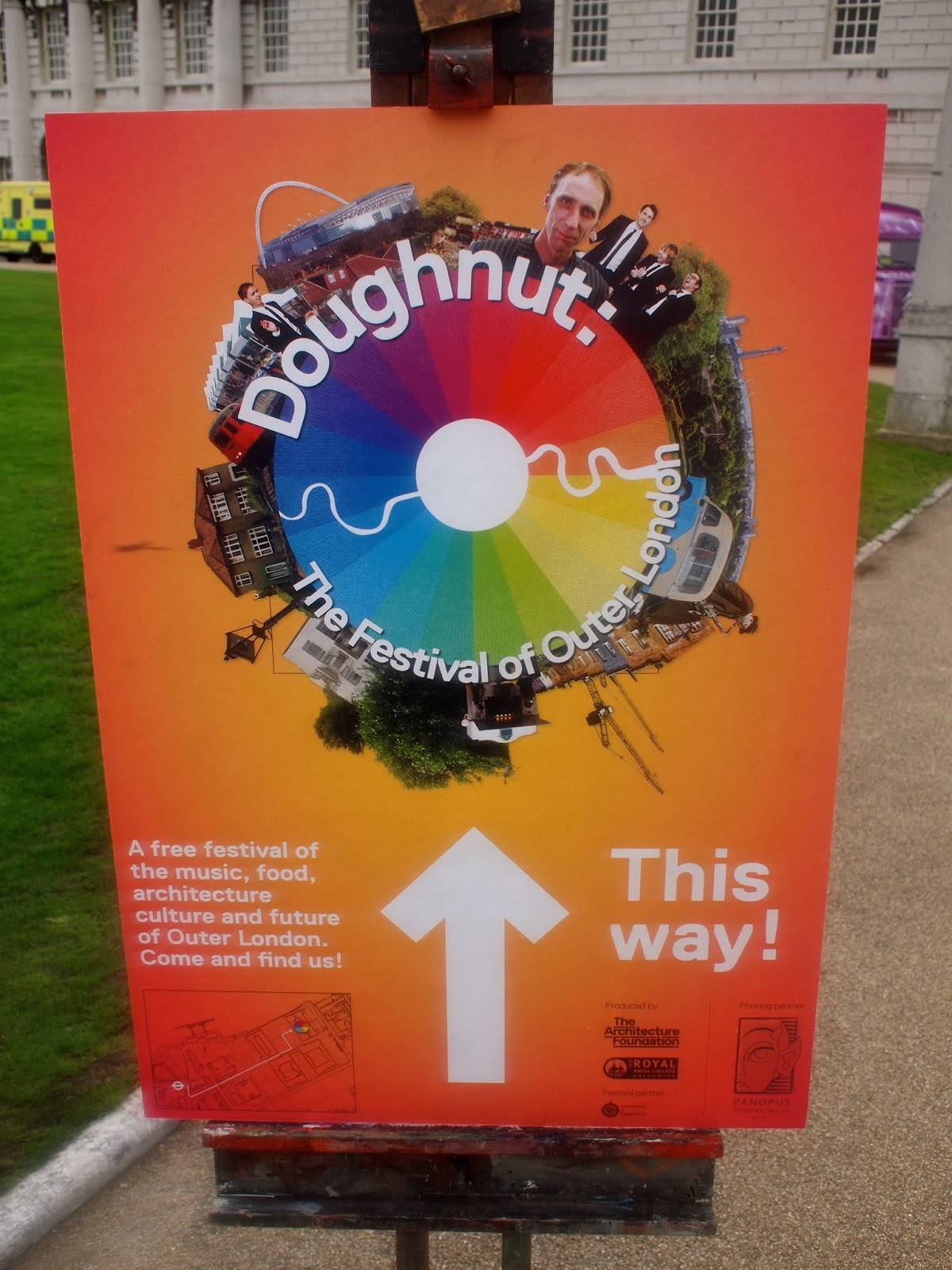
n article in the Evening Standard, Mr Self is encouraging Londoners to re-connect with the outer suburbs, in his latest role as a patron of something called
Doughnut: The Outer London Festival, which takes place at the Old Royal Naval College in Greenwich on Saturday 5 September.
Of course Greenwich is almost as far from central London as Croydon, and yet standing on the hill there surveying the grandeur of its naval past and the flashy excesses of Canary Wharf etc across the water, you feel you are right in one of the ventricles of London's dirty old heart.
It's great to hear that Mr Self has discovered the pleasures of Croydon and the verdant hills of the North Downs beyond. I am also thrilled that he believes outer suburbs such as these "heave and pullulate with sexiness".
I was brought up in an area of South Croydon, known as Purley Oaks. Oddly enough the only wooded area near us was called Purley Beeches. But the trees were real and beautiful, and within a 30 minute walk from our house were the open hills of Riddlesdown and Kenley, or the thick woods of Shirley and Croham Hurst.
I think these were all useful locations for necessarily alfresco sex, but I cannot produce any evidence for my belief. Or nothing that I am prepared to share here.
In the mid-60s, we young teenagers did not appreciate the fact that we lived in a golden age. We certainly did not appreciate the fact that our neighbourhood gave us easy access, both to the fleshpots of central London, and the healing hills and open country of the Surrey-Kent borders, the downs and the weald.
But we used these amenities very well, and generally enjoyed them without thought, until….well, I was only about 14 when I became aware that my area bore a deep social stigma, that persists to this day.
Even in 1968, Croydon had a poor reputation. It was still in the throes of a complete change of image, from rather stuffy north Surrey commuter town to a new London Borough. Many on the new council dreamt of Croydon playing leading part in Tony Benn's white-hot technology revolution. It would be modern, mod, and even a wee bit swinging, hanging on to swinging coat-tails of London. It started to build what it hoped would be the hottest example of a modern commercial centre.
Buildings we then though of as skyscrpaers went up: the 22-storey Nestlé building seemed ridiculously tall and glamorous.
A big swathe of the Victorian town centre was bulldozed to make way for a four-lane underpass, just like the ones in Leeds or Birmingham. There was a flyover under construction. We would be the motor-city of south London.
And then the cream on the cake - the Fairfield Halls complex, council-owned, better acoustics than most of central London's concert halls, and the site of my musical education. Aged 10 I was taken by my mum to see Duke Ellington at the then-new hall and never fully recovered. I was smitten, hard bitten by his impossibly elegant jazz - here in Croydon, of all places!
Up to our teen years we had unparalleled freedoms. We walked or cycled alone or in gangs around vast areas of north surrey and south London. We took buses and trains, we roamed through bomb sites and ruined buildings, we collected the tail-fins and cartridge cases from 1940s aerial bombardments, we drove beaten-up scoters and mopeds abandoned by our elder brothers on the crumbling runway of recently de-commissioned Croydon airport.
We nicked cigarettes, gin and Cinzano from our parents' drinks canbinets and monopolised their radiograms (or in expectional cases, their hi-fi systems) for our first proper parties.
We had so much freedom - too much, of course there were many casualties - but we also din't have much money, and the things we wanted cost too much.
We were just like kids of 12 to 16 everywhere else in Britain in 1965, 66 and the watershed year for me - 1967.
That year the next lot of new drugs reached the outer suburbs and it all changed again. We grew our hair long and died our clothes pink and purple. We looked for interesting things to smoke. We started buying the "underground press", mainly Oz and IT (International Times).
I remember reading with shame and anger a snooty review in IT of an Incredible String Band concert at the Fairfield Hall, written by some stoned Ladbroke Grove wit, praising the music but being rather distressed to see "Croydon's lumpy hippies" in the audience.
One of those phrases that gets branded onto one's soul. I like to think of that phrase and then think of Kate Moss, and other less than lumpy products of this borough.
That was the sort of attitude that gave so much force to the 1976 punk movement that burst out of the London suburbs - Croydon and (more famously) neighbouring Bromley producing many of that first wave. All part of the deep poetry of the outer suburbs that Mr Self recognises.
Punk was our chance to get back at those posh north London kids who'd all got picked to edit the 1969 "Schoolkids' Oz" - what a great career move that was for some of them. Even at the advanced age of 21, many of us took to the teenage punk scene with too much enthusiam, hoping no-one in the crowd at the Greyhound recognised us as the poltroons who were wearing loon pants and tie dies a year earlier.
That was Croydon, then. It might have been Barnet or Basildon or Headingley or any other small town on the edge of big city, a dormitory area for what in those days were called the lower middle classes, with pockets of working class (the council estates) and the occasional wealthier types (but they tended to live in bigger houses out in Shirley).
Yes, I can see why he finds it strange. All those lives being lived without any reference to the edicts of the metropolitan elite, yet only a 20 minute train ride away from them. All that suburban business - the vice, the good works, the charities, the hobbies, the religions.
Is it really going to be sexy again? Even in the 60s its supposed sexiness was soon seen through. Someone likened it to Canberra, Australia's apparently deadly dull capital.
Still, if Will Self says so, I'm not going to argue. I like his novels, but I love his journalism, his wonderfully lugubrious commentary on the world - he's splendidly multi-faceted. In one facet you might see a dark echo of JG Ballard, in another a bit of Howard Jacobson, a glint of Iain Sinclair over there...and then the one I really appreciate most, where he seems to channel the wry side of Clive James….. oh how we need that sort of intelligence in our media.
There's a slot on Radio 4 after
Any Questions, with a rotating cast of opinionated voices. Clive James did it for a while, and he was always the best by miles. I tune in, waiting nervously to hear who's on tonight. If it's WIll Self I cheer, inwardly at least, and drop everything to listen. If it's any of the others, I groan and go to another station.
So I'm going to go to Greenwich tomorrow and hope to find out exactly why he has such a high opinion of the suburbs of my youth.