About Me

"Use every man after his desert, and who should 'scape whipping?"
Showing posts with label gentrification. Show all posts

Sunday, 7 March 2021

The smells of London's lockdowns, part one: Toilets, toilets everywhere - but never a place to pee...


It's surely one of the most stinging ironies of these lockdown months. While the number of available public conveniences has reduced drastically as a result of austerity and Covid-19, there are actually many more toilets horribly visible to anyone who walks the streets of this or any other gentrified or gentrifying inner-London suburb.

Apart from the loos in the larger supermarkets, which are often as not out of order, I can only think of one public toilet in this postcode that is reliably open during the hours of daylight. 

Remember those first hot weeks of the first lockdown when parks - and especially Clapham Common - began to reek, not just of the normal dog-shit but of something more acrid? Beer and prosecco-tinged urine. It got to the point where the council had to provide portaloos.


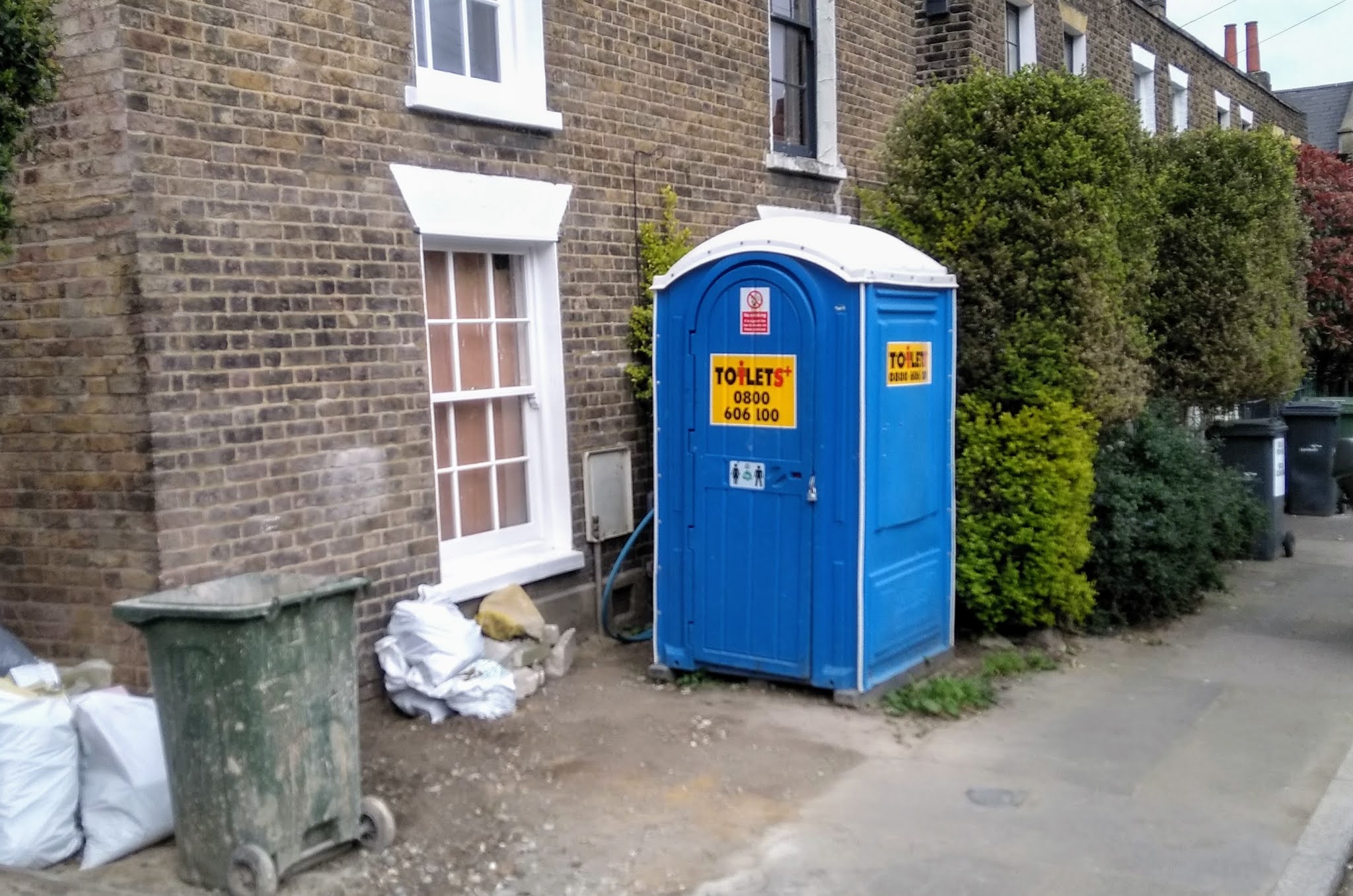
But padlocked, private versions of these same, sentry-box sized erections were already popping up all around us. 

Thanks to the phenomenon noted in much of the media, the bored super-rich all seemed to get the same idea - use their lockdown time and loose change to effect complete gutting and refurbs of their metropolitan properties. 

So you suddenly see lots of those blue or yellow plastic boxes outside every house that is having its innards replaced by something even more expensive.

Yes, I'm referring to those portaloos for builders that are now overflowing  (hope not literally) onto the residential pavements of South, North, East and West London. What's happened? In the past builders and decorators were quite happy to use the owner's loo when it was needed. And owners always used to let them do so, as well as offering them cups of tea and coffee, assuming there was a functioning kitchen.

But now, the entire family moves out to one of its other properties - maybe in the Cotswolds, or maybe somewhere more exotic.  So the builders have the place to themselves. Except, it seems, for the bathrooms. Perhaps the owners cannot bear the idea of not-quite-so-rich people using their gold-plated sanitary facilities. 

I can't help feeling slightly uneasy as I pass one of these private conveniences, which are sometimes only inches from a narrow pavement.  Or even on it. 

I side step, as if trying to observe social distancing: in doing so I often forget to look down and end up treading in the latest dog-do, miniature or massive. (Why do lockdown dog owners not seem to know about bagging the dirt? Another article there - but, no, don't worry,  that's one thing I can't face writing about.)

In theory the builder-bogs are emptied at least twice a week. I know this becuase I have watched the waste removal tankers pulling up across the road, to that house which has been undergoing god knows what improvements and additions for more than a year now. 

Even if you don't see this operation, you hear it as the powerful suction pumps blast into action. It's almost as noisily annoying as the dreaded leaf-blowers, which continue to shatter everyone's peace every Monday morning.

So, this is lockdown, Clapham style. Around five of the 120 or so houses in this streeet have had new super-basements excavated during the last year. There's hardly been a days when there have not been teams of workers arriving at 8am, followed soon after by the first deliveries of cement, sand, timber, steel, paving, glass, grass, porphyry washbasins and marble baths, Aga cookers, elizabethan bedsteads, Hollywood size tvs. You name it.

So, it's clear that London's wealthiest homeowners can assume they are exempt from all lockdown restrictions when it comes to building work. And are those builders also exempt? Have you ever seen a builder wearing a mask on site? Maybe they have the same immunity as professional footballers on the pitch.

I will stop moaning here and now, for a day or two. It was good to get that off my chest. I envy those workers the easy access to a toilet at work, as well as the many cigarettes they get through on the porches and open upper windows of thier clients' fourth of fifth homes. This is good: as I say in almost every posting, these days, at least these guys and (not so often) women have some paid work during lockdown. 

Thank you and good night. 

Wednesday, 3 March 2021

Developers seek permission to demolish historic Tearooms building

Is this the end for the building that once housed the famous Tearooms des Artistes?

This entry comes quite soon after the last one, which I hope is not too much of shock to my readership. The reasons for this hasty posting will become clear.

Passing the still intact Tearooms building at 697 Wandsworth Road for the thousandth time since lockdown, I noticed something distinctly sinister.

Tied to a signpost there's a laminated notice, stained by rain and rust, but still legible.

It was one of those Lambeth Council Planning Permission notices which, when you see them, you instantly know another beloved local feature will soon disappear to make way for yet another apartment block. 

The notice looked like it had been there for years, so I thought maybe those developers had had second thoughts.

No such luck. I took photos and read it at home, with a sinking heart. You can read the whole thing on the Lambeth Planning Applications database - including around 100 supplementary documents, as well as 8 comments (all in favour). If you don't have the time, here are a few crucial points:

"20/01227/FUL | Redevelopment of the site, involving refurbishment and extension of the existing building at no: 693-695 and replacement of no : 697 with 3 new storey building to create nine residential units (Use Class C3) and the retention of the Public House at no 693-695 at lower and ground floor levels, together with the provision of cycle and refuse stores, landscaping and courtyards. | 693 - 697 Wandsworth Road London SW8 3JF

To make this clear, the application relates to two buildings. 693-695 Wandsworth Road is the big old pub building on the corner of Wandsworth Road and North Street. 

In its final incarnation it was a nightspot, the Artesian Well, a place which specialised in lavish faux-Bohemian decor and (according to a friend, who went once) a clientele including many public school kids from Surrey who were competing for their Duke of Edinburgh's Award in decadence. But maybe this is unfair. It was certainly extremely popular right up its demise in 2014, seen by many as the interesting face of Clapham nightlife, as opposed to the meat-market reputation of the High Street clubs.

The second building, at 697, was the Tearooms des Artistes, a place which was known and loved by many from the early 80s through to its demise in around 2006, when it became a posher and more pricey bar called Lost Society, which lasted another few years. Since 2014 it's been left in the hands of Lowe property guardians, and looks little changed.  Well, at least it is providing some genuinely affordable housing.

I shared some of my own happy memories of this place a few years ago, and was delighted when several others added comments and  links to more info on this lost gem of south London's alternative hospitality spots.  Some great memories emerge, including the fact that the late Marc Bolan's pink Bentley was parked outside for a long period in the 90s. 

I have to thank Baz for some amazing info, including some history he found on the Wayback Machine web archive, which suggests the building went back to the 16th century, when it was a barn on the Clapham Manor estate (any further info on this would be amazing). Baz also built a site for the Tearooms, and some of his extremely evocative photos - can still be seen on the Wayback Machine, here - including bits of the ancient structure. Surely evidence enough to slap of high-grade listing on this building!

One attempt to redevelop was kicked out by Lambeth council in 2015. The new application, from April 2020, still awaits a decision.

The architects for the developer and would-be demolishers, Marston Properties Limited, are dismissive of the old building. It's useful to quote their reasons at length:

"At ground floor the fascia and shop front has been completely replaced with modern fabric of no visual or architectural merit. In the process, a large steel beam was inserted to open up the shopfront which was used as ‘Regional Tyre Services Ltd’ in the 1960s-70s, which has subsequently resulted in structural damage to the façade.

"There are no features of merit internally.

"At most the building makes a neutral contribution to the character of the conservation area. It’s (sic) relationship within the streetscape is awkward; it lacks connection with the terraces to the west and the former Artesian Well to the east. 

3.28 Given the assessment that the building is at best a neutral contributor with many detracting elements (shop front etc.), Heritage Collective concludes that overall the high-quality replacement building as proposed would represent an enhancement of the Conservation Area. 

Even if the Council remains unconvinced in this regard and retains the stance that the building is a positive contributor, its loss as proposed is acknowledged by the Officers to fall within the less than substantial harm category. 

3.29 In such cases a weighing exercise is required setting on the one hand the less than substantial harm and on the other the public benefits that flow from this scheme. In this case the benefits include the redevelopment of a poor quality redundant site, removal and replacement of harmful features, poor quality windows, railings etc., securing a beneficial and long term future for the site, the re-opening of a community facility (the pub), the provision of nine new high quality homes and the delivery of a highly efficient, sustainable new building..."

And so on, and on, and on. Thus do developers nail all opposition to the floor, thrashing them with fine phrases and vacuous arguments.

Not that the quoted "Heritage Collective" is a consultancy, not to be confused with an official heritage body.

Quite what a "neutral contributor" to the conservation area means is unclear to this writer at least. To us, and anyone who once visited the Tearooms at any point through its various phases, from hippyish vegetarian restaurant/wine bar/club to the après clubbing chill down nest of Sunday best in the 90s and 2000s, the sight of this unique place is a blessed reminder of a more interesting Clapham, before the anodyne clumps of tasteful luxury apartments started popping up like weeds.

The application was still active in January this year, when the architects submitted some modifications to their designs. All of these are available to view on the planning archive. According to the website the application expires on April 15. 

It's too late to submit objections, but I do wonder why the wealth of history associated with these buildings seems to be entirely ignored in this application. I wonder if any archaeologists have ever been there to look for some Tudor era oyster shells....
 

Monday, 15 February 2021

Eleven years on: where the hell did it all go wrong?

The lost murals of Mauleverer Road
Mauleverer Road, SW2, January 2021: remembering a lost paradise.

At the end of its tenth year, this old blog is still spinning, much to its creator's surprise. Maybe not  at quite its youthful 33 and a third rpm, but at least at one story per season. 

So after a prolonged winter interlude,  it's time to take stock. The question hovering just above this acrylic as opposed to woollen hat is: Why bother?

The first postings appeared in February 2010, when I had the unlikely job of teaching web-based journalism to undergraduates. It seemed a good idea to have a blog of my own to practise on, before I attempted to show them how to do it. Poor dears.

The blog began with a post about the difficulty of finding stories that anyone else would want to read. I think that was also my first big mistake - no-one is interested in the agonies of would-be writers, except perhaps other failing writers.

The second post described my joy at finding the community/arts radio station Resonance FM, just as I crested that hill on the M11 as you drive south back into London, and see all those distant towers.

The  eclecticism of that station on 104 fm leeched itself into the fabric of this blog. I started to write about the things I enjoyed, such as vinyl LPs, tape, 35mm film, print as opposed to Kindle,  bikes, charity shops, cheap cafes, live music in pubs and dodgy bars, crumbling houses and so on.

The absurdity of the project (original title, Old Bill's Analogue Blog) just made it more necessary to do. Write abut things I valued most, with the realisation that they were all under various forms of threat (except, ironically, vinyl records, which were suddenly the height of fashion).

Over the next decade, the blog became peppered with outbursts about the impact of the most insidious weapon of social change - gentrification - on all the most desirable aspects of life in a city. 

The many attendant insults to the senses that gentrification inflicts: ridiculously expensive bars and restaurants and "artisan" outlets replacing useful shops; the cramming of every residential street with massive, ugly, noisy, expensive cars (worst of all, the increasingly vile SUVs); the inevitable driving away of older communities, replacing them with a brash, young(ish), wealthy and seemingly rather selfish monoculture. 

So, what's changed? Have three (to me equally) catastrophic events - austerity, Brexit and pandemic - made gentrifiers hide in their expensively created cellars? 

Sadly not. They are just digging bigger, deeper cellars. 

I'm going to use this and the next few posts to check back on some of the places and events written about in recent years, starting with a shocker in 2015 that was an eye-opener: the destruction of the Mauleverer Road mural in Brixton.


This story still smoulders in the memory. Those wonderful painted walls of the old brewery were a highlight of the backroad cycle route from here to to the old Lambeth College on Brixton Hill, where I was taking a course. 

These paintings of a tropical garden of Eden, fountains, luscious plants, trees, even a stable  with beautiful horses, transformed what would otherwise be a perfectly normal south London residential street. 

Read the original posts for more on the creation of these murals. The story since then has been just as dismal as expected. Having destroyed the art, the developers appeared to leave the site fallow for about three years. Some plywood hoardings went up, and at one point a few planters were added with some sad plants withering and uncared for. 

Peaking through the  shutters, you could see a massive hole in the ground, which at one point seems to be full of water. 

Finally, building got going, and now the development is complete. Go and take a look if you want to see how clever modern architects and builders are: they have created a carbon copy (no, a 3d-printer style copy) of the Victorian terraced house opposite. Except that these are stripped all character. It looks as though it could be an ironic and cynical response to Turner Prize winner Rachel Whiteread, who cast the inside of an old house just before it was demolished for redevelopment in Mile End. 

There's also a near-identical terrace of new four-bedroom Victorian style houses on the other side of the site, fronting on Mandrell Road.

Nearly all of the houses have To Let or For Sale boards up. You can snap one of these four-bed, three bathroom clones up for a mere £1.44million. And as the estate agent's blurb points out, you are within easy reach of "The Village", Market Row, the Ritzy and other attractions of an area which is not actually named in this blurb (Brixton).

So, there you go - you lose a life-enhancing piece of public art but you gain strangely unreal seeming copies of your own house. You almost wonder if the occupants will be as immaculate as these buildings - like those computer-generated smart, smiling young people who populate architects' impressions of all new developments. 

The far end of Mauleverer Road was redeveloped in the 1980s, and it's fascinating to see the totally different styles of domestic architecture. 

My jaundiced view of the new houses was challenged last time I cycled through, when a group of cheerful young people were unloading their stuff from a big van and were clearly moving in. 

A lovely new home for someone, in a fascinating area of London. And at least they will be looking out at the real Victorian houses over the road. 

Over the next few weeks (or months) the plan is to revisit plenty of old places and topics this blog snooped around over the past decade. They might include:

  • The Tearooms des Artistes (RIP)
  • Peter the Greek's Lock-up treasure shop (RIP)
  • Lambeth Libraries (lost and found)
  • Nine Elms disease (there's no vaccine)
  • Er...lots of other things, with a south London bias.

Look on the bright side, it might never happen.


Monday, 24 August 2020

Leaf-blowers: one more reason why it's a bad idea to live in a wealthy area (especially if you're not wealthy yourself)

It's 9.30 on a Monday morning and all hell is breaking loose in one of the wealthiest corners of south west London.

Those people still "working from home" will be bashing their heads against their laptop screens. Even long-term freelancers, who should have become inured to the many minor disturbances, find this particular noise difficult to stomach. 

If this post is more disjointed than usual, it's because I'm being driven mad by intermittent assaults on my eardrums.

Every week, at about the same time, a pair of men working for a contractor spend 15 minutes or so blasting air onto the expensive paving stones outside a luxury "townhouse" development behind the block of flats I live in. 

There were a few leaves on the ground, six or maybe even seven, and they're chasing them, trying to corral them into a corner. Clouds of dust and grit are raised. 

One of them wears ear-mufflers - just as well because the noise this petrol-powered blower makes is awful, echoing around the brick-clad walls of this hidden enclave of luxury homes. It sounds like one of those unsilenced mopeds beloved of trainee bikers. But this one's going nowhere, except to the next gated development which has a contract with the same property management company. And all the noise and stink of two revving two-stroke engines remains within the high-walled confines of this generally quiet zone. 

For the rest of the morning we can hear their labours in the surrounding streets, as they move around the various gated "communities".

It's a sad refection on how easy it is for a privileged layabout like this writer to find an endless stream of things to complain about. Even in the depths of the worst global pandemic in 100 years, you find solace in moaning about trivial nuisances. But then it's the silly little things like this that finally break us.

The leafblower guy is cleaning the carefully calculated space outside these new houses, which used to be a wonderfully overgrown garden. The space is just big enough to allow a full-fat Range Rover execute a three point turn; assuming the person driving knows what they are doing. Sometimes they don't. So, more dreadful racket as the drivers mess up their turns.

But the leaf-blower men worry me most. At this time of year it's an unnecessary job, and it shatters everyone else's peace, as well as polluting the air.  If it had been necessary, say in October when there are plenty of leaves to shift, what's wrong with a broom? Can that be more tiring than having a howling motorbike engine strapped to your back?

But now come pangs of guilt, because, however much that noise and the stink of two-stroke exhaust gas annoys me, at least the man has a job, and is paid something for doing this. Compared to him or many of the other thousands of people working around here to keep things moving, I am wealthy, thanks chiefly to having moved in here five decades ago.

Whether the wealth-gap between me and the leafblower is bigger than the one between me and the owners of those houses, or the even more expensive houses along this street (£4 -5million, at a pinch) is open to debate. Whatever the answer, the property machine has to keep on polishing its many assets, and it does so around here with alarming amounts of energy.

Yes, lockdown or no lockdown, let us keep the economy moving on, like those leaves, whatever the costs.

To get away from the racket I move to the front of the flat. There's some really loud effing and blinding coming from the pimped-up house across the road. Since December they've had endless streams of builders coming in to do something to what used to be a perfectly pleasant front garden. We wondered - are they going for a new bigger, deeper basement? For weeks it seemed like it, as a temporary roof was erected.

As lockdown came into force, the inhabitants and their many showy automobiles, large and small but all very noisy - decamped, thank god, perhaps to some other home.

In their place came new teams of builders and scaffolders and decorators. The work has been constant now. Occasionally some sort of boss turns up in a big black shiny pick-up truck and shouts at everyone at the top of his voice.

A terrible silence reigns. He drives off in a huff. The next day different teams of builders and decorators turn up.

More recently, one of the occupants of the house, presumably the owner, returns in his monster two-seater sports car, which is parked on that now horribly bleak, entirely paved area. No doubt there will soon be a weekly visit from the blower-man, lest any fugitive leaves from next door's verdant front garden should dare to encroach upon this immaculate parking lot.

 (nb: owning noisy cars seems to be another trait of the super rich. They pay hundreds of thousands of pounds for "supercars" with huge engines tuned to make that fuck-you roar when they hit the gas. Which is often at 6.45am when they rush off to their personal parking spaces somewhere in the City or Canary Wharf).

A few days later, an enormous removals truck pulls up, double parked. Two men in red company t-shirts jump out and are almost immediately on their phones, as there's no-one there to let them in. They sit around for hours, their truck half-blocking the street.

Only very wealthy people can afford to hire so many workers, and not even to be there when they arrive, presumably paying them for those wasted hours.
Truck jams are an increasingly common sight in the
wealthy residential streets of SW4,
even during lockdown.

Similar scenes are being played out at other houses up and down this street at any given time, and throughout most of the "lockdown" period. Every day massive trucks arrive with building materials or huge skips to remove debris. 

Sometimes they meet head-on and a sort of macho trucker showdown ensues.  And all for what? Houses that were fully refurbished three or four years ago are undergoing another total gutting, to suit the whims of their latest owners.

But at least these guys have jobs.

I've had several decades of being the strange old recluse on the top floor. I could name hundreds more annoying things my wealthier neighbours do. But you would almost certainly dismiss them as the ravings of a deranged and bitter old fool. And you would be right!


Thursday, 21 May 2020

C*****m takes a well-deserved battering in local writer's twitter thread

The horror of Clapham Common on the first hot weekend of the year. To be fair, this was taken in May 2018, long before social distancing was an allowable phrase. I took this to illustrate yet another unpublished article on the strange behaviour of  the tribes of Clapham. 


After many weeks of lockdown trying to write a post explaining why lockdown might be a good thing for the dread postcode, SW4 - along comes a much more agile critic with a twitter thread that demolishes any of my remaining excuses for thinking it's OK to live here.

In an epic 17-post twitter thread yesterday, the Clapham-raised, Stockwell-based writer and podcaster Daniel Ruiz Tizon explained why he now avoids the place he so loved as a child.

And why these days, he says, "You cannot get me to #Clapham for love nor money and those that know me well, know not to ask to meet in SW4".

Like Daniel, I also loathe what the name "Clapham" now stands for in discussions about London suburbs (these discussions have been getting very heated on twitter of late).

It has long been a mockable address.  People have been joking about "Cla'am" for two decades or more now. I stopped rising to the bait in 2003, when those same people saw the values of their sensible homes in New Cross and Nunhead and Dalston soaring.

It got to the point in the early 2000s where I started to lie, rather than admit to living here. I would say "close to Lavender Hill". Sometimes more blatantly, by saying Battersea or Stockwell. In my defence I'd point out this flat is less 100 yards from the SW4/SW8 border. But that's like saying you're slightly pregnant.

Face it, hypocrite: you live in Clapham! And are you going to move? No, of course not. Like it or loathe it, I am rooted.

In fact a lot of this blog has been about trying to justify my presence here, even though I am now much more like one of those sad old relics living and dying in their bedsits back in 1985.

I agree with each of Daniel's points about the awfulness of Clapham now. I also agree that "No part of this city, or any city, should be exclusively white and middle class".

I agree that we've lost much of the diversity, the blessed shabbiness, the easy-come-easy-go transitory character Clapham had that made it attractive to all manner of migrants, external or internal.

I was about to argue that Clapham still has a lot of that diversity, it's just not quite so visible, and of course it has. There's still that patchwork of social housing; there are still the old grandees living on the North Side in their well-padded bohemian splendour.  With their views over a Common, often including the little camouflaged tents of migrant workers: late evening campfires, accordion bands, short stay visitors, sharing common turf with the crows. Park bench business dealings. Skunk smoke under the horse chestnut trees. Lone music students practising flugelhorn scales by the paddling pool.

There is still diversity here, but as in most of London's inner-zone residential areas, it's not the diversity you notice so much as the polarity.

There's a local photographer, Jim Grover, who has revealed some of richness of the Clapham demographic, right now. His work, inspired largely by the African-Caribbean congregations of his local church, tapping into the family histories of Jamaicans of the Windrush generation, or by the Jekyll/Hyde character of Clapham High Street, by day and by night.

Yes, here I am on the defensive again, sorry. The problem is that the most visible section of the population, especially in summer, are those youngish, well-off, white, "just-down-from-uni" types that Daniel complains of. The 2020s versions of the 1980s yuppies, of which I was one, if a distinctly shop-soiled example.

The worst time is early summer, when they (we) emerge all at once from their (our) flatshares like flying ants on National Flying Ant Day, to crowd the pavements of the "Old Town", pastel-shade tailored shorts, flip-flops, carefully casual cashmere jumpers, pink flesh turning red, oh Lord. This year, perhaps because of the press coverage of breaches of social distancing, they have been more noticeable than ever.

Poor old boring old Clapham Common. Come on, you can't blame it for the packs of loose-bowelled doggies on shared dogwalker leads who foul it so, nor for the hordes of keep-fit fanatics who will happily shower you with thier sweat if you get in their way.

But Daniel has much deeper reasons for the anger he feels towards SW4  as it is now. The gentrifiers have defiled the neighbourhood he grew up in. It is much more painful for him, than for a latecomer like myself.

I grew up in the leafy suburbs of Croydon, which in those days was categorically not in London. As a child of 7, I remember how the cityscape changed as we pulled out of Clapham Junction on the way to Victoria. The view across the smoking chimneys to the steep terraces on Latchmere Road, the then-new tower blocks of the Battersea council estates, and then the billowing clouds of steam above the power station: it might as well have been the title sequence for Coronation Street.

Yes, here I go, defending the place I arrived in almost by accident after a decade of moving around the postcodes north of the river, from NW1 to W9 to SW3 to E8. Despite claiming to hate everything Thatcher stood for, I too was lured into getting a mortgage, a foot on the ladder. My foot's still on the same rung of that ladder, but all around has changed beyond recognition.

As I peer out of the window so there's a god-awful howl reverberating off the houses, a black open-top Ferrari is hovering and revving up outside, a couple of thirty-something fellers in their designer shades, are braying away.  Lockdown? Wtf's that, matey?

Yep, OK. Clapham now. You win, Daniel.


Friday, 20 July 2018

Note to Brixton graffiti writers: thanks, nice...but we've too many yups here already

Some useful signposting on the overground rail bridge in Brixton High Street...trouble is they all tend to go right, straight to
the Pop Brixton container park....
That new bit of graffiti on Brixton's high-level rail bridge made a nice little photo-story for the Brixton Buzz site.

The writing is on the bridge. It reads: "Clapham that way, you 2D Flat White Tepid Colonialist Yuppy Wanker". There's an arrow pointing west down the Overground line towards the next stop: Clapham High Street.

Yes, it's fun, it's funny, it's to the point. Clapham was thoroughly yuppified back in the 80s - and that strange breed still prevails in much of SW4. But please, I've lived in the bloody area for longer than is reasonable, and the last thing we need is more of the buggers!

In reality the Yuppie has changed a bit since the 80s. Maybe the truest 2018 successor to the yup is the hipster with their artisanal this, their authentic that; the obsession with everything being just so. And of course they would not be seen dead in this postcode: strictly east and southeast London, please...

Vaguely hipsterish people I've met like to mock SW4: it's either Cla'am or Crapham. Probably the least fashionable place in all of London, from the viewpoint of Hackney Wick or Peckham Rye.

What used to be the yuppiest bits of SW4 are now colonised by corporate types - families with live-in au pairs and even chauffeurs living in huge houses. They are much, much richer than thou, antiquated Golf GTi driving yuppy of Peter York fame!

But keeping an Attenborough-ish, threatened species eye on the place, it's clear there are still millennial versions of real 80s-style Sloaney yups in Clapham, with a few differences. 1980s yuppies bought their crappy flats; the 2018 versions have to rent. They tend to share flats in the slightly cheaper parts of the area. Here they often mix with another strand of the young professional type: sports-mad Aussies, Kiwis and South Africans who for some reason still seem to love SW4. Probably it's the proximity of wide-open space on which to play games with strange shaped balls and frisbees.

The first hot weekends of the summer are prime-time for yuppie-spotting
How consoling it is that the young flock to our great open spaces at the first
real sniff of summer: May 19 2018, Clapham Common...
Every bright morning, every evening, the Common is a nightmare of grunting and sweating types, trying so noisily hard to get in trim like their bronzed Australasian neighbours.

But the core breed, yuppie lethargica, are most visible on the first really warm weekends of summer when they come out en masse and sit their well-fed, pastel-coloured-tailored-shorts-clad bottoms down on that little triangle of the Common nearest to the Old Town shops.
Sadly, they know nothing of re-cycling or even taking their litter (Prosecco bottles, etc) away with them. All the rubbish bins will be overflowing with over-stuffed orange Sainsburys carrier bags by early evening.

....but how sad that they so often neglect to take their rubbish
with them.
The richest ones (who live in the more expensive new builds in Old Town), will show off their powerful sports cars, often annoyingly revving the engines for no good reason at traffic lights. That really is wanker behaviour.

Yet, as one commenter on the Brixton Buzz story says, Clapham is actually a bit shit: it was always a byword for the "ordinary" suburb, ie mediocre, drab, stuffy. And it always will be.

It's not really a place, it's a collection of tube stations. It has no real centre: it's defined, if by anything, by a dirty open space - Clapham Common. The better bits to the north are either Stockwell borders or Battersea-Nine Elms borders. The better bits to the west around Lavender Hill are Battersea. The southern bits improve when they become Balham.

There are a couple of visibly smug areas - Clapham Old Town, Abbeville Road - that typify that first wave of well-heeled yuppiedom. Many of that first wave moved a bit west and south when they shacked up and had kids: hence Nappy Valley (really Battersea again, by Northcote Road, wrecking what was once a decent street market).

But there's a lot more to the social fabric of this district than the stereotype would have you believe. There's still a lot of social housing, and there are still a few hanging-on 1970s boho types, who, as we all now know, were actually the first essential phase of re-gentrification.

This blog has tried to throw some light on the social history of the area. But no-one, in recent years, has done more to reveal the many layers and deep and diverse roots of Clapham residents than the Jim Grover , who has had five acclaimed exhibitions in quick succession, all focusing on the area and the people who live, work and play here.
A fine example of a "Front Room" display cabinet, a rarity
now, but these took pride of place in many West Indian family
homes in south London back in the 60s. From Clapham-based
photographer Jim Grover's recent Windrush Generation
exhibition at the Oxo Gallery, London SE1.
photographer

His most recent show was Windrush: A Portrait of a Generation, a celebration of the West Indians who arrived in this part of south London 70 years ago. He got to know some of the original Windrush passengers and their children and grandchildren at his local church; as with all his work, he earned the trust of the people he wanted to portray before getting out his camera.

Other exhibitions have focused on the long-established Café Delight at Clapham North and its varied clientele; the double life (daytime and night-time) of much-maligned Clapham High Street; and the work of a priest at the church in Clapham Park Estate. It is already an impressive body of work that shows this area in a very different light to the media stereotype.

It's work like Jim Grover's, patient, painstaking, that truly reveals the complexity of a neighbourhood, of communities; lives that are led, families that flourish...others that do not. 

But thanks anyway graffiti people for reminding me of the way home. As for being a yuppie, well maybe 40 years ago. 2D? Well I guess I know what it means: bland, dull, fake. Flat, yes, flat white. But am neither smooth nor sane enough: I'm more like 5D. Flat-white? I prefer espresso. Tepid? Yeah, OK. Colonialist? Well, had to live somewhere. At least I got out out of Dalston just in time so that the real Dalstonites could move in. Wanker? Obviously.


Thursday, 11 May 2017

Two films, two Brixtons, many gentrifications

Went to Ritzy to see A Moving Image, the new film about gentrification in Brixton. Emerged 75 minutes later without much new light on the topic and rather disappointed. Another, very different two-part film, coming at the same topic from a different angle, was far more evocative of at least two of Brixton's dispersed communities. This film, For What We Are About To Lose - was coincidentally the centrepiece of a small exhibition in Brixton Library, next door to the Ritzy.

Talk about keeping it local!

A Moving Image started with a strangely low-key sequence of a young woman emerging from Brixton Tube station into the street with a smart wheelie suitcase. The underground arrival in Brixton is surely one of the great full-on London experiences, but it seemed underwhelming here. Maybe deliberately, as this young woman was supposed to be returning to Brixton after a few years out east in the artistic community of Shoreditch. Maybe Brixton seemed rather unthrilling to her, what with her memories of an even livelier high street of the early 2000s.

 If so it underlined not only the problem of gentrification, but also  the whole concept of the movie, which was constantly struggling against itself.

On her return to her home patch, this young mixed-race woman, Nina,  played by Tanya Fear, stays in an enormous and ridiculously fashionable loft apartment owned by a friend of a friend. She explores the area, wandering the streets with her top-end digital SLR, filming what she sees.

She has debates with her equally smart girlfriend who agrees to help with her "project". At first she doesn't know what she wants the project to be but when she gets mixed up in a Reclaim Brixton demo she decides that's her subject - gentrification. Not a documentary, mind you, but an art piece, a piece of art.

One great moment in the film only works if you see the film in this cinema: during the demo we see the Ritzy strikers calling for boycott of the Picturehouse group cinemas until they're all paid the living wage. It was one of the few moments in the film that triggered some cheering in the audience.

It takes a while to dawn on Nina that she is part of the gentrification, even though her friends keep telling her, and interviewees make it clear. It's as clear as day to the audience, because the dear girl is wearing a totally different designer outfit in every take, and speaks the lingo of the casually moneyed hipsterish young.

She befriends a young black guy who is meant to be part of the community but he's also an "artist" and the art and music he makes is a truly terrible. The villain of the piece is a young and very successful white actor who falls for the girl and has bought a flat in formerly-squatted Rushcroft Road - you know the buildings - as a "good investment". He's a villain, sure, but he's also, as we learn later on,  a working class lad from Bermondsey made good, whose own family have been driven away from their old neighbourhood. One of the admirable things about this film is that it shows just how complicated this gentrifcation busines is.

In the course of making her art, Nina interviews a few people, and these are the highlights of the film; the bloke from Peckham is especially entertaining. The black members of a local community group are suspicious of her motives and one of their members cruelly tells her that her project "doesn't mean shit".

By the end of the film you can't help but agree with him. It was really much more about Nina's internal struggles with depression (rather clumsily revealed by the discovery of a strip of anti-depressants) and her romantic life.  Maybe it was me, but  the scene where she makes the white boy actor dance with her was very odd: were we supposed to be entertained or what?

The other main character in the film is Big Ben, a mysterious, homeless black busker and ranter who acts as a sort of conscience of the movie. She films him a lot, and perhaps he should be the real subject of her movie. But as soon as she realises this he dies. There's a nice scene where she dreams he's in her flat and sitting on her bed, and then he disappears in a ball of blinding light.

 So, perhaps that's it: the revelation that the true soul of Brixton has already departed.

The interviews with anti-gentrification people from New York and Berlin popped into the film were intriguing; it's only when you go to the community bit of this film's website you realise these videos are part of a bigger project to collect voices from threatened communities around the world.

In other words, the director of A Moving Image, Shola Amoo, is trying to do exactly what Nina is doing: he is Nina, and suddenly it all sort of makes sense.

All in all, a film's a curate's egg; it's intriguing and ambitious, but also annoying, and it seems that some opportunities are wasted. But, if you've never visited Brixton you at least get some moody rooftop views; but not enough, even of this, for my liking.

Still, you have to commend the director for attempting such a complex project, and the film has had plenty of good reviews in the media, so please don't take my criticisms too seriously ( I know that won't happen!)

The other film, For What We Are About To Lose, is a very well-crafted example of the traditional documentary style, with many interviews intercut with archive photos and some lovely footage of Brixton in the 50, 60s, 70s and 80s.

It was made by the Clapham Film Unit, and is in two parts. The first 20 minutes covers the history of the Carlton Mansions squat from the 70s to the final evictions of 2014; the second half looks at Somerleyton Road community. Together the short films are a precious record of what was once the true heart of Brixton, that little bit where Coldharbour Lane crosses Railton and Atlantic Roads, which is now undergoing transformation as part of the Somerleyton Road redevelopment scheme.

You might say that the Carlton Mansions film is only representative of a small fraction of the old Brixton community, the squatters, and that would be true. "Maybe we were all misfits," says one of the  first occupants.  Former squatters are interviewed inside the astonishing and huge buildings where they made their homes and workshops and studios. There were poignant moments, and also painful memories.

One of the original squatters, Dale, reveals how they were actually invited into the building by Lambeth Council, which at the time ran progressive short-life housing schemes, helping people set up housing co-ops and handing out grants to make the places habitable. Dale also worked with Brian Barnes on the famous Nuclear Dawn mural on the huge side wall of the mansions - a mural which is still there but rapidly disappearing under new graffiti.

 Another guy talked about how they had to secure and guard their squat because Brixton was such a "difficult place" in the 80s. It was not only sex, drugs, and rock and roll. There were hard times, hard winters, fights, a suicide, rows. But also a lot of creativity, and we hear from several successful artists and makers who got their first big break in the Mansions.

The Somerleyton Road part of the doc is only 10 minutes or so but an utterly joyous film. Some former residents are brought together in a community centre on Railton Road, and they talk about their lives back in Somerleyton Road back in the 60s and 70s - even before the Barrier Block went up.

There are some wonderful memories of blues parties, some fantastic old footage of Brixton market, and even an impromptu performance of by former members of a lover's rock group, who reminisce about the excitement of seeing Jamaican DJ Peter Metro at a Somerleyton blues before letting on they were part of a group of  five women who took over the stage from him...."we were not deejays but sing-jays, we took a broadway melody and we ride the rhythm...."

One woman at the end sums up the process which is sometimes referred to as social cleansing: "It seems like a plot. They sell your house, move you into a block of flats. Why are we knocking wonderful buildings down to build atrocious things like that?  To me it was like a con. That was the beginning of the change."

You must watch these films! Catch them on the Clapham Film unit website now; there's also a very good, well illustrated free booklet about the films; copies were available in Brixton library, last time I was there.



Friday, 10 February 2017

Two more art enterprises fall victim to London's property vultures

It's hardly news that London's rapacious property developers are driving anyone who's not rich out of newly-fashionable areas. Among the victims are artists, who are being pushed out of their studios and work-spaces. It's a cliché (and therefore true?) that struggling artists, musicians and their ilk, who always tended to migrate to areas with cheap, large work-spaces, helped to make those areas fashionable and desirable. And then these very people who made the area popular get driven away as rents soar and the bankers, advertising execs and the hedge fund mob move in.

Any hopes that this dismal trend was slowing down have been dashed. It's only February and already, two very different artist-led enterprises in south London have been given notice to vacate their premises, both in once-despised areas that have recently become highly desirable: Vauxhall and New Cross Gate.

These are just two examples that I happen to know personally. The same thing is happening to dozens of others, typically in the areas which have been made more marketable to city commuters by the arrival of the London Overground.

These two places are at different ends of the art world.

The first is LARA - the London Atelier of Representational Art - a well-respected independent art school, known for adapting the classical atelier system for teaching the traditional skills of drawing, painting and sculpting the human figure. The tutors are all successful practitioners, and the students learn by example. They spend weeks and months and years learning to use the sight-sizing methods developed by Italian renaissance artists, to build their knowledge of paints and brushes and pigment, canvases, papers, the lot.

Who could guess that in the basement area of the buildings to the right,
on the busy Vauxhall gyratory system, there's an amazing hive of artistic
activity - the London Atelier of Representational Art.
It runs full-time diploma courses and a  busy schedule of short courses, evening and weekend masterclasses, exhibitions and excursions. It's a hive of intense artistic activity, and at the moment it inhabits the basement of a big old office/warehouse building on an unremarkable part of Vauxhall's one-way traffic system.

Recently LARA was given notice that the building they've been in for several years is going to be demolished for re-development later this year. They're going to have to leave by late summer, meaning students on their three-year diploma course could face disruption (although LARA already has its sights on alternative premises).

So here's a unique, creative organisation which provides employment for dozens of artists, tutors, models and others, which is at the heart of an international revival of the atelier method, and which has also played a part in the re-energization of this fascinating part of London. So close to the centre, and yet so different. And now of course the money-men have noticed, and the place - which survived so much, including one of the most murderous traffic systems in London - is now being torn apart for the development of high-rise luxury flats and "serviced office accommodation".

Ironic that, as a new upmarket Newport Street gallery owned by Damien Hirst opens in Vauxhall, so the organisations that will create future artists are being pushed out.

The second sad story is another hive of creativity: the ASC Studios in Bond House, Goodwood Road, New Cross Gate. This big old former factory, just round the corner from the railway station,  currently hosts over 100 artists' studios of varying shapes and sizes as well as exhibition spaces.

Amongst them are a celebrated community project, The Gate Darkroom, which started in 2011 and provides  studio, developing and printing facilities for hundreds of photographers, students and other artists.

These studios are just over the road from Goldsmiths; they are part of that incredible ecosystem of creative talent that's existed in this corner of south east London for decades, and which every so often erupts into international notice, as with Hirst and Co back in the 90s.

There's no doubt that proerty people - estate agents, the lot - owe a huge debt to these artists, students, the punks and poets and actors and activists who have between them, over decades,  created a unique atmosphere in the Deptford - New Cross - Peckham - Camberwell valley. That's one of the reasons this area is now so sought-after.

But alas the area is also succumbing to the Overground effect. Wherever this extremely useful railway lines goes, it carries a parasitic virus with it: the dreaded virus, Luxuriosa domos. The Overground trains arrive, then sure enough, along come outbreaks of "New-London-vernacular" flats, which pop up like a bad case of measles alongside the stations.

No doubt Bond House will go the same way, soon after the artists are kicked out on March 26. There's already a crop of them just round the corner.

ASC is one of several organisations that exist to secure affordable spaces for artists and craftspeople of all types, all ages, all nationalities. But no-one is immune to the squeeze: and there is no government or even local London legislation to ring-fence certain types of property, apart from the listing system for buildings "of special architectural or historic interest considered to be of national importance and therefore worth protecting".

Perhaps they could add: "and cultural, educational or local community" interest to those, as well as building up a strong "continued public access and purpose of use" to this admitrable system.   This is what should be happening NOW!

Or maybe legislation that forces developers to provide alternative, equally well-positioned accommodation to any of the above that they displace, and that that should only happen with full agreement on all sides - current occupiers, other local businesses and residents.

But this is pipe-dream stuff in the world of Theresa May and co.

In both the cases I cite above, hard-working dedicated artists and students will have their long-term plans disrupted, even wrecked by the impatient greed of property people - these ones who are perhaps trying to squeeze the last millions out of the London property market before it goes pop when all the money men leave for Paris.

Then maybe the cycle will start again. Meantimes there's only one sane response for those with the strength and energy to do it: Squat!


Thursday, 7 July 2016

Daniel Ruiz Tizon is even more available

Here's your chance to own a little bit of something very rare - and something that, as the glittering towers of Nine Elms continue to rise, will soon become as rare as  as an honest broker in the property business.

I'm talking about local, homegrown, SW8 talent, more specifically about a local writer, broadcaster, social commentator, stand-up performer, and podcaster supreme. I'm talking about a bloke who at the annoyingly young age of 42 has gone and published a book.

I'm talking about Daniel Ruiz Tizon, whose weekly radio show used to be a highlight of the Resonance FM schedules, and whose oblique, hilarious and sometimes tragic memoirs of life on the borders of the boroughs of Stockwell, Clapham, Brixton and Kennington have kept a growing band of fans and followers entertained and appalled for a decade or so.

I'm late arrival at the Tizon party and I see his output as  building up into a unique record of  life in communities that are on the verge of disappearing, or being dispersed to the edges of the metropolis, or expelled altogether from this disunited queendom. Daniel was the child of Spanish immigrants who settled in Lambeth in the 1960s. He's one of very few writers in this area fully qualified to talk about social change in the last four decades, and the impact of gentrification. And he does this in a way that is totally original, entirely his own.

Luckily for  us, and for future historians, the man himself has bundled together some of his best and most telling bits of writing, and made a book of it. Ok, it's an e-book, but that's still a book isn't it? It's called Me, Me, Me! - and you can get it for a mere £2.

I've said enough about Daniel, he's much better than I am at writing about himself and his strange but strangely familiar experiences. But, as a non-Kindle owner, I'm really hoping he'll produce a print version of this book, then he really will be Available, even to old sold farts like me.


Wednesday, 11 May 2016

When I was just a snotty wageslave on the third floor of your luxury apartment block

BBC TV Centre on Wood Lane, London W12 - as it was, just before the BBC vacated it back in 2012. Now it is embarking on a new life as the centrepiece of a new "Live, work, play super-hub" with luxury apartments going for upwards of half a million for a studio flat (not that sort of studio, fool!)
You might have noticed recently how one big new property development in west London has grabbed loads of headlines - the rebirth of the former BBC TV Centre at White City as a so-called  "live-work-play super hub" .

Yep, that 1960s snail-shaped building, home of Blue Peter, Top of the Pops, Dr Who  and a host of other 1960s, 70s and 80s TV blockbusters, is now the big round jewel in the crown of an £8 billion development of luxury flats, hotel, restaurants, shops, gyms, cinema, etc. Like Nine Elms or Stratford, but on a smaller scale, it's another of these "city within city" projects we're having to get used to.

As I read this article, I felt a bit sad as I spent a lot of time in this building back in the mid-80s. And unlike its future occupants, I was being paid to be there.

And then it dawned - it was not just TV Centre, half the places I have ever worked in are now - or are being turned into - luxury apartments.

By some odd coincidence that's actually probably quite normal in this town, at least four of the buildings I worked in over  a long and undistinguished non-career are now seen as the most desirable of residencies for these groovy new Londoners with loads of dosh.

Bonkers, or what?

Last time I went into the BBC TV Centre in W12 was a few days before I walked out of a very strained and painful job as a reporter on the BBC's staff newspaper, Ariel.

Spring 2014: the retreating BBC and incoming developers
 advertise public meetings to outline the proposals for the
big change of use of this building, which seemed so modern,
even futuristic, in 1961 and seems so quaint now....
It was a weird job, being a sort of parish pump hack for an organisation packed with award-winning journalists. They liked to refer to Ariel as Pravda, and all who worked there were obviously management-fed apparatchiks.

At the time of then director-general John Birt's first round of cuts, I can remember attending a programme launch up on the hallowed 6th floor of TV Centre. I bumped into a well known reporter on a flagship current affairs programme, who asked me what I did.

 "I'm a reporter for Ariel", I said.

"You should be ashamed of yourself", he replied.

Well, soon after that (but not for this reason) I was out of there.

It was not the first or the last job I've walked out of, and I always have regrets. The BBC then was a fascinating, ghastly place, full of internal agonies, but TV Centre was a sort of 20th century Gormenghast. You could disappear in there, into the depths, where there were workshops and labs and people creating the most extraordinary things.

Meanwhile, the new lords of this Birtist era, the explicators of the world, the not always that young marble giants of youff  TV, strutted around in their Jean Paul Gautier creepers and red linen jackets and leather miniskirts and crumply dark blue Armani suits on the 6th floor gyratory system, the inner circle of BBC heaven.

The Erno Goldfinger designed Alexander Fleming
 House at Elephant & Castle is now a block of
private and very desirable apartments, known to
some as "Metro Central Heights". 
Now, presumably, that dreaded sixth floor circle of hell, that corridor of lost dreams for most, no longer exists. Instead that whole floor will have been carved up into a handful of the most desirable apartments in the development.

The occupants will be able to gaze over the rail tracks to the Westfield  Shopping Centre and ponder which luxury items will be next on their shopping lists. Just like lead characters in an unwritten sequel to JG Ballard's High Rise.

So odd - but then it struck me that this is not the only place I've worked that is now a desirable
residence.

Former DHSS building: Alexander Fleming House

My first proper job, after doing A-levels at the local tech college, was as a Clerical Officer in the DHSS headquarters in Elephant and Castle.

I worked on the third floor of Alexander Fleming House - a modernist block designed by Erno Goldfinger.

At the time it seemed enormous,  but now it looks tiny, dwarfed by the garish monster-blocks sprouting all around this once cheerful, cheap, scruffy transport hub of south London.

The building where I spent 18 months or so as a lowly clerk in a cheap brown chalk-stripe C & A polyester suit, is now Grade 2 listed. I enjoyed my time there, even though it meant traipsing up and down to the sixth floor with missives for the Oxbridge-graduate fast-track trainees who buzzed around minister Keith Joseph's office.

The office in which my boss, an amiable ginger-bearded Glaswegian, would offer me a Friday afternoon swig of malt whisky from a brown paper-bagged bottle, is now probably the cherished, minimally furnished living room of a million-pound plus apartment.

Once an overheated forcing-house for IPC's weekly
magazines, the former King's Reach Tower in Stamford
Street has now grown another 12 storeys and is open to
all bidders with a million or two to spend on a new flat.
Poor old AFH. Its name has changed to something far less distinguished: Metro Central Heights. Yuk, how feeble can a name be? Perhaps the developers were correctly forbidden to suggest any connection with someone as great as the discoverer of penicillin. But they've still won, by getting their mitts on a building designed by Erno Goldfinger in London SE1 - that is, in the gasped-ver Zone 1.

But as a recent visit confirmed, the conversion of former office space to high-end residential has been reasonably sensitive, with little or no change to the outside appearance.  In fact it all looks a bit like Goldfinger's other big tower blocks - a nice piece of social housing. Except the people living here have paid through the nose for their flats.
Which is presumably all a testament to the power of the Grade 2 Listing.

The towering inferno: IPC Magazines, SE1

Later on I got a job with IPC Magazines in Stamford Street. I worked in Dorset House, opposite the IPC magazines HQ, Kings Reach Tower.  We sometimes went in there for meetings and lunches.

Last year, it underwent more than the usual transformation. Not only did it turn from business to residential, but the developers added a dozen or so new floors on the top. The whole lot is now up for grabs, with the usual developer's bollocks on the hoardings at street level.

Fortress Wapping

Then, much later on, and with a certain shame, I went to work in Wapping for a certain Rupert Murdoch.

He sold us lot off down the river in 2006, and soon after sold the whole of that unsavoury site which - however fascinating its pre-Murdoch past - will forever be known as Fortress Wapping.

Probably the most hideous dump of all those early 1980s buildings in London, the News International hq was fascinating for having its own print works and a raised newspaper distribution centre on the second floor.

Huge trucks circled and penetrated the building, loaded up with copies of the Sun and the News of the WOrld, then zoomed off down the Highway to connect with the M25.

In 2012 Murdoch finally sold the entire 15-acre site to Berkley Group, for a reported £150 million.

Back in 2014, the Evening Standard gleefully reported how people were scrambling to buy up the first
of around 1,800 flats on the site, going for upwards of £740,000 for a one-bedroom flat. Well, I worked in their bedroom for 10 years. In total I might have earned £280,000 in that period. It was good money at the time but it wouldn't have bought half the flat now.


Tuesday, 3 November 2015

Clapham's North Street Mews community under threat from property developers

The unassuming entrance to the North Street Mews in Clapham - a hive of businesses, artist studios and workshops
that is now facing  redevelopment, rent hikes, and thus in reality, destruction.
Dreamily rhapsodizing about art spaces over in SE16, I turn back to email to see that one of the last communities of small businesses, artists' studios and workshop spaces in SW4 is threatened by the malaise that has become the main theme of this blog - "gentrification",  or "social cleansing".

We're talking about North Street Mews - a hidden hive of useful creative activities right by the Wandsworth Road - North Street crossroads (that's the junction that's being chewed up by gigantic cement mixer trucks, all day long).

The 21 tenants have been told property developer HighLaw Ltd intends to "upgrade" this valuable slice of property, so close to the charms of Clapham Old Town (please please don't use that v-word here) and the even greater future charms of the glorious, jaw-dropping Nine Elms development!

You can read the North Street Mews tenants' concerns here, and sign the petition if you feel the same way I did.

The North Street Mews people say that  "All 21 units have been fully occupied for the last 20 years, allowing careers to be made, families to be supported and a strong community to be built."

They add that the developers, HighLaw Ltd,  claim the space is "underused", "isolated" and in need of "enhancing" with expensive townhouses and 'hot-desk' commercial office space. 

And that the existing tenants have not received  any "offers or assurances...to be included in the future development or to be supported in relocation".

They developers also " refuse to acknowledge that they will in fact be kicking out 21 small businesses and their staff, leading to numerous potential job losses and adverse affects on their families", they add.

"The mews is an asset to the local community which will be lost in the prospect of a redevelopment that will serve the interests of profit, those wealthy enough to buy luxury houses, and large companies who can afford commercial desk space."
They say that the development "is not a done deal - yet!" –  but it's clear a planning application will be made shortly.
So -  urgent action is going to be needed. So many good places around here have already fallen victim to this same trend.  The North Street Mews are not far from the old "Tearooms des Artistes" on the Wandsworth Road, which closed a few years back and is now waiting for new owners. 
Maybe that place was no longer a viable business, but North Street Mews clearly is - and it needs to be allowed to flourish. They're picking these places off, one by one, but only because the rest of us let them get away with it.
Check out the North Street Mews Facebook page at: facebook.com/wearenorthstreetmews
There's also an Open Studios Day on 5/6th December from 12 - 6pm. 


Monday, 18 May 2015

Forget the Chelsea Flower Show - what about the Clapham front garden no-show?

Utterly disgusting is this habit of paving over old front gardens when these Victorian houses in Clapham are re-developed as crash pads for corporate bakers families: please, stop this.
This has to be stopped - it's a crime ! A decade ago, all but one of those houses had thriving gardens, some with beautiful mature trees; the houses have been  bought and sold and gutted and re-gutted. All people want now is somewhere to park their fat-cat bonus-bought SUVs: the rest of us lose not only the beautiful gardens, but also our scarce on-street parking space. 
So pleased the RHS has fired a warning flare about the revolting habit of Britain's car-owning class to replace established front gardens, some of which had been lovingly tended for a century or more,  with a few slabs of stone or concrete.

The paving-over has reached drastic levels nationally - according to the RHS, over a quarter of front gardens are now concreted over, with the consequently terrible consequences for  wildlife, not to mention water-tables.

In this area, of the 10 large four-storey houses visible from my window,  all but two have destroyed their front gardens in the past 10 years.

They have all dug up and paved-over beautiful old front gardens, simply to turn them into miniature car-parks. In some cases, beautiful old trees have been felled.

As if these acts of vandalism against horticulture were not bad enough, think again about the implications.

For a start, they further reduce the absorbency of the land - this road pitches downhill steeply towards Battersea. If they get some bad flooding in the Nine Elms area soon, I will not be weeping on their behalf.

Of, but don't worry, the fuckers living in those developments will no doubt have some super-sewers dug especially for them, to ferry away their very large and smelly excrement. And of course they will all have blue chip insurance cover.

Meanwhile, up here, just walking along the street becomes more of a hazard: it seems that,  from every other house some fat cat or one of their unfortunate employees is trying to reverse the Audio SUV out of the paved -over front yard, just as you are trying to walk or cycle past.

It's hell, it is shit. Don't cycle up this street in SW4, the gap between parked BMW SUV's is already narrow enough: then there are the white vans delivering all those online purchases and the non-stop school-run or nursery run Range-Rovery manoeuvres. There are the supermarket deliveries, and then there are even vans coming to collect the dear family doggies for their daily walks.

I kid not, there are even vans coming to deliver new gardens, new chunks of flowering glory for the summer. If any of these new residents feels they are lacking in something  they go online and a van-full of experts arrives. And blocks the road for the duration for  the rest of us.

But - back to the point. Lambeth Council controls this street. Over a year ago they said they'd stop this ridiculous conversion of gardens into parking spots. And by the way, in case you didn't notice – each time they allow a garden to be concreted over, and a set of kerbstones to be lowered, they are depriving the local flat dwellers of another parking space.

We talk of winners and losers. After a while, chronic losers begin to get angry. Fucking angry!