About Me

"Use every man after his desert, and who should 'scape whipping?"
Showing posts with label SW4. Show all posts

Sunday, 7 March 2021

The smells of London's lockdowns, part one: Toilets, toilets everywhere - but never a place to pee...


It's surely one of the most stinging ironies of these lockdown months. While the number of available public conveniences has reduced drastically as a result of austerity and Covid-19, there are actually many more toilets horribly visible to anyone who walks the streets of this or any other gentrified or gentrifying inner-London suburb.

Apart from the loos in the larger supermarkets, which are often as not out of order, I can only think of one public toilet in this postcode that is reliably open during the hours of daylight. 

Remember those first hot weeks of the first lockdown when parks - and especially Clapham Common - began to reek, not just of the normal dog-shit but of something more acrid? Beer and prosecco-tinged urine. It got to the point where the council had to provide portaloos.


But padlocked, private versions of these same, sentry-box sized erections were already popping up all around us. 

Thanks to the phenomenon noted in much of the media, the bored super-rich all seemed to get the same idea - use their lockdown time and loose change to effect complete gutting and refurbs of their metropolitan properties. 

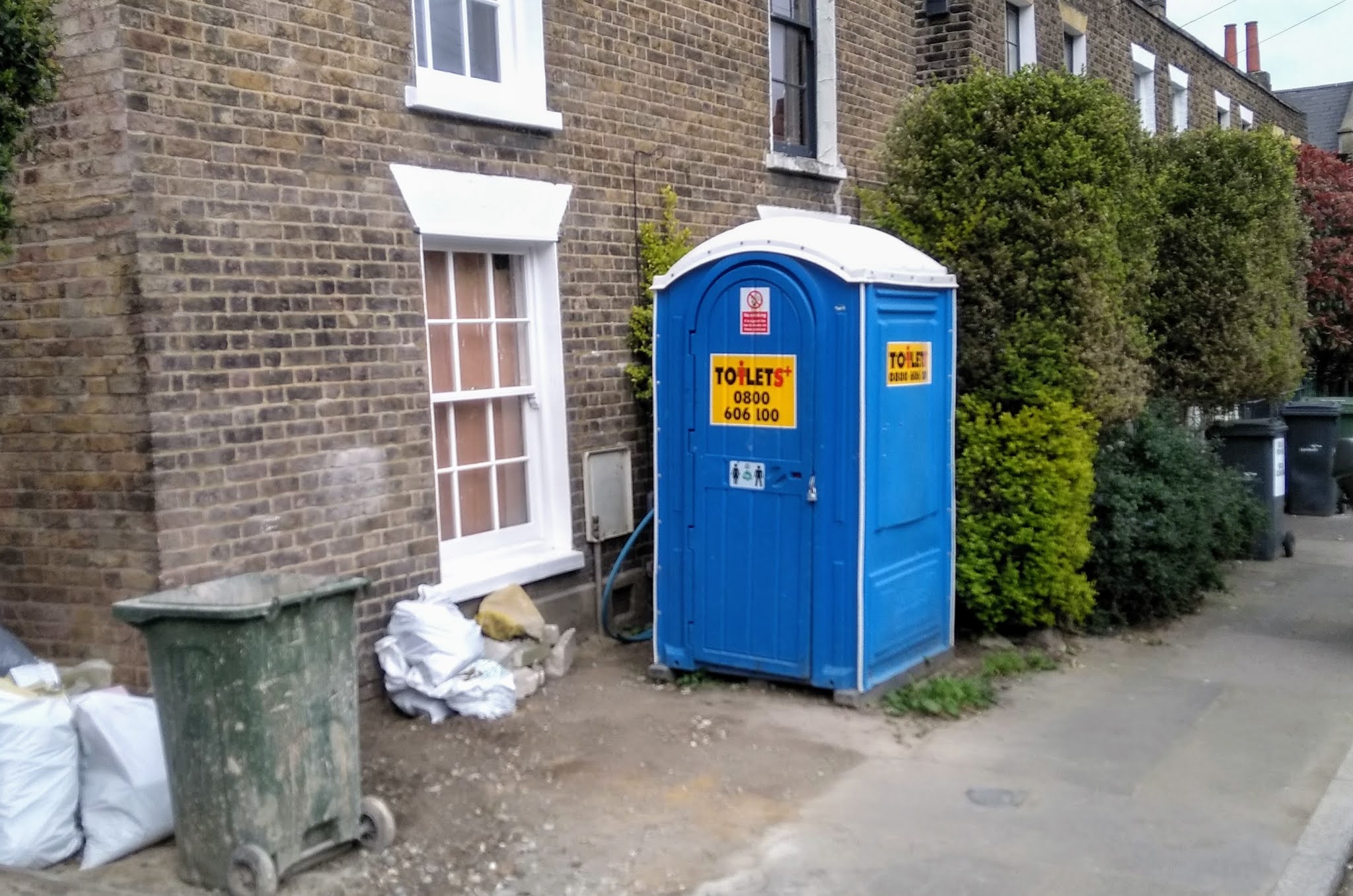
So you suddenly see lots of those blue or yellow plastic boxes outside every house that is having its innards replaced by something even more expensive.

Yes, I'm referring to those portaloos for builders that are now overflowing  (hope not literally) onto the residential pavements of South, North, East and West London. What's happened? In the past builders and decorators were quite happy to use the owner's loo when it was needed. And owners always used to let them do so, as well as offering them cups of tea and coffee, assuming there was a functioning kitchen.

But now, the entire family moves out to one of its other properties - maybe in the Cotswolds, or maybe somewhere more exotic.  So the builders have the place to themselves. Except, it seems, for the bathrooms. Perhaps the owners cannot bear the idea of not-quite-so-rich people using their gold-plated sanitary facilities. 

I can't help feeling slightly uneasy as I pass one of these private conveniences, which are sometimes only inches from a narrow pavement.  Or even on it. 

I side step, as if trying to observe social distancing: in doing so I often forget to look down and end up treading in the latest dog-do, miniature or massive. (Why do lockdown dog owners not seem to know about bagging the dirt? Another article there - but, no, don't worry,  that's one thing I can't face writing about.)

In theory the builder-bogs are emptied at least twice a week. I know this becuase I have watched the waste removal tankers pulling up across the road, to that house which has been undergoing god knows what improvements and additions for more than a year now. 

Even if you don't see this operation, you hear it as the powerful suction pumps blast into action. It's almost as noisily annoying as the dreaded leaf-blowers, which continue to shatter everyone's peace every Monday morning.

So, this is lockdown, Clapham style. Around five of the 120 or so houses in this streeet have had new super-basements excavated during the last year. There's hardly been a days when there have not been teams of workers arriving at 8am, followed soon after by the first deliveries of cement, sand, timber, steel, paving, glass, grass, porphyry washbasins and marble baths, Aga cookers, elizabethan bedsteads, Hollywood size tvs. You name it.

So, it's clear that London's wealthiest homeowners can assume they are exempt from all lockdown restrictions when it comes to building work. And are those builders also exempt? Have you ever seen a builder wearing a mask on site? Maybe they have the same immunity as professional footballers on the pitch.

I will stop moaning here and now, for a day or two. It was good to get that off my chest. I envy those workers the easy access to a toilet at work, as well as the many cigarettes they get through on the porches and open upper windows of thier clients' fourth of fifth homes. This is good: as I say in almost every posting, these days, at least these guys and (not so often) women have some paid work during lockdown. 

Thank you and good night. 

Thursday, 21 May 2020

C*****m takes a well-deserved battering in local writer's twitter thread

The horror of Clapham Common on the first hot weekend of the year. To be fair, this was taken in May 2018, long before social distancing was an allowable phrase. I took this to illustrate yet another unpublished article on the strange behaviour of  the tribes of Clapham. 


After many weeks of lockdown trying to write a post explaining why lockdown might be a good thing for the dread postcode, SW4 - along comes a much more agile critic with a twitter thread that demolishes any of my remaining excuses for thinking it's OK to live here.

In an epic 17-post twitter thread yesterday, the Clapham-raised, Stockwell-based writer and podcaster Daniel Ruiz Tizon explained why he now avoids the place he so loved as a child.

And why these days, he says, "You cannot get me to #Clapham for love nor money and those that know me well, know not to ask to meet in SW4".

Like Daniel, I also loathe what the name "Clapham" now stands for in discussions about London suburbs (these discussions have been getting very heated on twitter of late).

It has long been a mockable address.  People have been joking about "Cla'am" for two decades or more now. I stopped rising to the bait in 2003, when those same people saw the values of their sensible homes in New Cross and Nunhead and Dalston soaring.

It got to the point in the early 2000s where I started to lie, rather than admit to living here. I would say "close to Lavender Hill". Sometimes more blatantly, by saying Battersea or Stockwell. In my defence I'd point out this flat is less 100 yards from the SW4/SW8 border. But that's like saying you're slightly pregnant.

Face it, hypocrite: you live in Clapham! And are you going to move? No, of course not. Like it or loathe it, I am rooted.

In fact a lot of this blog has been about trying to justify my presence here, even though I am now much more like one of those sad old relics living and dying in their bedsits back in 1985.

I agree with each of Daniel's points about the awfulness of Clapham now. I also agree that "No part of this city, or any city, should be exclusively white and middle class".

I agree that we've lost much of the diversity, the blessed shabbiness, the easy-come-easy-go transitory character Clapham had that made it attractive to all manner of migrants, external or internal.

I was about to argue that Clapham still has a lot of that diversity, it's just not quite so visible, and of course it has. There's still that patchwork of social housing; there are still the old grandees living on the North Side in their well-padded bohemian splendour.  With their views over a Common, often including the little camouflaged tents of migrant workers: late evening campfires, accordion bands, short stay visitors, sharing common turf with the crows. Park bench business dealings. Skunk smoke under the horse chestnut trees. Lone music students practising flugelhorn scales by the paddling pool.

There is still diversity here, but as in most of London's inner-zone residential areas, it's not the diversity you notice so much as the polarity.

There's a local photographer, Jim Grover, who has revealed some of richness of the Clapham demographic, right now. His work, inspired largely by the African-Caribbean congregations of his local church, tapping into the family histories of Jamaicans of the Windrush generation, or by the Jekyll/Hyde character of Clapham High Street, by day and by night.

Yes, here I am on the defensive again, sorry. The problem is that the most visible section of the population, especially in summer, are those youngish, well-off, white, "just-down-from-uni" types that Daniel complains of. The 2020s versions of the 1980s yuppies, of which I was one, if a distinctly shop-soiled example.

The worst time is early summer, when they (we) emerge all at once from their (our) flatshares like flying ants on National Flying Ant Day, to crowd the pavements of the "Old Town", pastel-shade tailored shorts, flip-flops, carefully casual cashmere jumpers, pink flesh turning red, oh Lord. This year, perhaps because of the press coverage of breaches of social distancing, they have been more noticeable than ever.

Poor old boring old Clapham Common. Come on, you can't blame it for the packs of loose-bowelled doggies on shared dogwalker leads who foul it so, nor for the hordes of keep-fit fanatics who will happily shower you with thier sweat if you get in their way.

But Daniel has much deeper reasons for the anger he feels towards SW4  as it is now. The gentrifiers have defiled the neighbourhood he grew up in. It is much more painful for him, than for a latecomer like myself.

I grew up in the leafy suburbs of Croydon, which in those days was categorically not in London. As a child of 7, I remember how the cityscape changed as we pulled out of Clapham Junction on the way to Victoria. The view across the smoking chimneys to the steep terraces on Latchmere Road, the then-new tower blocks of the Battersea council estates, and then the billowing clouds of steam above the power station: it might as well have been the title sequence for Coronation Street.

Yes, here I go, defending the place I arrived in almost by accident after a decade of moving around the postcodes north of the river, from NW1 to W9 to SW3 to E8. Despite claiming to hate everything Thatcher stood for, I too was lured into getting a mortgage, a foot on the ladder. My foot's still on the same rung of that ladder, but all around has changed beyond recognition.

As I peer out of the window so there's a god-awful howl reverberating off the houses, a black open-top Ferrari is hovering and revving up outside, a couple of thirty-something fellers in their designer shades, are braying away.  Lockdown? Wtf's that, matey?

Yep, OK. Clapham now. You win, Daniel.


Wednesday, 16 October 2019

Angela Carter makes it four Blue Plaques in one Clapham street ....but are they all what they seem?

Breaking months of silence to report a nugget of old news from this blighted corner of the blighted city. English Heritage has at last slapped one of their Blue Plaques on the house where the writer Angela Carter lived for the final 16 years of her life, at 107 The Chase, Clapham.
Those plastic-looking venetian blinds were certainly not there
when Angela Carter owned this house in Clapham. So
far as I remember most of the house of was painted deep
blood red.

This was reported in the Guardian on 11 September, but not in many other papers. I wonder who turned up to do the honours - and whether the plaque was covered with those rather camp little curtains on a drawstring, as happened at the unveiling of Natsume Soseki's plaque a decade ago, a few houses up in the same street.

I'm not sure where Angela Carter's work now stands in the literary world, but I do know that she meant a great deal to me. To anyone who had been turned on to the subversive delights of 'alternative' fiction and poetry in the late '60s, largely thanks to Penguin Books, Carter's fiery works were irresistible.

I read one of her early novels, The Magic Toyshop, on the top deck of the 68 bus, all the way from South Croydon Bus Garage to exotic Chalk Farm and what seemed the impossibly sophisticated world of NW3 hippie-dom.

En route the bus rumbled up and down the roller-coaster hills of south London - Beaulieu Hill, West Norwood, Tulse Hill,  Herne Hill and Camberwell. There was a specific corner on Norwood Road, SE24, opposite Brockwell park, which in the early November dusk seemed to me the perfect location of this story.

That area grew in imagination: I would dream about cycling to this Magic Toyshop. In my dream,  there was always a magic second-hand bookshop next door which also sold the best flapjack. And Brocks fireworks.

When, 25 years later I moved into a rickety 3rd floor flat in Clapham, I had no idea the author of that book lived in the same postal district.

Now I turn to her journalism more than her fiction. There's a great collection of her non-fiction writing called Shaking A Leg, which includes an article "D'you mean South?," written for New Society magazine in 1977. It's about South London in general and Clapham in particular, and says more about gentrification than anything else I have read. Although the process we see now is so much more aggressive,  more arrogant and selfish, it is essentially the same. And yet she clearly still loved living where she did live.

All this was the subject of an earlier post on this blog, written when the house where Natsume Soseki lodged for the last few months of his unhappy but productive stay in London got its plaque. Carter must have known Soseki lived a few houses up the street, but I don't think she ever references him.

For along time there was a tiny but fascinating Soseki Museum in a flat directly opposite this house. Sadly it closed, and the flat it occupied was sold, two years ago. I wrote about it here.

Nor (so far as I know) does Angela Carter ever mention Dorothy Dene, the artist's model and actress who lived for a while at 103 The Chase. Two doors and a hundred years apart: Dorothy Dene was for some years muse-in-chief to the Victorian painter, Frederic Lord Leighton (whose fancifully Arabesque house in Kensington is much as he left it, there for the visiting).

Notice the same brickwork and the same property-developer-approved grey
blinds two houses along from Angela Carter. I think Dorothy and her
employer/admired Lord Leighton would have favoured velvet curtains.
She stayed in Clapham for part of the 1880s, before Leighton helped her move to an altogether more respectable address in Kensington, from which she could more readily launch herself into the West End theatrical world.

There's a Blue Plaque on Dorothy Dene's  house as well - that's three in a row for this side of The Chase. It's only a Clapham Heritage platter, and not the full English Heritage monty. But, it looks the same. And there's an interesting essay on her life on the Clapham Society website.

There's a fourth, rather less convincing blue plaque in this now quite repulsively wealthy street, with its electric gates and Fort Knox front doors; of brickwork sand-blasted to a smooth blandness; plus paved-over front gardens to provide squatting space for an obese Range Rover or two.

This rather dubious memorial is at the southern end of The Chase, where it meets Clapham Common. On the side wall of a house there's one Blue roundel and two brown oblong plaques. They all commemorate street parties held to mark recent royal events - weddings etc. None of them is official: they do not even have the authority of a local history society.

All well and good, if you must show off your adoration of the family Windsor. Almost everyone who visits here comments on these plaques. The basic thing they ask is, how come you are you living in a street of monarchists? Who put those plaques there, and why?

They are mentioned by film-maker and author Adam Scovell in an excellent article on his blog Celluloid Wickerman,  "Wanders: Angel Carter's House". This was written a couple of years before the plaque arrived. His disappointment builds as he approaches his destination via the South Circular and a Clapham Common infested with people keeping fit in lycra. Seeing these bogus plaques at the end of Carter's street is another blow to his mental image of Carter's mythical south London habitat:

"It was a realisation that the road had changed, that it was now the antithesis of any of Carter’s visions in its gaudy celebration of monarchy. Walking on, the cars became expensive and the houses either empty or rammed with envy-inducing rooms of books."

I am afraid he would find even more expensive cars but fewer rooms crammed with books, in this street in October 2019.

It's embarrassing. I just wish someone had had a street party for Castro or Che or Karl Marx (or even  Groucho). Then maybe we could have a Red Plaque. Surely Lambeth council - once famously Red itself - would allow the balance?

Maybe Angela Carter, who looked forward to seeing a "Red Dawn over Clapham" - but sadly never did – might have agreed on this one.


Sunday, 1 September 2019

Best pub in SW4: here's to The Bread and Roses and its under-appreciated music


It's a well-known and much-loved pub a few minutes walk from the mini-Babylon of Clapham High Street. It's 10.30 on a summer Friday evening, there's a great African band in full flight on stage, and there are - what - at most 25 people in the audience.

It's the http://www.breadandrosespub.com/whats-on.html, and almost every week they put on free live music, with a leaning towards soul, funk,  reggae,  jazz, and other, similarly danceable styles.

The pub - which is owned and managed by the Battersea & Wandsworth Trade Unions Council, the only trades union run pub in London  - also has a lively upstairs theatre, and runs popular comedy and open mic nights.

Last week they had a group of musicians led by a koura player from Burkina Faso, Boubacar Kafando & The Zaama Nooma Band. They played for over two hours, setting the air on fire with long, hypnotically rhythmic pieces, the deeply funky bass and drum kit section offset by this amazing koura player, who at times seems to levitate to some sort of astral plane all his own.

It reminded me of the great days of Afrobeat from the 70s, 20-minute tracks building up to multiple climaxes....and all this in a small pub next to my GP surgery. I love this place!

The pub is all embracing, all-welcoming, serving an incredibly wide demographic, the full range of ages equally represented. They do get the hordes of youngish types out for a night in Clapham, topping up on reasonable (for these areas) beer prices before they move on to the pricier bars on the high street, or whatever.

There's a constant flow of regulars through the evening, dropping in and out, many from the adjacent Clapham Manor Estate, decent low-rise social housing just across the road from hugely expensive early Victorian terraced houses. And usually a few old geezers like me nursing a pint and a half for an hour or two.
Check this place out, it's one of the best places in London to see new and up and coming bands, singers, poets, comedians; there are regular soul, blues and reggae nights. Dance, drink, eat, celebrate!

Update April 4 2020: Obviously, like every other pub, The Bread and Roses has had to shut down for the duration of the Covid-19 pandemic. I revived this post to remind myself of better times and maybe in the hope it finds its way into the minds of a few others who will make the trek to SW4 to experience this gem of a place for themselves. The original story does not mention that the B & R also does great food, and has a large conservatory area and a garden, as well as a terrace out fron which is popular with smokers etc....it really is the perfect place for socialising, any day of the week. Please god it survives!


Friday, 20 July 2018

Note to Brixton graffiti writers: thanks, nice...but we've too many yups here already

Some useful signposting on the overground rail bridge in Brixton High Street...trouble is they all tend to go right, straight to
the Pop Brixton container park....
That new bit of graffiti on Brixton's high-level rail bridge made a nice little photo-story for the Brixton Buzz site.

The writing is on the bridge. It reads: "Clapham that way, you 2D Flat White Tepid Colonialist Yuppy Wanker". There's an arrow pointing west down the Overground line towards the next stop: Clapham High Street.

Yes, it's fun, it's funny, it's to the point. Clapham was thoroughly yuppified back in the 80s - and that strange breed still prevails in much of SW4. But please, I've lived in the bloody area for longer than is reasonable, and the last thing we need is more of the buggers!

In reality the Yuppie has changed a bit since the 80s. Maybe the truest 2018 successor to the yup is the hipster with their artisanal this, their authentic that; the obsession with everything being just so. And of course they would not be seen dead in this postcode: strictly east and southeast London, please...

Vaguely hipsterish people I've met like to mock SW4: it's either Cla'am or Crapham. Probably the least fashionable place in all of London, from the viewpoint of Hackney Wick or Peckham Rye.

What used to be the yuppiest bits of SW4 are now colonised by corporate types - families with live-in au pairs and even chauffeurs living in huge houses. They are much, much richer than thou, antiquated Golf GTi driving yuppy of Peter York fame!

But keeping an Attenborough-ish, threatened species eye on the place, it's clear there are still millennial versions of real 80s-style Sloaney yups in Clapham, with a few differences. 1980s yuppies bought their crappy flats; the 2018 versions have to rent. They tend to share flats in the slightly cheaper parts of the area. Here they often mix with another strand of the young professional type: sports-mad Aussies, Kiwis and South Africans who for some reason still seem to love SW4. Probably it's the proximity of wide-open space on which to play games with strange shaped balls and frisbees.

The first hot weekends of the summer are prime-time for yuppie-spotting
How consoling it is that the young flock to our great open spaces at the first
real sniff of summer: May 19 2018, Clapham Common...
Every bright morning, every evening, the Common is a nightmare of grunting and sweating types, trying so noisily hard to get in trim like their bronzed Australasian neighbours.

But the core breed, yuppie lethargica, are most visible on the first really warm weekends of summer when they come out en masse and sit their well-fed, pastel-coloured-tailored-shorts-clad bottoms down on that little triangle of the Common nearest to the Old Town shops.
Sadly, they know nothing of re-cycling or even taking their litter (Prosecco bottles, etc) away with them. All the rubbish bins will be overflowing with over-stuffed orange Sainsburys carrier bags by early evening.

....but how sad that they so often neglect to take their rubbish
with them.
The richest ones (who live in the more expensive new builds in Old Town), will show off their powerful sports cars, often annoyingly revving the engines for no good reason at traffic lights. That really is wanker behaviour.

Yet, as one commenter on the Brixton Buzz story says, Clapham is actually a bit shit: it was always a byword for the "ordinary" suburb, ie mediocre, drab, stuffy. And it always will be.

It's not really a place, it's a collection of tube stations. It has no real centre: it's defined, if by anything, by a dirty open space - Clapham Common. The better bits to the north are either Stockwell borders or Battersea-Nine Elms borders. The better bits to the west around Lavender Hill are Battersea. The southern bits improve when they become Balham.

There are a couple of visibly smug areas - Clapham Old Town, Abbeville Road - that typify that first wave of well-heeled yuppiedom. Many of that first wave moved a bit west and south when they shacked up and had kids: hence Nappy Valley (really Battersea again, by Northcote Road, wrecking what was once a decent street market).

But there's a lot more to the social fabric of this district than the stereotype would have you believe. There's still a lot of social housing, and there are still a few hanging-on 1970s boho types, who, as we all now know, were actually the first essential phase of re-gentrification.

This blog has tried to throw some light on the social history of the area. But no-one, in recent years, has done more to reveal the many layers and deep and diverse roots of Clapham residents than the Jim Grover , who has had five acclaimed exhibitions in quick succession, all focusing on the area and the people who live, work and play here.
A fine example of a "Front Room" display cabinet, a rarity
now, but these took pride of place in many West Indian family
homes in south London back in the 60s. From Clapham-based
photographer Jim Grover's recent Windrush Generation
exhibition at the Oxo Gallery, London SE1.
photographer

His most recent show was Windrush: A Portrait of a Generation, a celebration of the West Indians who arrived in this part of south London 70 years ago. He got to know some of the original Windrush passengers and their children and grandchildren at his local church; as with all his work, he earned the trust of the people he wanted to portray before getting out his camera.

Other exhibitions have focused on the long-established Café Delight at Clapham North and its varied clientele; the double life (daytime and night-time) of much-maligned Clapham High Street; and the work of a priest at the church in Clapham Park Estate. It is already an impressive body of work that shows this area in a very different light to the media stereotype.

It's work like Jim Grover's, patient, painstaking, that truly reveals the complexity of a neighbourhood, of communities; lives that are led, families that flourish...others that do not. 

But thanks anyway graffiti people for reminding me of the way home. As for being a yuppie, well maybe 40 years ago. 2D? Well I guess I know what it means: bland, dull, fake. Flat, yes, flat white. But am neither smooth nor sane enough: I'm more like 5D. Flat-white? I prefer espresso. Tepid? Yeah, OK. Colonialist? Well, had to live somewhere. At least I got out out of Dalston just in time so that the real Dalstonites could move in. Wanker? Obviously.


Saturday, 12 May 2018

Rookery Road on Clapham Common: the re-surfacing job that time forgot...

Rookery Road cuts across the north-east corner of Clapham
Common. It gets very heavy traffic (as you can see) and yet it has
not been resurfaced in decades. Unlike all the other roads
around here. Why not?
Both Lambeth and Wandsworth Councils have shown exemplary enthusiasm when it comes to re-paving certain troubled areas of their boroughs.

Soon after the 2011 riots, the whole of the Clapham Junction area broke out into a pleasing arrangement of tastefully-variegated pastel-shaded paving blocks: the old dark grey filth-stained pitted tarmac and granite gave way to soothing garden centre chic.

Seven years on this lovely new work is already showing serious signs of decay; no material known to humankind can cope with the daily downpour of spat-out chewing gum, nor the vile stains of McDonald's toxic shakes as they dribble out from discarded polystyrene buckets.

Let alone the pollution from tens of thousands of combustion-engined vehicles passing through the junction every day.

Meanwhile, Lambeth labours away to make little bits of nice street furnishings: Clapham Old Town; Windrush Square; Stockwell Cross. Weeks and months of disruption to locals and passing traffic as gangs of workers rip up the old and carefully lay the new.

All jolly good - we suppose; if we are charitably-minded. What a splendid way to use our council tax quids.

Pity they totally fucked up the traffic flow in Clapham Old Town in the process - giving even more rat-runs to the mumsnet SUVs and off-white-van drivers, confusing cyclists with a ridiculous cycle-lane layout and sending pedestrians all round the houses to find safe crossings. Trouble with those rat-runs is drivers tend to speed up when sneaking into them, hoping they won't be spotted.

And - AND - above ALL! - what about Rookery Road? Yes that little but very important bit of road between Clapham Southside - the main A3 trunk route - and the left turn turn down to the Northside one-way system.

The deeply pot-holed surface of Rookery Road: enough to throw you off
your bike and under the wheels of a speeding SUV.or whatever.
Who will take responsibility for this death-trap?
This couple of hundred metres of road sees very heavy traffic. It is called Rookery Road because it passes under the great plane trees that still accommodate  some truly fine murders of big black bastard carrion crows.

But the surface of this road is also MURDEROUS! It's bad enough in a small car - but approach on a pushbike at any speed and you are dead. Especially if you are trying to position yourself centre road to take the north-flowing lane towards Old Town and Larkhall Rise.

Does this bit of road not fall into one or other borough's care? Who is responsible for this? Most of the other roads around there have been re-surfaced two or three times since even one bit of gravel has been replaced here.

Why?

Maybe Lambeth and Wandsworth think the crows should do it.


Friday, 24 June 2016

The stupidity of the EU vote: problem one, how to control the rage?

Been feeling physically sick since about 2.30am today when it became clear the "leave" people were going to win.

The feeling, at 7am, that if I didn't look at the internet or turn on the radio, it might not actually have happened.

The feeling, during the day, cycling around south London, that every sighting of a Union Jack or St George's flag triggered an immediate desire to deface it with red or brown paint. You know, a bit of reciprocal vandalism, a sort of childish urge to hit back at the types who have shat all over our (and our children's) futures.

Sadly, many such flags, sodden with the earlier rain, are flapping around in this very street.

A sort of provocation, a squad of dangling insults, these flags were strung out two weeks ago for some snooty street party, ostensibly to celebrate the queen's birthday, actually to celebrate just how frightfully rich most of the residents here are.

And they left the flags up. Last week they seemed merely pathetic, today they seem insulting, in a borough that voted 80 per cent to stay in the EU, that voted overwhelmingly to support and extend the supra-national European project.

So the sodden flags dangle and flap. At least many of them are pink versions of the flag, LGBT jacks perhaps, nice thought, maybe that's OK. The tolerant UK flag. But maybe not....check out the fake blue plaques on a wall at the southern end of this street, celebrating two earlier street parties to celebrate two other events in the life of the dreary Windsor family.

Please, take down these flags!

It's a time to grieve and mourn the destruction of 40 years of efforts to bring people together, to soften borders, to encourage mobility, to increase understanding.


Sunday, 29 November 2015

Peter bows out: a bit of Clapham High Street that should forever be Greece has gone. Almost...

Peter the Greek's final, final closing down sale last week: another bit of old, untidy Clapham is about to disappear
to meet the tidy, buttoned up and thoroughly steel-gated demands of London's property vultures.
2015 will be remembered for plenty of bad reasons. For some of us, amongst much else, it will probably go down as the year in which two of the pillars of Clapham's small but tenacious Greek Cypriot community finally chucked it all in, and called it a day.

If you've been listening to ace SW8 podcaster Daniel Ruiz Tizon's marvellous interviews with Andy, the Greek Cypriot barber of Landor Road, (Part 1 here and Part 2 here)  (and if not why not?) you will know that he is now really on the verge of retirement, after half a century of expertly wielding the clippers and the cut-throat razor to the astonishing parade of characters who have navigated this important furrow between SWs 2, 9 and eventually 4.

So, if you believe him, Andy will be back on the isle of his birth, tending his vines and the olive trees, in January 2016. Meanwhile, it seems that Peter,  the Greek second-hand-goods dealer of Clapham High Street, has also finally had to shut up shop. His lock-up on Prescott Place will soon disappear and be turned into yet more expensive residential property.

His final day was officially  Monday 23 November - as the often repainted "Closing down sale" banner made clear. But by the end of that day the bailiffs had not turned up, so Peter kept on trading a little longer….and then, a few more days…but one day soon, he will be gone.

The vine begins in the soil of a tiny garden
outside  St Peter's Catholic Church...
You wander down Prescott Street today and the shop is shut-up. But even when the single storey lock-up is demolished, there's going to be a durable reminder of his two or three decade presence here. It's a grape-vine, which was planted back in about 2009 in the tiny bit of garden by the side of the catholic church, which by happy coincidence is dedicated to St Peter.

Amazingly the vine has thrived, twisted itself round the corner, and started out on a long journey towards the joys of Clapham High Street. If you look at it even now there are clusters of this autumn's black grapes still hanging down.

According to Peter, once it was established the vine needed very little maintenance, "Just a little cutting back in the spring".

Will he be there to do it next spring? "Who knows."

It has now advanced about two-thirds of the way along the wall of the Two Brewers bar and nightclub on its way to the main road. Peter's hoping he'll live to see it make  the full distance. He;s got another growing along the alley-way behind his flat. It seems vines like Clapham soil, and like Andy, Peter clearly knows how to cultivate.

Unlike Andy, Peter's not planning to return to his birthplace. He likes Clapham and wants to stay here. It seems though he still has further battles, to do with where he's living, to get through.

And it continues along the wall of the Two Brewers, one of Clapham's most
famous gay bars, on its way to the wide-open spaces of the High Street
But, as for the shop, from what he told me, he did not intend to oppose the closure, as he's ready to give it all up. The shop had been quite busy recently, and whenever I visited there were plenty of people trawling through the boxes of books, records, glass, china, and the rails of clothing.

For Peter himself, maybe not such a bad outcome - but for this curious bit of Clapham, which had hung onto its 1980s feel far longer than you'd expect in an area now swamped by a second or even third generations of blond and blazered and chubby-cheeked ex public schoolboys and their well-groomed gals - it's a serious loss. One more of a very small and fast dwindling number of independent, totally  ungentrifiable business ventures, makes its exit, stage left.


Sunday, 11 October 2015

Clapham's last real junk shop given two months to clear out

Closing down sale of the last century: Peter and his son outside their Prescott Place shop, which looks set to disappear for good by November 
Walking east down Clapham High Street, it's very easy to miss a hidden survivor of an old but almost extinct London institution - the pavement junk-shop.

Next time you walk this sticky main drag, keep to the north side pavement, and when you get to Prescott Place (just after Snappy Snaps) look to the left and you'll see a scene that looks more like a bit of Brick Lane in the 1980s rather than Clapham in 2015.

The narrow street, which has one of Clapham's best known gay bars, the Two Brewers, on one corner, is also home to Peter Chrysostomou's second-hand store. When it's open, all manner of stuff - pictures, furniture, coats, old radios, books, potted plants, hatstands, boots, you name it …are spilling out of his store-rooms across a non-existent pavement and onto the double-yellow lines. The interior looks too crammed with stuff to enter.

Eager bargain hunters know this is a great place for nosing out old frames, china, glass, an ancient camera...you name it….Clapham's very own one-man flea-market. Surely this little bit of old London will be treasured by the new generations of style-conscious hipster-yuppies?

Not a bit of it. Peter has been served notice of eviction, and has just had one possibly final stay of execution, two months after the expiry of his lease.

He's now facing demands he clears out the premises by November 15. So the big sign advertising his  long-running "Closing down sale" is finally, sadly, going to be true.

On one of the shelves outside there are two picture frames, each containing what looks like a page of text torn out of magazines. The articles are both about the house in Clapham High Street that once belonged to the widow of Captain James Cook,  Elizabeth.  I am not sure if these are there for information or for sale, and try to catch the owner's eye. But he's shutting up for the day and framed pages are put away before I can read any of the detail.

So I decide to come back another day, and I ask him about the "Closing down sale" and how much longer he'll be there. He immediately seems suspicious: "Why? Who are you? A taxman?"

 I assure him I'm just a drifting unemployed refugee from the modern world, a low-grade scavenger of stories,  and then he opens up a lot and starts listing the various authorities by whom he's being chased. "Police, Fire Brigade, council, all the people in uniform…"

They are, he says, all out to get him and this time there seems to be no hope of avoiding the ultimate killer blow, eviction. "I've been in Clapham 50 years" he says. "But this will be the end of it."

I have no idea about the rights and wrongs of Peter's case. He's understandably stressed and distressed and feels hemmed in by people who just want to make him and his shop disappear.

All I know is that the sort of place Peter runs is now a seriously endangered species in London. It's a truly scarce commodity that should be valued. You walk past all these dreary chain stores, or even worse the endless estate agents occasionally punctuated by silly overpriced food stores or gift shops, then you see down this dark narrow street a glimpse of a pre-(Falklands)-war world of bartering, thrift, bargaining, men in big coats arguing over a bit of furniture, it's all straight out of an Ealing comedy or something earlier.

It's also real, and as such will inevitably die. But does it have to die so soon? In this new age of Mr Cameron's austerity, there are an awful lot of us who need to pick up some stuff dirt cheap, and I haven't seen many decent saucepans at the 99p Shop recently.

Peter has a son who tells me his shop used to be on the High Street, in what is now a Trinity Hospice Charity shop. This is double-edged blow for me. It reminds me that I am here as part of an attempt to update an earlier entry on the best charity shops in the SW quarter. It also reminds me I once worked for these Trinity Hospice shops. And it reminds me that charity shops - much as I love them - have severely cannibalised the second-hand retail trade. Charities have insuperable financial advantages over all their independent retail rivals. They pay no tax or VAT, they get low or zero rents, they get their stock for free and they don't pay most of their staff.

Like I said,  I love charity shops (and my nearest and dearest will say I love them too much). But it's clear they more or less wiped out that whole tribe of junkshop entrepreneurs. Some of course have joined the charity bandwagon (because there is money to be made there still - the ragging, the occasional gem that be picked up for 50p  and flogged on to antiques geezers for 50 times the price.

But, overall, this massive retail shift has squeezed out the mid-range antiques shops, nearly all the low-price second-hand book shops, and many others. Old clothes shops now have to be "retro" or "vintage" to compete.

So, back to Peter. I am hoping to talk to him at more length soon. But if anyone has any reminiscences of this shop, or knew it in any way, or knew similar shops in their area that are still operating, please for pity's sake let me know!


Tuesday, 22 September 2015

Mud, grass, more mud: a storm in Clapham Common's dirty SW4 festival teacup


Oh, think of the joys of dancing to Fat Boy Slim or whoever in all this glorious mud….just another pic of
Clapham Common post-South West Four festival 2015

As usual,  complaints about the impact on Clapham Common of the annual and increasingly popular dance music festival, South West Four, have been coming in thick and fast, with the Friends of Clapham Common making their annual protest along with the Open Spaces Society.

For the second year running the massive pills, balloons and pilsner fest coincided with August bank holiday torrential downpours. As a result, a month later, the common still bears the scars of this two-day event, attended by thousands buyers of what strike me as very pricey tickets for dancing to a bunch of ageing djs with an admittedly very big hi-fi system and lots of mud.

Not unusually I am in two minds about the whole goddam quagmire fiasco.

Yeah, right - remember this you oiks!
I usually like the idea of this Common - which , let's face it, is a pretty unlovely patch of NOrth Surrey sediment - being used for music events, however big. While I'm personally not that much into electronic dance music, and do not have much love all its millionaire club DJ superstars, and its crowds of screeching 18-25 year olds with their tangerine-tan legs and their floral wellies,  well, it's all too young for me obviously, much but then, it is a well established event. And grass does grow back. And the fireworks at the end were nice.

I'd be a filthy hypocrite to condemn this lot. I couldn't believe my luck when within a few months of moving into this area I got to see the best and most beautiful soul-jazz singer of recent times - Sade - at a huge free Anti-Apartheid concert on the Common.

This event, in June 1986,  was huge, and yet surprisingly little remembered. Apart from Sade, we had the ubiquitous (then and now) Billy Bragg, but so far as I remember there were also appearances by Culture Club and the late Gil Scott Heron…but maybe I am misremembering. There were so many of these events in those days of GLC vs Thatcher.

Later on there was a series of smaller GLC-sponsored gigs at the bandstand, where I was lucky enough to see  Dr John and Desmond Dekker amongst others (I have the photos to prove this!) I also have hazy memories of a big reggae event which I think was called London Sunsplash after the Jamaican events, as well as a good crusty thrash-fest with people such as Transglobal Underground. All, needless to say, were free.

Then in the mid to late 80s we had annual visits from the hardcore French circus troupe, Archaos. One of my many abiding regrets is that, in all those weeks of rushing to and from work, across the Common, back again, passing each time all these wonderful Archaos people, their massive tent-arena, their lights and sounds and their outlandish vehicles (I remember a big old Citroen covered in a sort of thick plaster crust of shellfish…but maybe I was just drunk that day)…hesitating, breathing it all in, and then off I went, back to my domestic joy.

Many if not all of these events elicited hostile responses from the Clapham Society and the FOCC, and so I developed a dislike for them. It seemed they were a bunch of privileged residents, probably living in those gorgeous houses lining the north and west sides of the Common, of a certain age and class, and perhaps they did not like their rus-in-urbe bliss being smashed into by all these smelly left-wing oiks…and indeed they still don't.

Another delightful aspect of those days were the summer Sunday Latin American football fiestas on the  cinder-dirt pitches up by the South Circular. Even if, like me , you didn't care much about football, you would be drawn to walk along those paths near these pitches, where the open-air feasts were getting going, the smoke of the barbecues and the improvised grills, the drumming, big family groups seeming to follow a deeply compulsive choreography, the Latino or Brazilian or Cuban or whatever music was thumping  out of various ghetto blasters, people seemed so happy, whoever was winning!

These people have long since shifted across to the new Burgess Park in SE1, so much closer to the heart of their community. Now the Common is infested by (sort of) poor rich kids from the SW London commuter belt. Ok, plenty of them continue the fine traditions of Sunday afternoon soccer.

But these days, every day, they are outnumbered by the fashionable runners  (jogging seems to have gone well out - "I do not jog, I run!" ). Then there are the big, sad groups of post-work or Saturday morning fitness-seekers, they are being shouted at by some fat ex-squaddie bastard charging £30 an hour to bully them out of their cellulite. Sometimes all you can see is a sea of rippling dayglo lycra. Bottoms up, dears.

I can't say I like Clapham Common as an open space. As one lifelong local told me, it is without doubt one of the filthiest places in the UK.  I think that's inevitable: here it is, open and unguarded,  24 hours a day, surrounded by …well, all of south London's residential streets. People do things here, they dump things here. In the warm months they more or less live here. It's dull, but it is a real common.

If it can remain truly common I will continue to love it for that virtue. It must be a place where anyone can do whatever they want, more or less within the law….OK, less.

So there it is. The first memory I have of the Common is on school trips to the West End, for theatre or museums or whatever. Crossing the Common on the A24 was a sign of leaving suburbia and entering the city. If that's still the case, who knows…this filthy old bit of mud and grass and litter and stunted or tortured trees, and dog-shit, and stagnant water,  is still as common as the muck it is made of , and  that much the better for it.


Wednesday, 22 October 2014

Deep autumn blues blown away by red-hot sax on Clapham Common

Sax player on Clapham Common helps blow away autumn blues with some great John Coltrane phrasesLife can seem like shit at this time of year in SW4, especially if you are broke and adrift and 61 years of age.

The beautiful sadness of autumn can be thrilling if you have the heart for it, deeply depressing if you haven't. Anyway that's the sort of crap I was pondering on a recent walk around the common, late afternoon, after the school's out crowds but before the commuter rush.

Heading towards the  boating lake, the yearning sounds of  someone practising jazz tenor saxophone resonate across the  plate-glass water. There's a bloke in blue sitting on a bench on the other side of the pond, and he seems to be blowing his heart out with these repeated phrases, which sometimes seem almost to rip the fabric of the air they travel through.

Gradually he builds it up, adding a few notes each time, until it's unmistakably from Coltrane's A Love Supreme.

Another man, perhaps his friend, joins him on the bench and just lies back to enjoy the music and his bottle of whatever. Solitary walkers and a few couples  are watching from other benches. I move closer, stop, listen, move on, walk back across towards the North Side, still hearing those fabulously melancholy yet paradoxically uplifting riffs.

If I hadn't already been a jazz fan this would have ignited my interest. Instead it re-0ignited this dormant  flame. Thanks, anonymous sax player. I wish I knew who you were.


Thursday, 18 September 2014

Oh the horror! Roundabout succumbs to Nine Elms ravages

Watch out, Nine Elms Disease is coming your way.

It's spreading fast, its viral spores shunted around at speed by massive concrete mixer-trucks that rush up and down Silverthorne Road, spilling a little of their load as they go. If you're a cyclist, you are quite likely to get one of their little pebbles shot into your eye from under the fat tyre of a speeding car.

I'm astonished the council (Lambeth or Wandsworth?) hasn't stepped in to do something about the destruction of the road surfaces, particularly at the junction of Silverthorne and Wandsworth Road and down by the one-way junction of Silverthorne and Queenstown Roads.

This is where the trucks - which have just feasted on fresh ready-mixed concrete from the massive silos of McALpine's London Concrete Ltd - storm off in a cloud of dust to dump the material at some building site or other.

But the latest horror is the speed with which it has destroyed that perfectly harmless old floral roundabout hub at the south-east entrance to Battersea Park.

It's hard top cycle through any of this area at the moment because the air is so full of dust. When they were destroying the old MArco Polo House, it felt like sharp bits of marble were shredding the linings of your throat and lungs. Now it's the powdery cement dust sieved over everything by those speeding dumper-trucks and mixer-lorries.

God help us, residents of SW8, 4, and 11. God help us one and all.


Thursday, 3 July 2014

Clapham Old Town: A good place for single people who wish to remain single

This bit "of urban regeneration" around the Pavement/Polygon area of Clapham has already come in for some stick here - most of all for its murderous, Alice-In-Wonderland approach to bike lanes.

There's another aspect which only became startlingly clear right at the end of the project. This charming "piazza" where Claphamites (not Sodomites or Catamites, you understand) can stroll around showing off their very expensive designer gear and haircuts to each other.

Single-seater piazza in London SW4 - lonely old town, as they say.
We are single and we will damn well stay single: Clapham Old
Town's new public space  boasts seating arrangements are great
for the aggressively anti-social: don't invade my space, OK yah?
Sure, the mustard yellow surfacing of large areas of this "piazza" will not flatter many skin tones, but at least it's a big open space with no cars; well not many cars - going over it.

But if it's wonderful for good old-fashioned Clapham yuppy posturing, it's definitely not meant to encourage socialising.

Look at the seats the council has so thoughtfully provided for our rather onanistic population.

Yes, they are all one-seater affairs, placed at weird angles to each other. As though wanting to stop people reading newspapers over your shoulder or whatever.

Just far apart enough to make conversation difficult.

You see, if you want to socialise in SW4 you are meant to go to one of the designated places - a bar or restaurant or "patisserie" or "brasserie" or whatever - and pay through the nose for it.

Of course, there's the Common for the Common folk, like me.


Monday, 30 June 2014

Clapham comes up smelling of Bread and Roses (sort of)

Having consistently slagged off my own neighbourhood in this blog, I decided - over a lovely £3 pint of Guinness at the Bread & Roses pub in Clapham Manor Street - that in all fairness I should praise the good aspects of this fair borough.
Poetry guaranteed to lift the spirits even after the grimmest Northern Line commute -  thanks to the cultured staff of Clapham North tube station
Poetry guaranteed to lift the spirits even after
the grimmest Northern Line commute
 -  thanks to the cultured staff of Clapham North tube station

There's the first and one of the best things about the SW4 area - this pub is just as good as it ever was, and by that I mean it feels to me just the same as it did in 2004. In fact, not even the prices seem to have changed much, and while the street it is in has undoubtedly seen a five-fold increase in house-prices, the local people seems just as mixed-up and crazy and strange as ever they did.

With all the high-visibility gentrification and ruggerisation of this area, of yummy-mummification of
twixt-commons nappy zone, the banker-wankers of old-town, and boot club anti-tummification of the common itself, you can be forgiven for forgetting that Clapham is still a deeply diverse place, it still has a great clump of deep roots, as deep as the deep shelters at Clapham South where the first post-war West Indian migrant workers were supposed to sleep.

Lots of good reasons to like the place, starting as soon as you exit the Northern Line at Clapham North and read their daily quote chalked up on a board as you head for the ticket barrier.

Whoever chooses these has some genius, setting you in a frame of mind to appreciate the true spirit of this once radical borough. Remember this is where the Clapham Sect met to push through the biggest humanitarian reform in British history - abolition of the slave trade.

Hard to imagine it now beneath the onslaught of Range Rovers and yummy mummies and chaps in rugger-shirts, this place til quite recently was favoured by the left-leaning, the bohemians. Hence the HQ of the Socialist Party of Great Britain in Clapham High Street, the trade union HQs in Old Town, the former squats in Rectory Grove.

All going or gone, now, but before it all disappears completely, do something!


Thursday, 30 January 2014

Toilets to let as Clapham Old Town "regeneration" nears completion (we hope)

Last year it was Clapham Junction - this year, its Clapham Old Town getting the local authority regeneration treatment, which, as was discussed elsewhere on this blog, seems nowadays to be largely a matter of paving, street furniture and curbstones.

The current refurbishment of the area  - written about recently on the Love Clapham blog - aims to liberate some of the space around the area known as the Polygon.  Right now it is a hell of mess - you have to pity people living in that charmed pentangle, which is now a mud bath surrounded by hideous green and orange and white and red plastic barriers, with workers' loos housed in curious zebra-striped huts-on-wheels.

It seems an enormous disruption for what, looking at the plans, is a chiefly cosmetic operation. OK, the Polygon was a wasted space - a lovely bit of the Old Town, a gently sloping triangular space ruined by the busy roads bounding it on all sides with a bus stand taking up much of the apex.

Check the (lovely shiny all-new) Lambeth Council site for what the finished project will be like. Clearly, the traffic side is improved, but it looks to me like the pleasingly scruffy patch of grass - the last gasp of the Common - just south of the pub - is to be sacrificed on the altar of tidiness and conformity, to the deity of tasteful paving slabs.

It's truly entertaining to look at the architect Marks Barfield's computer-generated images of the completed project. It's a clever montage of photos of real people - a perfectly  representative sample of the men and women and children on the Clapham omnibus - clearly amazed by these vast new wandering areas! Some of them look quite stunned to be there, to the point where they don't notice the person they're about to bump into.

Strangely, we don't ever quite see what is going to happen to the notorious old public toilet block - once a hotspot on the south London cottager's personal A-Z (I know this for certain as I once wander in there innocently in about 1986 and was astonished by how crowded it was, and how many men seemed never to finish their peeing).

Passing there today I noticed that what was once a public toilet is now "to let" - yes, the old schoolboy
A lovely cottage on the Common, yours for a price. The old public
loos at the Polygon, Clapham Old Town, are now up for rent as
another big Lambeth regeneration project nears completion
vandal joke lives on. They're also trying to get some interest in the even smellier lavs by  Clapham Common tube station - if only our lovely council would realise why these places were created with so much love and care in the first place. Humans need to get out of their homes, they need to move around, and about every  two or three hours they need to drop some liquids or solids. It's simple.

BUT - let me end on an immensely positive note. Maybe as part of all this work, the council contractors have done something beautiful. In a stroke, they have liberated an area imprisoned by iron railings for decades.

The removal of the railings around those sad patches of grass between the tube station and the Common is a revelation - suddenly;y, we have real space. Please, don't bother to landscape this - just think of it as
a bit of the Common that never managed to cross the road. Love.


Sunday, 11 November 2012

Angela Carter , a street in Clapham, and a homesick Japanese novelist

It's almost 30 years since I moved to this street. It was January 1985 - a very cold January. My father had just died, I was recovering from the funeral and all that fallout, and at exactly the same time I realised I was living in the same street as one of my favourite writers.

Clapham was a dirt cheap place to lodge
 when Soseki came here in the 1900s.
Two of the many often bewildered
 Japanese literary pilgrims photograph
 his Blue Plaque.
I remember going to buy a Sunday paper. I got back to my new  front door and realised, with a strangely un-panicked realisation, that I had forgotten my keys. There was snow blowing all around, settling lightly now. I was simply thrilled to have a new flat in what seemed to me at the time, a rather lovely street, wide and lined with beautiful, gaunt trees. And I no longer had a father.

Luckily the house was in scaffolding. I scaled the three or four ladders, I climbed over the parapet onto the roof, and  slithered down a drainpipe onto my own roof terrace and in through the bathroom window (I am too fat to do that now).

I made some coffee and started reading this plump bundle of newsprint. In the colour supplement, Ian McEwan was writing about visiting Angela Carter. As I read it I realised he was describing my own street. How the  terraced houses crowded together as if for mutual protection as they approached the social border of Wandsworth Road. How hers was one of those last houses before the badlands of the Battersea marshes and their sprawling estates.

How her famous visitors sauntered down the road, looking at house numbers, wondering, where on earth does she live?

I encountered her a few times in the newsagents, but I was a fan, awestruck, struck dumb, mumbling nonsense. "Hi. Keep well, it's freezing out there ...", etc.  Never daring to say how much I loved her writing.

After that I was always watching. I was so proud to have such a wonderful near neighbour. I found out all I could about her, and soon realised she was (like me) an aboriginal south Londoner.  She had even worked as a junior reporter for the Croydon Advertiser (I tried to get work experience there, they sent me away).

This amazing woman with her commanding presence, that face,  that beaming smile, the extraordinary cloud of grey hair, and then - not , as I remember, so long after, her child, the baby in the pushchair, the shy man who I imagined was her husband....

Soon after this, I discovered that another well-known writer had lived even closer. The Japanese novelist, Natsume Sōseki, had been sent to London as a young man, and had found miserable lodgings - about six doors up from where Angela Carter lived. Opposite  the house where he endured a foul
English winter is a small museum devoted to his works.  In the summer,  Soseki fans (usually middle-aged Japanese couples, or younger, often solitary, students) would arrive in The Chase to visit the museum, and to photograph the blue plaque. Often, I would see them looking puzzled,  and think, should I volunteer some information? Offer them tea? Then think, well, they will soon find what they seek - and the last thing they want is inadequate help from some bumbling, clumsy Englishman.

The Blue Plaque was added about five years ago, a crumb of comfort to those Soseki followers whose plans to erect a statue of the writer on Clapham Common had been thrown out after a particularly mean-minded and xenophobic campaign by the so-called "Friends of Clapham Common".

Angela Carter lived in Japan in her 20s, and I assume she was well aware of this connection. But was it a coincidence that she moved  into this street? As much as Soseki loathed London, and especially loathed Clapham, so Angela Carter seemed to feel at home here.

I wonder how she'd feel now, about this street, dominated as it is by super-rich city types with their Range Rovers and Aston Martins, their royal connections, their street parties for the queen's jubilee and the wedding of william and kate. I wish she was still around to ask, because now, having shed that vile false modesty and shyness of the hobbledehoy, I would ask her too.