Just in case you think I am a stupid old nutter, ranting on about the modern world and how it's ruining London…. read this article on Al-Jazeera.
Yep, the Qatari-based news channel is running this story about the rampant greed that is currently destroying the cultural fabric of this strange "city" we live in.
The studio in question, SARM, is famous for many reasons - Queen, Bob Marley, Band Aid and many others - but the point is that there are only so many of these iconic places left in London.
And the real point, behind this point, is that the people who own these places are now under irresistible pressure to sell up and move out. It no longer makes economic sense to run a a recording studio - that is, a space equipped for the production of a highly valued global commodity, popular music - in the central zones of this city.
A music factory - one week's recording of artists such as those named above might produce a return of a hundred million over a decade - is simply not profitable enough in a "city" where similar sums can be made in a few days or weeks by hedge funds.
About the only creative industry that can still survive in central LOndon (apart from creative accountancy) is fine art - and that is thanks to the curious bastard child of the art-marketing revolution of the 1990s, Frieze and all that - that fine art has become a high-value commodity on a par with arms or diamonds.
Earlier today, on the excellent Robert Elms Show on Radio London, I heard a musician lamenting there was only one full-size recording studio left in this city, Abbey Road.
Once they've all been turned into expensive places for expensive people to spend a few weeks of the year shopping in expensive shops or doing deals - well, the next generation will have very little reason to be interested in this brutal Thames-side mudflat settlement that was once so attractive.
It is now, visibly, the place to come to spend the vast amounts of money you have acquired by crushing the spirits of millions of others in other parts of the world.
We live by the river. We watch Waterloo sunsets, we know it's the Great Wen. We don't do the Lambeth Walk and we don't want to go to Chelsea. I was there this afternoon and I tell you, it is dull, dull, dull these days.
SO, if we manage to dodge their 4 x 4 wagons on our bikes on our way to our little part-time jobs selling things to these very rich people, or pampering them, or building the next block they can invest in - what happens next? Is there somewhere for us to live or must we move away, back to Croydon?
No, Croydon is undergoing re-generation and re-gentrification. You will have to go elsewhere.

Spinning happily at thirty-three-and-a-third revolutions per minute, not wanting to stop
Wednesday, 10 December 2014

Tuesday, 2 December 2014
New flying pig square, anyone?
Oh how I love Rachel Holdsworth! Her latest post on the Londonist regarding the Battersea Nine Elms project and its latest release of plans for Malaysia Square (or flying pig square, as she suggests as an alternative name) is both glorious and shocking at the same time.
Yes, that £800,000 studio flat is a strange notion - but maybe it will be just right for some of the young students attending this week's Nine Elms Career Expo, organised by London SouthBank Univeristy and the Nine Elms Vauxhall contractors.
As the press release so helpfully points out, "Nine Elms Vauxhall is a 195 hectare redevelopment area in the London boroughs of Lambeth and Wandsworth and is set to be the biggest construction site in Europe".
I still prefer my own name for this development - Nine Elms Disease. But I am biased - it is blighting my life at the moment, and slowly but surely ruining the view from all vantage points to the south and west of Vauxhall.
Yes, that £800,000 studio flat is a strange notion - but maybe it will be just right for some of the young students attending this week's Nine Elms Career Expo, organised by London SouthBank Univeristy and the Nine Elms Vauxhall contractors.
As the press release so helpfully points out, "Nine Elms Vauxhall is a 195 hectare redevelopment area in the London boroughs of Lambeth and Wandsworth and is set to be the biggest construction site in Europe".
I still prefer my own name for this development - Nine Elms Disease. But I am biased - it is blighting my life at the moment, and slowly but surely ruining the view from all vantage points to the south and west of Vauxhall.
Still, let's not be unfair, and give these guys their due: they are building our future, after all. And it's true there'll be plenty of new jobs down around the old power station. The fair, held today and tomorrow (2nd and 3rd December) will include "demonstrations and workshops by the main contractors working on the development, giving the students the chance to learn about the future opportunities at Nine Elms Vauxhall".
"Contractors attending the event include companies such as Whitbread, Transport for London, John Lewis Partnership and the Berkley Group Foundation."
Good news, then , for jobs in the retail, hospitality and construction sectors - but for those really big bucks, I'd head straight for the property developer booth - that's probably the only sort of employment that will get your name on the waiting list for one of these lovely new studio apartments.
Good news, then , for jobs in the retail, hospitality and construction sectors - but for those really big bucks, I'd head straight for the property developer booth - that's probably the only sort of employment that will get your name on the waiting list for one of these lovely new studio apartments.
Monday, 1 December 2014
How Great Thou Art: last chance to see amazing Charlie Phillips exhibition at Photofusion
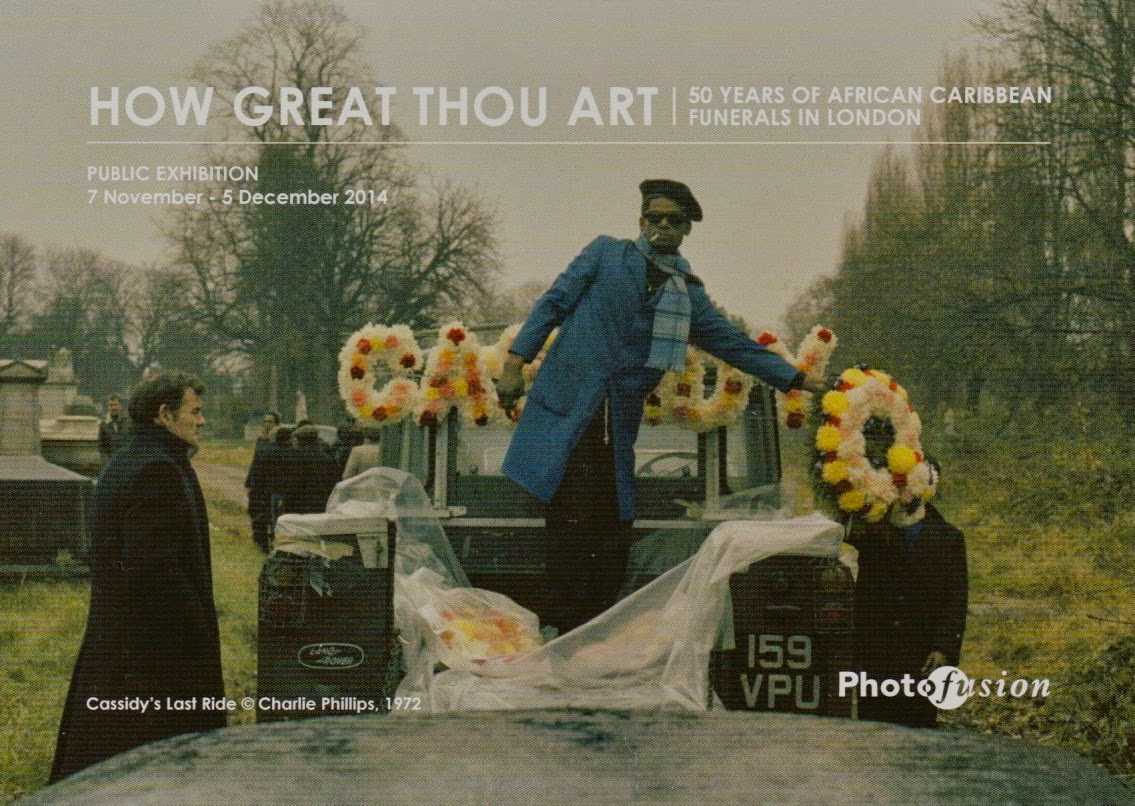
Another evening in Brixton to treasure: at the Library, listening to the 70-year-old photographer, Charlie Phillips, talking about his latest exhibition, How Great Thou Art: 50 years of African Caribbean funerals in London.
This exhibition, held at the Photofusion Gallery just round the corner in Electric Lane, focuses on the funeral traditions of West Indians living in London from the mid-1950s right up to now. Two rooms of beautiful photos and videos vividly and beautifully capture these living and changing traditions, which mix up African, Caribbean, Christian and West African religious customs.
The powerful resonance and documentary value of those images was reflected in the crowd of people who filled out the upstairs hall at Brixton Library on a wet Wednesday evening to hear the master talk.
The show is only on 'til this Friday, December 5th - so get along there quickly!
Apparently the photos had been languishing in boxes in Charlie Phillips' house, until the Photofusion people - co-curators of this exhibition, Lizzy King and Eddie Otchere – came across them and realised their importance and quality. "I had retired" Charlie complains. "I wanted to look after my allotment." But the next six months was spent going though over 5,000 negatives, hours of video and creating both a book and an exhibition out of the results. As a result, his allotments suffered a bit: "Sorry, it's not going to be such a good crop this year".
Charlie Phillips, a well-known Ladbroke Grove character with a taste in sharp suits and hats, has that aura of celebrity - not the cheap PR-manufactured type, but the genuine, hard-earned article. This is something he shares with many of the great characters in his photos, these people who've put up with so much over decades and still smile and laugh and know how to party, but also how to parry when ever necessary.
Tonight he's in a white jacket, buttoned precariously over a tight dark shirt and brilliant orange tie, his white hair and moustache and mischievous, warm eyes flashing behind glasses giving him the look of a seasoned comic actor.
The exhibition title comes from the hymn that for Charlie sums up all the funerals he's been to - it is that hymn, so dirge-like in the dull voices of an English congregation, that takes on new life and vigour and meaning when sung by generations of Jamaicans beside an open grave in Kensal Green cemetery.
He tells us his story - how, from being an altar-boy he grew into a rebellious teenager, hanging out with the youth at the shabeens and blues parties in the Notting Hill area, how he got hits first camera (a Kodak Retina) from one of the black Amercian GIs who brought their precious blues and jazz and R & B discs to these parties, helping to spawn the London sound-system tradition as well.
Charlie was entirely self-taught, and he did his own processing and printing using equipment bought on the proceeds of a paper-round. He would wait until all the rest of the household were asleep before using the bathroom as his darkroom.
But it was when he went to the funeral of Kelso Cochrane, the 32-year-old Antiguan murdered by Teddy boys in Golborne Road in 1959, that the power of these these events really struck him and he took his first funeral "snaps" (as he insists on calling all his photos).
Over the next four decades Charlie became a must-have guest at the funeral of the great and the good and the bad and the ordinary families of African Caribbean descent all over London.
The photos - which you can see until at Photofusion's small gallery up on the first floor of the Brixton MArket buildings - capture the joy as well as the grief of these vents. Everyone speaking tonight - which included the professor Michael McMillan and writer Empressjai - emphasised how the West Indian funerals pick up on the West African belief that the spirit does not die, but has to move on - it's the job of everyone at these funeral to help that spirit on its way, hence "the good send off". Hence the opening of windows at the wake or the Nine Nights (the night before the burial when the spirit is said to leave the body), even in the depths of a London winter.
"It's not all peace and love", he adds. Quite often a old family tensions burst out at such events, there are fights, scuffles even over the coffin .
The photos show not just the big burial processions, but also the wakes - and especially the crucial "Nine Night", that last night of the wake before the burial, when music and dance and drink and what have you often take upper hand.
There's some great photos there of these events - as well as some more recent videos, including one showing another professor, Gus John, giving a traditional libation at the funeral of the All Saints Road activist, Frank Critchlow, who ran the famous Mangrove restaurant and bar back in the 60s and 70s.
That libation speech was so good, you have to see it, especially when the guy sits down to take a few sips of the libation gin bottle. It illustrates one of the big themes of this evening's talk - the way old African traditions have survived any amount of battering by the white missionaries. Their lasting contribution, on the other hand, is the hymn.
We had an expert, Dr Michael McMillan, talking about these traditions - and he made the point very clear that these "Black death cultures" are actually about life - the spirit that lives on, to join all those other spirits, good and bad, which get on with their business all around us all the time - the duppies and the jumbles and the djinns and the sprites, the spirits of place, of the earth and the sky.
Dr McMillan noted that most of the cemetery chapels in London were far too small for a proper West Indian funeral, hence the massive wakes and receptions before and after that event. The burial itself is different - relatives don't just drop a few crumbs of earth onto the coffin, they cover it and fill completely. But only after the deceased's favourites things have been sprinkled over the grave - maybe some flowers, some jewellery or clothing, some records or some rum or perhaps some ganja.
He picked out the great images of a funeral wreath in the shapes of a giant pack of Rizlas, and another as a Singer Sewing machine - "Our traditions have single handedly revived London's floristry business!" - and also noted how these echoed the Ghanaian tradition of burying people in coffins which reflect their occupation. A boat-shaped casket for a fisherman, a Mercedes Benz for a taxi-driver.
What a great evening this was - but Charlie had some regrets, as becomes clear in the more recent photos in the exhibition. He doesn't really like the way the younger generations have allowed the funeral traditions to become a bit diluted - how they often choose Frank Sinatra's "My Way" or even the "Simply the Best" as the theme music. And how there's now so much emphasis on bling and colour-co-ordinated clothing.
But as others noted, including Empressjai and Dr McMillan - the tradition is alive and changing, new traditions are being created. The evening ended with a big discussion on this issue, the changing trsiditions of different generation, with many people chipping in with their thoughts and their memories.
Friday, 21 November 2014
Faith in Clapham restored by Radio 4 and John Agard
Just when it seemed this district was hopelessly engulfed in dirty money and booze-swilling, Maserati-driving rich kids, came a timely reminder on (of all things ) Desert Island Discs, of what Clapham used to stand for.
The guest this week was poet John Agard, and the presenter gently persuaded him to recite one of his best-known poems, the 1986 satire on academic views of poetry, Listen Mr Oxford Don.
Agard didn't need much persuading and spoke the lines with as much passion and precision as he did nearly 30 years ago:
Me not no Oxford don
me a simple immigrant
from Clapham Common
I didn't graduate
I immigrate
Back in '86. of course, Clapham was still a truly mixed-up place, but the yuppies were already flooding in.
The guest this week was poet John Agard, and the presenter gently persuaded him to recite one of his best-known poems, the 1986 satire on academic views of poetry, Listen Mr Oxford Don.
Agard didn't need much persuading and spoke the lines with as much passion and precision as he did nearly 30 years ago:
Me not no Oxford don
me a simple immigrant
from Clapham Common
I didn't graduate
I immigrate
Back in '86. of course, Clapham was still a truly mixed-up place, but the yuppies were already flooding in.
Oddly enough I din't think Agard ever lived in this area. When he first came to the UK in 1977 he settled in Shropshire, and I think he's stayed there. The Clapham reference harks back to the arrival of the Windrush era immigrants, many of whom were temporarily housed in the deep shelter near Clapham South Tube station - in fact, on the Common, less than a mile from the church where the Clapham Sect met 150 years previously.
The full story is here on the History Today site.
Wednesday, 19 November 2014
Just when I was getting reconciled with Clapham, along comes this bugger
I've been trying hard over the past few months to remind myself of the things I used to like about Clapham, and to dig out other good things that make living in this land of the rich yob bearable.
Thought I was doing well until I started reading another local blog, which was going on about food and why the SW4 area was up there with the best in London. Well, given that said blog had recently run a paean to a series of new burger joints on the high street, I didn't set too much store by their views on cuisine. But what really turned my blood cold was the author's use of the word (I can hardly bear to write it) "Clappers" - to refer to this most common of suburbs.
Why does this annoy me so much? Is it because I am an elderly curmudgeon and cannot bear the affectionate diminutives so often used for things these days?
Yes, in part, I am guilty of that. I don't like hearing people refer to "uni" for university and barbie for barbecue. That I suppose is part of the Australianisation of English can mainly be blamed on Kylie and Neighbours. Fine in Brisbane, annoying but unavoidable all over affluent south-east England.
But this one goes back further and deeper - it stimulates one of my deepest hate-glands, and it is all to do with ball games and the class system.
The only other bit of London that gets abbreviated in this was by a certain type of young male adult is Twickenham. And that is usually referring to the stadium where rugby is played. The people who call Twickenham Twickers often call rugby rugger and if they visit or live in Clapham (which is quite probable I fear) they might well call it….well, you get my dismal drift, don't you?
But seriously, is there anywhere else that gets this treatment? (excluding, of course, names that have the -ers ending in their full version, such as Chequers or Yonkers, or Arsenal's nickname…)
Well, at least this outburst of disgust led me to a new word. According to Wikipedia, this usage is a form of "hypocorism", from the old Greek meaning "child-talk" and now often referred to as pet name, term of endearment, nickname, etc. Another word, infantilism, springs to mind.
I wouldn't have minded it at all if it was not for the rugby connection. You will deduce that I loathed that team game which I was forced to play for two of my most miserable years at an English boys' grammar school.
Odd, though, that some nicknames seem fine. I like Pompey for Portsmouth and Big Apple for NYC, The Smoke or the Great Wen for London. Auld Reekie is just fine so long as it is said in a real Scottish accent. No, it's just the context, it's that attempt to revive the demotic of rich young Englishmen of the 1920s, the chaps and chapesses; it should definitely stay within the pages of P G Wodehouse, old fruit.
Ironic then that I should end up in this suburb full of beer swilling types with those wide-striped shirts with turned-up white collars.
Thought I was doing well until I started reading another local blog, which was going on about food and why the SW4 area was up there with the best in London. Well, given that said blog had recently run a paean to a series of new burger joints on the high street, I didn't set too much store by their views on cuisine. But what really turned my blood cold was the author's use of the word (I can hardly bear to write it) "Clappers" - to refer to this most common of suburbs.
Why does this annoy me so much? Is it because I am an elderly curmudgeon and cannot bear the affectionate diminutives so often used for things these days?
Yes, in part, I am guilty of that. I don't like hearing people refer to "uni" for university and barbie for barbecue. That I suppose is part of the Australianisation of English can mainly be blamed on Kylie and Neighbours. Fine in Brisbane, annoying but unavoidable all over affluent south-east England.
But this one goes back further and deeper - it stimulates one of my deepest hate-glands, and it is all to do with ball games and the class system.
The only other bit of London that gets abbreviated in this was by a certain type of young male adult is Twickenham. And that is usually referring to the stadium where rugby is played. The people who call Twickenham Twickers often call rugby rugger and if they visit or live in Clapham (which is quite probable I fear) they might well call it….well, you get my dismal drift, don't you?
But seriously, is there anywhere else that gets this treatment? (excluding, of course, names that have the -ers ending in their full version, such as Chequers or Yonkers, or Arsenal's nickname…)
Well, at least this outburst of disgust led me to a new word. According to Wikipedia, this usage is a form of "hypocorism", from the old Greek meaning "child-talk" and now often referred to as pet name, term of endearment, nickname, etc. Another word, infantilism, springs to mind.
I wouldn't have minded it at all if it was not for the rugby connection. You will deduce that I loathed that team game which I was forced to play for two of my most miserable years at an English boys' grammar school.
Odd, though, that some nicknames seem fine. I like Pompey for Portsmouth and Big Apple for NYC, The Smoke or the Great Wen for London. Auld Reekie is just fine so long as it is said in a real Scottish accent. No, it's just the context, it's that attempt to revive the demotic of rich young Englishmen of the 1920s, the chaps and chapesses; it should definitely stay within the pages of P G Wodehouse, old fruit.
Ironic then that I should end up in this suburb full of beer swilling types with those wide-striped shirts with turned-up white collars.
Thursday, 13 November 2014
Transpontine: my new favourite south London blog
Am here to praise a not so buried treasure - Transpontine. Just a quick note - but heavens, I could write a ream or roomful of words about this blog.
It's transpontine - like trastevere or oltrarno or rive gauche, so blah, blah and on - but do note it is specifically south east London, and as a south west London resident I applaud that. SE kept flag flying long after SW capitulated, the crowds crossing yahoo bridge - Chelsea, Battersea, you know.
So, this one has the feel, the great feel of a sort of student mag from the 70s, but still being written by the same people now in their 30s or 40s or whatever: better writers, more mature, funnier.
It's actually a rather grown up blog of the twenty-whatevers, which keeps filling me in on all those gigs back in the early 1990s that I so nearly went to and then failed to get to. And on all the great things that are happening just a 35 minute 37 bus ride from my front door, almost all of which I shall miss.
Especially stuff at The Venue, New Cross, and so on. But this does seem to be the blog that digs deeper than most….love it.
It's transpontine - like trastevere or oltrarno or rive gauche, so blah, blah and on - but do note it is specifically south east London, and as a south west London resident I applaud that. SE kept flag flying long after SW capitulated, the crowds crossing yahoo bridge - Chelsea, Battersea, you know.
So, this one has the feel, the great feel of a sort of student mag from the 70s, but still being written by the same people now in their 30s or 40s or whatever: better writers, more mature, funnier.
It's actually a rather grown up blog of the twenty-whatevers, which keeps filling me in on all those gigs back in the early 1990s that I so nearly went to and then failed to get to. And on all the great things that are happening just a 35 minute 37 bus ride from my front door, almost all of which I shall miss.
Especially stuff at The Venue, New Cross, and so on. But this does seem to be the blog that digs deeper than most….love it.
Wednesday, 12 November 2014
I love Brixton College for exactly the reasons many think it's obsolete
 |
| Glad to hear that if it's true - but it probably won't be in this modest but remarkably workable and friendly building, but something more like the flashy Clapham branch a couple of miles west of here. |
I'm a part-time student at this place, which is one of the three campuses used by Lambeth College, and I have grown to love its 1960s utilitarian simplicity.
It really is a classic example of school/college architecture of that late 50s to 60s era - lots of metal-framed glass, block-colour panelling, hard floors, a simple, elegant quadrangular plan with a large dining area at one end with an equally spacious library on the floor above. The classrooms are what some Labour minister might have called bog standard - a run of rectangular rooms, spacious, all well lit, though the ones facing Brixton Hill get a lot of traffic noise.
I can't be certain, but it looks like "system built" or CLASP (Consortium of Local Authority Special Programme) college. Between 1957 and the 80s, CLASP provided a set of basic, approved architectural designs for community buildings - not just schools, but clinics, libraries, community centres and even fire stations) for use across the UK (for more on this system, read Chris Matthews' fascinating piece on the legacy of CLASP buildings in Nottinghamshire and beyond on his blog, Internet Curtains ).
Economies of scale, partial prefabrication, standardisation of sizes of classrooms and gyms and assembly halls - all of these things made for cheaper but not necessarily poorer quality buildings. If the basic design had been hideous or hideously wrong, it would of course have been a different matter - but these modest buildings, in schoolyard Corbusier manage to fit in, to rub shoulders with many older styles without seeming to be rude or aloof.
Yes, they were designed for a time when education theory was different: there was optimism, the child was to be at the centre of learning, the schools were as far as possible open plan and filled with light. These were anti-austerity buildings in a way, modernist, but they were also utilitarian in the good sense of the word - they served a purpose (I hate to use the modern version of that phrase, 'fit for purpose').
So, back to Brixton Hill - and just look at the courtyard or quadrangle. Even in its current entirely neglected state, it's a godsend, a breathing space, a lovely echo for Brixton's ESOL and other students of the classic style of old universities. To modern ways of thinking, it is just a waste of space.
The building is friendly, unshowy, and it works - although I've no doubt it costs too much to heat in winter and that it probably gets over-hot in summer. These issues could have been addressed with adequate investment, maintenance and improvements back in the 80s and 90s.
Instead, they let the building get a bit run down, then say no-one likes it any more. Half the site has already gone to a so-called free school. Now the remaining bit, fronting Brixton Hill, seems destined to be destroyed. It still houses most of Lambeth's ESOL classes and at certain times of day the place is buzzing with hundreds of different languages.
It's true the place is underused, especially in the evenings, and staff cuts mean the excellent library is not open late, which is a real shame.
I tell you, I infinitely prefer the old school style of this place to the stomach churning colour schemes, garish carpets and gormless sloganeering of the modern equivalents -- all those purples and green carpets, the silly wooden cladding, those inane slogans you get painted in huge letters on the walls of 21st century schools and colleges, the annoying curves and confusing layout. Visit the newest Lambeth College building, at Clapham Common, and you will see what I mean - it's a nightmare to find your way around this place, and after less than a decade it is already looking a bit frayed.
Maybe I am just a 60s nostalgist - but I will miss this place, and am glad at least I chose to do a course there in its latter days.
Subscribe to:
Posts (Atom)