About Me

"Use every man after his desert, and who should 'scape whipping?"

Monday, 28 November 2016

One jazz festival, two buildings, freedom, democracy, love and a stupid blog


Eve Risser (far left at piano) and the White Desert Orchestra blew everyone away with an astonishing 90 minute free set on the final day of LJF 2016
At first this blog was going to be about music on vinyl and cassette, record shops, second-hand bookshops, charity shops and other analogue stuff.  It quickly went off piste and started ranting on about property developers and library closures and all manner of outrages on the sensibility of a disappointed old fool living in a London he no longer understood.  But, by coincidence, the last batch of posts have all been about music in one way or another, and this one will complete that series. It's about the free-est of all free music, jazz music, and the delights of two jazz-filled afternoons, courtesy of the wonderful 2016 London Jazz Festival.

Revelations as Hackney Young Musicians challenge the jazz:classical
music divide at the Festival Hall. Note the thunderous dual drumkit set
up, one of many reminders of the great Sun Ra & his Arkestra
The first of these was at the Festival Hall - yes, back in the Clore Ballroom, scene of last month's National Poetry day events.  You just can't fault the Southbank Centre: yet again on a cold Sunday afternoon a cultural refuge for old vagrants like self, serving up a feast of free, fresh and surprising jazz music for anyone who happened to be around. This was the opening weekend of the festival, and the event was dominated by young musicians.

Over five hours, four big groups took the stage, from the Royal Welsh College of Music & Drama; the Hackney Music Service/LSO "Classical meets Jazz" project; a band from the Guildhalll School and finally the Trinity Laban Shapeshifter ensemble.

All through the afternoon, a growing audience was treated to a diverse and exciting range of music. Like many others I drifted in and was quickly hooked - in my case, by some truly astonishing collisions of well-known jazz and classical standards from the young Hackney/LSO group. At one point they seem to be playing Gustav Holst and Sun Ra pieces simultaneously: the two pieces of music fused and intertwined and separated out again in a thrilling way.

Equally intriguing to watch the big Guildhall project, (Im)possibilities and their guest-star vibraphone player,  Orphy Robinson. He played as an equal member of this big ensemble, but when his solo slot came round you see the others rapt in admiration, feeding on his brilliance, firing some truly explosive funk off off each other's skills and energies.

The music that seemed to draw people in from the many corners of this massive arts complex was the funky stuff, and of that there was plenty. A good few blessed moments when total sonic chaos suddenly seemed to crystallise out into a broken madly dancing off-beat, linking back to the root of all jazz, all blues, all music.

The finale was a sort of jazz symphony in six movements written by Mark Lockheart. This was complex, subtle music. The players were the Trinity Laban Shapeshifter orchestra, and a clutch of professional stars, including  Polar Bear drummer Seb Rochford, but without his trademark afro. That great explosion of wiry hair seemed such a good visual equivalent of his incendiary jazz-punk. But here has was taking a much lower profile, his drumming super-sharp but restrained, tied to the composer's score or the conductor.

Hard and angry jazz in London's greatest  brutalist citadel

Medium cool: Israeli trumpeter Itamar Borochov wins over the whole of the
Barbican crowd with a passionate, note-perfect musical storm
A week later, more free festival jazz,  this time over the river to the 1970s response to the Southbank....that is to say, the Barbican Centre.

The Barbican arts centre is even more astonishing, buried deep within the apparaently fortified City of London  housing estate, with its three gaunt, beautiful concrete towers and its high wall and walkways. Inside it's so beautifully crafted, the wood-block flooring and hammered concrete walls,  fabulous 70s style lighting, the weird vistas and angles and the many levels....it's a magical place with a great space for free performance in the main concourse.

I love the Barbican and everything it stood for, although these days those council flats are occupied by rich city types. One thing for sure - we'll never see anywhere of this quality, and on this scale being built in this way in London, ever again.

Again, the ground-level foyer was the scene for a full Sunday afternoon programme of free jazz. As I arrived, an amazingly sharp Israeli-based band led by trumpeter Itamar Borochov were playing a storming set fusing a sort of hard bop with rich Levantine and Maghrebi flavours.

It was the next and final band that really made me write this piece: a French musician, Eve Risser, and the White Desert Orchestra.  Here was a group of highly talented instrumentalists making music that truly defied labelling. In other words, it was jazz.

That for me is what jazz is or should be. Not background plinking in a posh restaurant, not endless noodlings in a posh concert hall, but engrossing, mind-expanding, body-shifting sounds. For the first five minutes or so of the Paris-based band's performance, I wondered if I would stay (and quite a few were leaving). They were doing that thing where each band member seems to be playing a different piece,  at maximum volume, in a crescendo of discordant noise, racket, jangling the nerves, setting teeth on edge, and then it all changed.

This was music for a the new world, incredibly angry at times, amazingly soft and comforting at others, benignly overpowering. It was a sea or ocean of sound, you could jump in and let it knock you about a bit, then it would calm and you dive through it. You just had to trust it!

And after first piece, an almost shellshocked audience hesitated before bursting into applause, and then Eve Risser herself (who had been in the shadows at her grand piano, stood up and began to explian in beautifully French English what the next piece was about, then cracking up with laughter when the English words failed her.

A few minutes later she was laying into her beautiful shiny Steinway grand like a pile-driver. So much anger, but so wonderfully controlled! At each slam of the piano-lid the crowd jumped or winced; it all made sense in the context of this piece. Memorable!

Then I watched from another angle and saw the sax player pick up this massive baritone sax. It was as big as he was, I swear, and he was not a small bloke. He made this monstrous horn emit great honks of sound, like lead bubbles, which plopped out and hit the first three rows of the audience like Atlantic breakers on a north Devon beach. One  man was flinching at each blast, and then grinning like mad.

This is what jazz should be, is: surprising, astonishing, crazy.  And for me at least, the only way to really enjoy it is to be at a performance, to see the musicians close-up, watch how they interct with their instruments and with each other and with the audience, that is  for me about 80 per cent of it. The best recording on the best hi-fi is just a reminder of this if you're lucky.

But the true music criticism needs to be left to the professionals, the informed, and in this case there is no better place to read deeply intelligent reviews of festival performances than the London Jazz site.

All I can say is thanks to the LJF, wish I'd gone to dozens more of their events, will try to next year if by some miracle I've managed to hang on by my cracked nails to my small perch in this maddening city.

Thanks, thank you so much, thanks Eve Risser, and the amazing White Desert Orchestra, for bringing your strange, violent,
hallucinatory, erotic and poetic music to the UK.


Sunday, 13 November 2016

Busking reggae sax player triggers Brixton tube station epiphany

Miss Megoo and her sax on a cold November evening, Brixton tube station, London SW2

Approaching Brixton tube station early on a cold, dark November evening, the sublime rhythms and
haunting saxophone melody of some early Jamaican reggae warmed the air. You could even see people's walking pace change to get into step with the beats coming out of a small portable speaker-amp.

The sax melody was provided by one of the many talented buskers this location is famous for - and in this case I was almost certain I knew who she was. A tall, slender young woman of Japanese appearance, in a beautiful full-length striped and tiered silk dress, matching silk scarf, her jet-black hair pulled back tight in a bun, and secured with a huge crimson flower on the right side of her head, swaying to the music, playing what looks like an old, much-loved alto sax, the case open on the floor in front of her feet.

If you like ska or reggae and live in London you will almost definitely recognise this striking young woman - she's unmistakably the sax player who joined The Trojans onstage at Gaz Mayall's set at the Notting Hill Carnival, who's a key member of the wonderful south London ska band, The Top Cats, and a truly big name in the international reggae/ska world.

And here she is - I was 98 per cent certain it was her, that is Megumi Mesaku - busking outside Brixton tube station on a cold November evening.

She's already something of a legend. She's played sax with many of the great names of Jamaican music, and many of the greats of jazz, soul and funk too. They include Max Romeo, Maceo Parker, Rico Rodriguez, Dennis Alcapone, Laurel Aitken, and numerous other big names from the ska and reggae world, young and old.

So is this really Megumi, busking? I am 99 per cent sure it is. Look at her. One hundred percent certain. But I was too shy and stupid to ask.

It's still rush hour at 7.30pm around here, crowds surge out of the station as each new train arrives, and her music always catches a few of the people as they leave, detaining them, some just stand and smile and nod, some  are swaying, but only one person is really dancing. A young black woman with shining eyes, she's already been taken over by this gorgeously fluid music and is using the whole pavement outside the station as her dancefloor, deftly avoiding the commuters as they swarm around her.

The sax player - yes, it has to be Megumi, also known as "MissMegoo" - has that characteristic
modesty, always smiling in response to any applause, always acknowledging any donation, there, alone with her mini-sound-system, filling the air with promises of warmth and love and a better future.

She's playing lots of reggae and ska classics, but also some old soul and R & B numbers. At one point I could've sworn she even played some Glenn Miller.

So that was it - the epiphany thing, it was the sort of very much wanted antidote to weeks and months of gloom and fear and anger, from Brexit through to Trump. A tonic, a reminder of what we could be.

A realisation how grateful we should all be to all the people who come here from other continents and countries.

Here was a Japanese woman playing her interpretations of the music of the Jamaican ghetto outside a tube station in one of the most racially-mixed areas of London. All happening, just like that, perfectly normal.

Anyway, if that was you, Miss Megumi, thanks for providing some light in the gloom.  You are surely one of this city's many musical treasures.


Saturday, 12 November 2016

Cultural chat in the Library as Clapham remembers Smiley

Smiley and Me was another of Lambeth's excellent programme of Black History Month events - and this time it was dealing with quite recent history, focusing on a time  (the late 70s and early 80s) when this area was on the frontline of a new style of home-grown reggae music, London's answer to the Jamaican dancehall toasters and DJs.

Here's the book - a rip-roaring read if ever there
was one, the true story of a pair of likely lads making
it big in the London reggae music scene of the
1980s. That cover pic, showing Smiley (left) and Asher,
looks like a phot but in fact is an astonishing painting
by their friend and former Saxon Sound System
fellow artist, Peter King.
The new generation of young DJs and MCs emerged from the big council estates running from Battersea to Lewisham, via Clapham, Stockwell, Brixton and Peckham.

They attached themselves to the big established sound systems of the time - but they'd also moved on from the Rasta-influenced roots reggae of their elders. Their lyrics were sharper, still socially conscious, more directly relevant to life on the streets and in the estates of inner-city London. These lyricists were often witty, often challenging, and nearly always in competition with rival sound-systems.

A handful of these homegrown proto-rappers broke through to become mainstream pop stars. Among them were Lewisham's Maxi Priest,  Papa Levi and Tippa Irie from Brixton  – and Smiley Culture and his constant friend, co-conspirator, and sparring partner Asher Senator, both from the Stockwell-Clapham area.

One of the top lyricists of that era's musical innovation, Asher Senator was recently at the Clapham Library to talk (and rap) about his new book, which tells the story of his enduring friendship and musical partnership with Smiley.

The book, Smiley and Me, tells Asher's version of the fascinating, exciting, hilarious and finally tragic story of the Stockwell school kid, David Emmanuel, who became Smiley Culture, tasted international fame and stardom with his two hit records, Cockney Translation and Police Officer, but then ran out of luck in a big and painful way. It's a handsome, nearly 400-page, well illustrated book published by Vitow (Voice in the Open Wilderness) Media - which is, aptly, also based on the Clapham-Stockwell borders.

 I say "talk" - this was Asher Senator, the man famous for fast chatting in a continuous rhyming style. As you might expect, he'd brought a big 2016 version of a ghetto blaster with him, and told at least half the story on his mic, in exactly the style of those early-80s tracks he and Smiley used to light up London's dancehall nights with.

The book is truly thrilling memoir, the pace is quick and the stories come thick and fast. It's written from the point of view of a gifted lyricist and performer who was a sort of Boswell to Smiley's Dr Johnson, or maybe Dr Watson to some skanking Sherlock. Asher, although a star MC in his own right, was always slightly in the shadows cast by his more fame-and-fortune-seeking friend.

As the blurb says, it pulls no punches, describing in some fairly grisly detail the downward spiral that seemed to set in after Smiley got mixed up with some heavy-duty gangsters - initially, it seemed, to frighten off local rivals who resented his success. But that decline went on right up to Smiley's mysterious death in March 2011, during a police investigation at his final home - a house in Warlingham, which is a semi-rural village on the far southern edge of south London. A single stab wound to the heart, which a jury later decided was self-inflicted: what a sad, hideous end for such a talented man.

But this night, Asher concentrated more on the upward years, giving  great readings from some of the earlier chapters of his book. There's a lot of poetry in his writing. The chapter on their first sound system, Buchanan, based at "Lansdowne in Stockwell, Just behind the station" - begins with a eulogy for "Miss Coarsey".

No, she was not some inspirational school teacher. "Miss Coarsey" was the name they gave to their battered old van, which was an essential bit of equipment for any London sound system at the time, used to transport the huge speaker cabinets and amps around the clubs and party venues, along with the crew of DJs, MCs, rappers, techies and hangers-on. Despite needing push starting, Miss Coarsey did not let them down until a vengeful ex-girlfriend set her on fire.

Get a taste of Asher and Smiley on Buchanon here, dating right back to the beginning of their musical careers.

These passages, this music,  reminds me strongly of Franco Rosso's 1980 film, Babylon, covering much of the same territory, just a little earlier.  Only 35 years ago, yet it seems like a different century....well of course it was a different century, a different millennium, a totally different world.

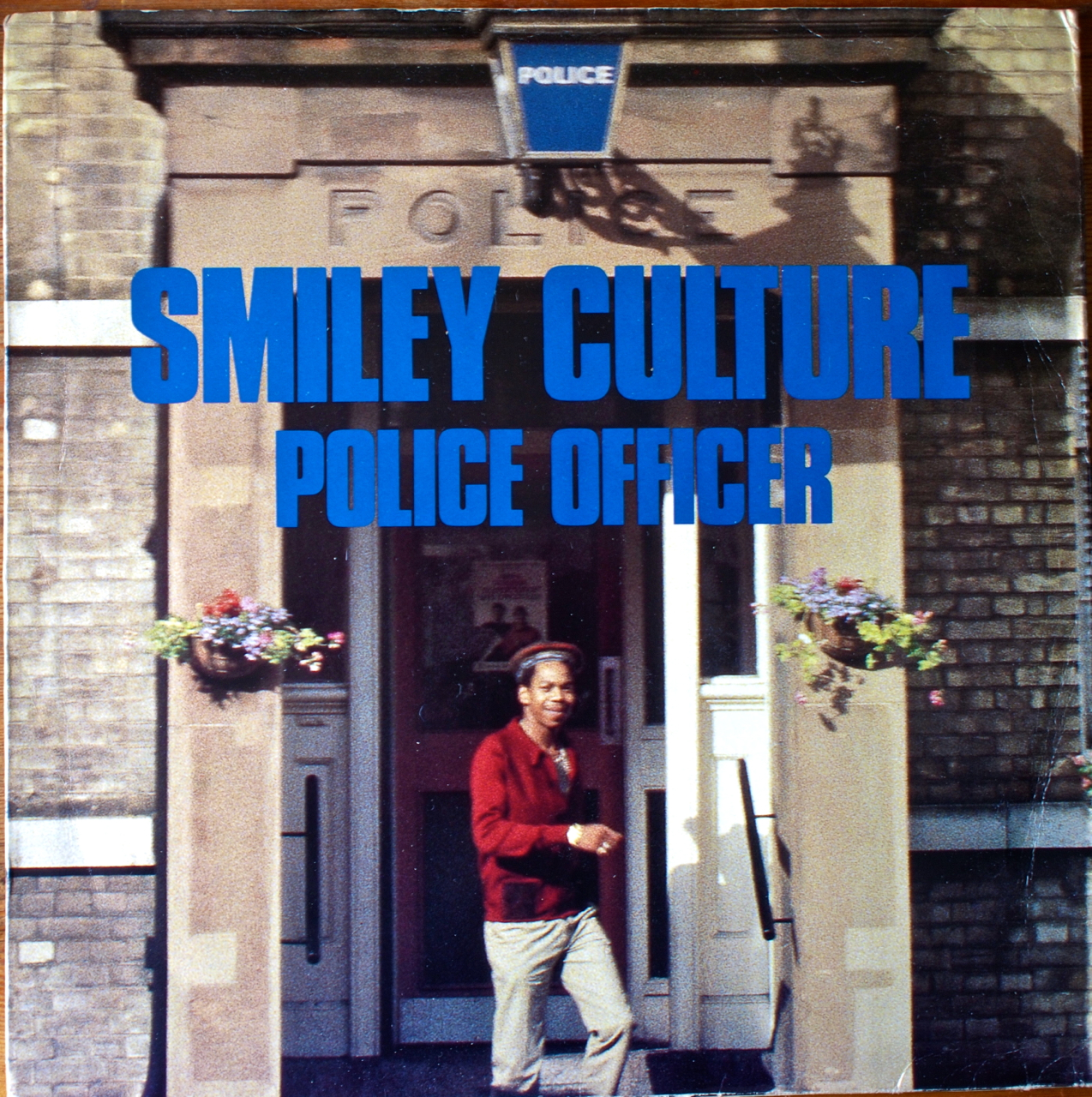
Smiley Culture's 'Police Officer' 12inch 45rpm single, Fashion Records, cover, outside Brixton(?) police station, 1984
Smiley Culture's 'Police Officer', the top-selling 12inch 45rpm single of that
year, released on Battersea-based Fashion Records. Looks like
 the cover was shot outside Brixton(?) police station, 1984
Their breakthrough night at the Four Aces Club in Dalston is a beautiful moment: the first time they ever get paid (a whole fiver for both of them!) for their MC-ing. Note that at this time it is always "they", with Asher and Smiley working like a team - which continued even after Smiley performed on Top of The Pops and became a big star.

The early chapters paint a vivid picture of South London street life in those bleak late 70s winters, through to the 1981 and 85 Brixton riots and beyond.

It's a strange read for anyone like me who lived in the same area at the same time, actually a few streets away from some of their favoured locales.

How often I lay awake a night, hearing the police sirens and helicopters, and wondering what the youth were up to now. As a sort of low-rent yuppie, weaned on a lot of jazz and blues, a little punk and then tons of roots reggae, I was deeply attracted to that scene, even though I might as well have been a million miles away.

The nearest I  got was a few nervy trips down Coldharbour Lane, a few evenings in the Atlantic pub, where with a few other white-boy thrill-seekers and dub-addicts, I payed my local taxes and got to see the young Courtney Pine coming on like a reborn Coltrane.

Meanwhile Asher and Smiley were signed up to Fashion Records, which operated out of the same building (and had the same management) as Dub Vendor, the legendary record shop at the Clapham Junction end of Lavender Hill. As this blog noted previously, Dub Vendor eventually went out of business after it was affected by the fire started during the riots of August 2011.

Nice how he has printed the lyrics on the back cover of this 12 in single....
There is Smiley, and there are the lyrics to Police Officer, helpfully
printed on the back of the cover of the 1984 Fashion Records 12in
single - which became Smiley's biggest -selling hit.
There are so many great and hilarious stories in this book, you have to buy it and  read it for yourself. It has that picaresque drive of a ghetto-based Don Quixote, with Asher as his Sancho Panza. Or maybe the Laurel to his Hardy, or the Butch Cassidy to his Sundance Kid. All those elements are there.

One story I can't resist mentioning happens while they're on tour in Jamaica, taking their London coals back to Kingston's reggae Newcastle.

First night in a hotel, they get a visitor who offers to show them round the sights and nightspots. It's none other than the best of all the new wave of Kingston based dancehall reggae singers and MCs, Barrington Levy - the guy whose carnival anthem, Under Mi Sensi, is a Kingston-style cousin of Police Officer, what with its chat and its dialogue. But which track came first?

Barrington, however, never get the kudos that Smiley has received in the UK for more or less defining a new London dialect. Teachers and academics and top children's writers have all quoted the lyrics of Cockney Translation as being the record which took this form of speech out of the ghetto and into youth culture nationwide. Children's author, poet and teacher Michael Rosen even included Cockney Translation as one of his eight most precious bits of music for the BBC Radio 4 Desert Island Discs programme.

There's immortality for you!

Asher, always the more level headed one, despite having plenty of his own troubles, was the survivor. He's gone on to launch a charity, Code 7 which helps kids in the estates get into the same sort of music business he and Smiley excelled at. Better  to clash with sounds than with guns and knives.

On the night he was a total charmer, and gave his all to the performance of many lyrics, even though it was a ridiculously small but very responsive audience. Also at the event was his publisher, Rickardo Quintyne-Wright of Vitow Media, who is also involved in film production. Read this book and you will soon be thinking, when are they going to make a big-budget movie of this? It has all the elements and more. Let's hope it happens.

Details and where to buy your copy:

Smiley and Me, author Asher Senator, edied by John Masouri, illustrated by Peter King,   published by Voice in the Open Wilderness (ViTow) Publishing; 1st edition (15 Dec. 2015).ISBN-10: 0993511007

Thursday, 10 November 2016

A brief life of Bob in seven songs: radical author stirs up some deep Wailer memories at Brixton Library Black History Month event

Another Black History Month is over,  and you have to admit that Lambeth's events department and the library services organised a really excellent programme of local events. Of dozens of talks, exhibitions,  performances and shows, the event on Wednesday 19 October at Brixton Library was always going to be a big draw: the title, Bob Marley: Roots, Reggae & Revolution - ensured that.

Sure enough by 7pm the seating had all been taken as Bob's totally familiar but always surprising songs kept everyone happy until author Brian Richardson stood up to begin his talk.

Self-effacing from the outset, he joked that he realised most of the audience would probably rather just listen to Marley's music all evening...and of course there's always going to be an element of truth in that. But we also wanted to hear what new things he had to say about such a well-documented modern hero.

Brian Richardson is a prominent activist and campaigner against racism. He's also a practising criminal barrister and - not surprisingly - a deft public speaker. He seemed so modest and self-effacing as he explained the background to his book, and he played the whole event in a very cool and open manner. He straightaway admitted he was indebted to the Booker Prize-winning novel of Marlon James, A Brief History of Seven Killings, for the structure and approach of his book, which chronicles Bob's development against the political turmoil of Jamaica, the USA and the great East-West divide of that era.

In fact he even borrowed a bit of Marlon James' structure for his talk, covering Bob Marley's political and spiritual development in seven songs.

He pointed out how Bob became a musician, a songwriter, an artist - just at the time that the politics and history of newly-independent Jamaica became a microcosm or crucible of all the great global events at the time of decolonisation,  and of the ensuing conflicts, left versus right, rich versus poor, material versus spiritual.

But this was no dry history lecture. As soon as the first song fired up, large parts of the audience were swaying their seats, and just about everyone was smiling. The song was the Wailing Wailers' 1965 hit Simmer Down, which - even so soon after Jamaican independence - showed that the honeymoon was over and that things had got back to normal - poverty, corruption, oppression, violence in the streets.

Over the course of an hour, Brian played six more Marley songs, all of them well-known classics, each capturing a specific phase of the singer's career. We had the obviously political titles sich as Get Up Stand Up,  the reflections on Trenchtown poverty, and his celebration of late 70s London punk meets roots scene in Punky Reggae Party.

That time when The Wailers were more or less in exile in the UK proved to be a rich seam of memories for some of the audience. One guy remembered playing football with Marley in a park, which led on to discussion of the various stories of Bob's toe injury and whether or not it led to his fatal cancer. (Most likely not, is the answer, though it probably didn't help either).

Another audience member was present at the famous open-air One Love Peace concert in Kingston Jamaica, April 22 1978,  when Bob got the two opposing political leaders, Edward Seaga and Michael Manley, to shake hands on stage.

Brian asked if she remembered Peter Tosh's performance earlier at the same event, when, according to some accounts, legend, he gave the two leaders a very critical lecturing, then fired up a giant spliff as a very public display of his opinion of the government's supposed crackdown on ganja smoking. Sadly she couldn't remember - she was very young then, she said. (Other reports suggest it was Jacob Miller who did the most spliff-smoking, but Tosh certainly talked hard politics).

There were other memories of Bob in London, specifically the time when the Wailers performed at a primary school in Peckham, and also of his visits to a Rasta centre in Kennington.

It was this sort of living memory that made the whole event so different. When Brian got onto the Exodus era, with Marley both espousing but also challenging some of the Rastafarian ideas, a big debate broke out. Several very vocal audience members said that  once again - in the light of recent increase in racist attacks in the UK and USA - nothing had changed, and that the only sensible option was to get out of here, take the Black Star Liner back to Ethiopia, re-patriation, to turn their backs on rotten Babylon.

Others disagreed, saying they were here to stay, British citizens, with exactly the same rights as any other, and that this status was not up for negotiation. To an ancient and fairly dumb baldhead like me it was surprising, even sad, that this debate has resurfaced, or bubbled up, gained new heat, what 35 years after the first Brixton riots proved a wake-up call to an essentially racist establishment.

So, it is taking the establishment a veyr long time to get out of bed, and recent events suggest it's eyelids are once again drooping. But what did we see in Brixton just a month before, the Black Lives Matter movement. Have things gone right back to the 60s? Brexit and Trump suggest that's getting dangerously close to reailty.

But this was a great event, and we need more. It was packed out, lively and reasonably mixed in terms of age and ethnicity - though to be honest, seeing how Brixton is now, I'm surprised there weren't more young white hispter types there. We left soon after the speechifying finished at about 9, but according to sources it seems it went on way past official closing time, when debate gave way to music, and everyone turned to dancing. Exactly how any event in the name of Bob Marley  should end.

Bob Marley: Roots, Reggae & Revolution by Brian Richardson, published by Redwords, February 2016, available from the Bookmarks, the socialist bookshop, at £7.99 plus £2.50 postage.


Friday, 28 October 2016

The death of another cyclist, this time on Lavender Hill, hits home like nothing before

A young woman cyclist has been killed near this terrible junction where Lavender Hill meets Elspeth Road: three lanes into one as drivers ignore the left and right filters and use it like a drag-race grid to be first at the next set of lights. Re-design
this junction, tame the traffic, ban the six-axle lorries, police it!
Ever 15 minutes or so on Monday, BBC Radio London's traffic news warned drivers to steer clear of the Battersea-Clapham area because of a serious accident, and that part of Lavender Hill had been closed by police for investigations.

Later that day the accident moved from traffic to mainstream news: it became clear that a cyclist had been involved in an incident with a large truck, and that the cyclist had died at the scene.

A bit later the news websites changed the word "cyclist" to "woman".

A woman had died - been killed - in an accident on Lavender Hill involving a truck leased by a company known as British Gypsum, a big supplier of plasterboard and related building products.

Early reports included quotes from a witness who'd seen the truck with a bike stuck under the front wheels, driving along, with the driver apparently not realising anything had happened, until waved down by pedestrians. According to the Evening Standard the lorry eventually pulled up about 150 yards on from the point of impact, which was close to Battersea Police Station.

So why am I writing about this horrific incident? Because I have become so aware of the danger of huge trucks being driven so fast along these roads in recent years, I have just been dreading something like this happening.

-  Because I live less than a half a mile from where this accident happened.

-  Because I am a cyclist and have cycled up and down Lavender Hill most days over the past 35 years.

-  Because I must have past the point where the 32-year old Lucia Ciccioli was killed on Monday, literally thousands of times. I passed there twice today, which is when I took these photos. 

And because on one occasion, I avoided being hit by a lorry by such a small margin that I know I will never forget that sensation of a brush with death.

It was 8 years ago, at a point just after the crossroads with Elspeth Road. In fact, within a few metres from where this poor young woman died. I was cycling west towards Clapham Junction. I pulled away from the junction, where three lanes of traffic suddenly become one. Traffic at this point is competing for position in the queues that always build up on Lavender Hill.

As I crossed the junction a big refuse truck from the company that does the bins for Wandsworth Council stormed up behind me. It wasn't merely close to me, the flange of its white painted front wheel arch touched my right arm. If I had continued on my course I would have been hit by the front wheel of that lorry.

Instead I made myself fall to the left, into a set of railings that have now, I think been removed. At the same time I rammed on the brakes, and sort of collapsed into the railings, without  any serious injury, but bruised and shaking like hell. The truck surged off into the distance, at what seemed like a speed well above the 30mph limit, and the driver clearly hadn't noticed me. I was so freaked out that I started to shout out obscenities at the top of my voice, but no cars or trucks stopped. A couple of pedestrians asked if I was OK and I realised that I was OK.

I was so lucky. A few years later I was knocled off my bike by a car in the same road, near the Queenstown Road junction, broke some bones but I survivied. I am so lucky.

No-one can really help the family and friends of this young woman, killed on her way to work at a new job on a cold south London morning. It is heart-breaking, as is every death on our hopelessly congested roads. But this one, it just got to me, and to many others, it seems.


The only thing we can try to do is to try to convert this tragedy into an energy to change things, to make such tragedies less frequent in future.

And yet, even now, after 10 years or more of efforts to make these gigantic trucks safer for other road users in heavily populated, mixed-traffic areas, these hideous incidents keep on occurring. What can we do, what can those with power do? Well, here are some ideas:
  • Look at the size of these trucks, measure their speeds.
  •  Check out the drivers' delivery schedules and  how they are paid. They have to get through dreadful traffic on congested streets in unreasonably short spaces of time. 
  • Crack down on the firms - and they are often suppliers to the construction industries - who impose these schedules and penalties.
  • Re-route heavy trucks - a vehicle this size shouldn't be on this road. And certainly not at 7.54am rush-hour time. It's absurd. What's the point of the Mayor and those powers if he never uses them?


Today (Thursday), Evening Standard journalist Rosamund Irwin writes about this tragic incident, as a fellow cyclist who also uses this street on her way to work. She's compassionate and, when it comes to trying to stop this carnage, she makes some very sensible suggestions. The Mayor Sadiq Khan's proposals to ban the most dangerous lorries from London streets is fine - but it will takes several years to implement. She wonders if this could be speeded up, perhaps by incentivising haulage companies, perhaps offering a discount on the congestion charge if they modify their trucks.

I understand her point - but it is coming form the wrong direction.  These companies are making huge profits from supplying the vast numbers of building and regeneration and transport projects in central London. We need a much tougher stance to protect the interests of all road users from these thundering, murderous vehicles. I say this as a car driver (and road-tax payer) as well as a pedestrian, cyclist and local resident, sick of the stink and the damage caused by this relentless procession of huge lorries.

What is  such a huge truck allowed on Lavender Hill anyway? Surely the parallel route along the north side of Clapham Common would allow more space and less congestion? But no, strangely, this road - the one you might think would be the logical trunk route towards the A3 at Wandsworth - is the one with traffic calming measures. Is that to do with all those grand houses and posh private schools
that line the edges of the common? There you have the space to widen a road; maybe build a bridge for pedestrians. Get these speeding monstrosities off Lavender Hill!


Tuesday, 18 October 2016

On not leaving London 2: Africa on the Square, photography at Somerset House and some rich coincidences

Bukky Leo and Black Egypt transport a rapt Trafalgar Square crowd - out of cold, rainy London and straight into the heat of
Fela Kuti's Shrine, in the Kalakuta Republic, Lagos, Nigeria. For half and hour. And then the rain came down.
So by the following week, still not having left London, despite the increasingly grim view of the vile Nine Elms - Battersea development from the back of the flat, it would have been plain churlish not to go to Trafalgar Square for the Africa festival.

There are many such events on this square, always free, of course, and always endorsed by the Mayor of London. They include Chinese New Year, the Russian spring lenten festival, Maslenitsa, Diwali and so on. They are generally heavily sponsored by big corporate interests and the Tourism ministries of relevant countries, and often as a result a bit bland and worthy. Plus the square itself always struck me as one of the bleakest and least encouraging of communal meeting places of any major city I've ever visited.

But remember we now have a new Mayor of London, Sadiq Khan. This event is part of the annual educational exercise, Black History Month. It does have a big sponsor - Air France, but the media sponsor is The Voice newspaper. And if anyone can transform an awkward,  grey, ex-triumphalist colonial space into something good, it must surely be Africans.

And by god they did, from the bright colours of the different stalls and pop-up stands selling food, fashion, artefacts, books etc - to the non-stop upbeat patter from the two main presenters on stage. And one super-brilliant DJ. Read on...

So, having arranged to go to the Picasso exhibition at the NPG, we encounter the Square already bustling with people, and with some high-energy South African music echoing off the facades of the old colonial offices all around.

We stay in the square, and watch

We tear ourselves away from this, head to the NPG, even though the sun is shining. Inside there's a big queue for Picasso, so we head for another exhibition, across Covent Garden to Somerset House to see photos by the late Malick Sidibé of nightlife and beach-life in his native Mali. All the photos are black and white and taken on a Kodak Brownie 127 camera with flash gun, and they are superb, evening blown up to a metre square or more. It's a small show and unmissable for the absolute elegance and beauty of the people he cpaptures, their innocence and eloquence of movement, in the matter of body language and facial expression.

This small, unforgettable exhibition has an audio dimension as well, thanks to a background soundtrack of African music contemporary to the photos - that is to say, mainly 1960s, 70s and a bit of 80s.

It's gorgeous music, mixed up with ambient sounds from parties and streetlife of Bamako. This mixtape was produced by the DJ Rita Ray.

By 4pm I am back in the square and there is amazing music coming over the PA. The DJ is Rita Ray. The crowd is dancing, and it keeps on dancing through the three final bands of the day. And dancing even more when Rita Ray ends the whole thing with some astonishing mix-ups or mash-ups of god knows what dub and Afrobeat and tribal chanting and desert blues and who knows what else, but so expertly blended that the sound seems to make the ground slide beneath your feet.

Then the Algerian musician Seddick Zebiri comes on with his band Seeds of
Creation, mixing what sounds like classical Berber oud playing with some serious jazz-funk and a bit of far-out acid-rock riffing and drumming. He's another crowd pleaser! This guy is a crazy singer and mover and his band flies,  always shifting its musical ground, and after a short but fiery set they get a huge round of applause.

The amazing Algerian master musician Seddick Zebiri with his band, Seeds
of Creation, bring a unique brand of North African funk to the Square.
Then comes the final act - a band known as Black Egypt, led by the Nigerian afrobeat Saxophonist Bukky Leo. Yes, the same  Bukky who used to play Sunday evening sets at the Beufoy Arms inLAvender Hill, back in the early 90s I think, a true disciple of the Black Presidnet. ANd sure enough Bukky dedicates this set to Fela, who, he says, "was borh in this month and died in this month". SO Black History month is also Fela Kuti month. Sounds good to me. WOn't argue with that.

Certainly won't argue with this band's top-class renditions of a string of Fela classics, Zombie, Water Get No Enemy, Coffin for Head of State....the voice and the sax are so good, the band is great, even though much smaller than the full Egypt 80 or whatever band Fela had at the time. You could almost imagne the iron hand of Fela himself leading the tight, deadly accurate and beautifully-rehearsed ensemble playing. Trafalgar Square has surely never before resounded to such a fabulous onslaught of music straight out of the Kalakuta  Republic. Love!

Monday, 17 October 2016

On not leaving London 1: National Poetry Day at the Festival Hall

Some days you feel, how much longer can we stick around here? This swamp of  bad money and poison air, especially in this area, stricken as it is by deadly Nine Elms Disease.

Falling out of love with London happens increasingly often in this household, and yet it never lasts more than a day or two because the city has a winning habit of serving up something wonderful, just in time.

Last week it did this again. It was National Poetry Day and a series of readings and discussion was advertised at the Festival Hall. This happened in the Clore Ballroom area, a big space underneath the main auditorium, but a useful performance space in its own right, where most of the Southbank's biggest free events are held.
Poet Ian McMillan and his team prepare for the live recording of Radio 3's
The Verb on National Poetry Day, at the Southbank Centre, London.

There was a full programme, all free. A lot of the earlier sessions were aimed at schoolkids, and the place was packed at 3pm. Poet after poet went up and did their stuff: I was looking at the art show in the basement (the excellent annual event featuring art by people in prisons and young offenders institutions) but every so often came the cheering and chanting and stamping of feet on the floor above.

As the afternoon went on, the school groups left and more and more men and women of a certain age and look arrived and found seats. These people looked to be in their 40s, dressed in tight black clothes, austere of look, thin people. They were quite likely fans of one of the poets due to appear - the singer P J Harvey was in fact top of the bill. And to be perfectly honest, I too was there, above all, to see the scarily wonderful singer of so many powerful songs, in person.

But first, the poets. At 4 o'clock, the poet and radio broadcaster Ian McMillan took to the stage with  four poets to record a live session for his Radio 3 programme, The Verb. He's a brilliant master of these strange ceremonies, and calmly proceeds to get the by now rather staid looking audience whooping and cheering and even chanting responses to certain words, as he take the mickey out of pre-conceived notions of what a poet looks like.

One by one he talks to the line-up of four poets, and each reads some of their work. Meanwhile, the resident cartoonist Chris Riddell is busy sketching his own interpretations of the event. So while Luke Kennard reads one of his pieces featuring a very knowing wolf, Riddell has quickly drawn the most insouciant, upper-crust fanged leader of the pack you could want.

All this is thrown up onto two big screens.....but of ocurse it has to be described for the radio listeners...It's a hilarious event, with McMillan making the most of his power in this situation to get his audience to particpiate in repeating all manner of curious and surreal  lines.

You can listen to the finished programme here.

After that - more poetry, and the highlight of this session was Salena Godden. 

She's a powerful performer, highly political, hilarious as well. She'd written "Citizen of Nowhere" specially for the day, a poem full of anger which grew stronger as the way we treat refugees from wars we have helped to start became clearer.


Her finale was "Die Wasp!" - a long angry hilarious piece inspired by a recent stay in Berlin. She's in a cafe, watching a very young and beautiful woman being very young and beautiful and cool as she works on her laptop, and comparing this vision of calm and collected smartness and brilliance with her own unconfident, messed-up accident-prone self. A wasp bothers her. It does not touch the girl. Hence the title, the chorus. It is so funny, and so harsh, and so beautifully true.

Several of the pother poets were just as good, just as moving - it was an eye-opener, a tear-duct opener. 
Sabrina Mahfouz for example, read "The most honest job I've ever had" - a poem in the voice of woman working in the sex industry. Many of these young poets were first or second generation immigrnats to the UK< and several of them are contributors to the new anthology The Good Immigrant which is currently being serialised on BBC Radio4. 

So that by the time we got to the climax, many were already emotionally exhausted. Not what you'd want to be if you were waiting for a performance from  the high priestess of extreme emotional expressiveness, PJ Harvey.

As it happened, Polly-Jean was as cool and collected as a recently harvested cucumber in a chilled room. She strode up to the mic, opened her book, and read away, announcing each poem with a few very straight to the point words. Maybe she was more nervous than you'd expect of a seasoned performer: her voice sounded a bit strained, it was the voice of a newly-qualified English teacher in her first week at a school in Surrey.
She never really let go. She was almost the opposite of the PJ Harvey we knew from tracks like Rid Of Me.  Beautiful, cool, calm, reading splendidly crafted poems about people and places she had experienced, in Bosnia, Afghanistan, and in the USA. Some of the well-turned images and metaphors were read with almost audible quote marks around them. We clapped each poem, politely.

She's such a brilliant singer and exponent of that spare, blood-curling brand of electric punk blues-rock music, that you wondered, why is this beautiful, slighly diffident lady behaving in this prim manner? Personally, I think her poetry is already there in her music, and it is not  fully expressed in these quite careful, restrained poems about very bloody, horror-filled situations. Maybe we've already seen too much.

The only one that really seems to smoulder a bit was a poem about the countryside, from a new book she's working on. That seemed more like it: raw, bloody nature.

Rock stars who become poets ften have htis problem, and it was fascinating that PJ's set came just a week or so before the Dylan-Nobel prize news broke. Why people get so hung up about definitions of poetry I don't know. If someone uses words and music to have an effect that could not be imagined or achieved any other way....it is poetry, just as an unaccompanied song is just as much music as is a full orchestral performance.

Another poet who had a big role that afternoon was Inua Ellams, who was one of the MCs along with Indigo Williams for part of the event. He's one of that generation of young black poets, inspried as much by hip-hop and rap as by European writers; inpsired by jazz and politics,  and as you can see on his excellent website, he's inspried even by a visit to the office of a quantity surveyor. But today he performs a piece which gets straight to my heart. It's called the ‘Saxophone Player’s Mouth’, and its a sort of warts and all tribute to the great dead Nigerian musician, the inventor of Afrobeat,  Fela Kuti.

Which leads naturally on the next episode of this occasional series....