About Me

"Use every man after his desert, and who should 'scape whipping?"

Thursday, 25 March 2021

A walk on the vile side: underwhelmed by Nine Elms' hottest properties

Not so inviting on a dull winter's day, perhaps. The much talked about Sky Pool, 10 storeys above the Embassy Gardens zone of the Nine Elms, Battersea and Vauxhall development - seen here with its sun screen half extended. 

 
Work never stopped on the Battersea, Nine Elms & Vauxhall development over the long months of covid-19, and many of its supposedly headline projects are nearing completion. We've seen 'em (nearly) all...the Sky Pool, Frank Gehry's skew-whiff apartment blocks, Foster's voids, the rich doors, and the poor doors. The question which arises most often is: Why?

In the third lockdown, I started doing longer walks, sometimes with my support bubble friend for some mutual grumbling about anything or nothing.

Several times the stroll took us a mile north to that strip of oddly mismatched new buildings going up along the river, from Battersea Power Station to Vauxhall, aka the "Vauxhall Nine Elms Battersea opportunity area" (VNEB).

Each time there are new things to gasp at. Yes, we had more to gasp about this time as well - though not so much in admiration, but in dismay and disbelief.

Affordable housing? Maybe not quite within your average budget, but nice and close to the
Portuguese cafés and Tesco on Wandsworth Road.

We approach from the large area of industrial units and scrapyards that border the Patmore Estate, Wandsworth Road to the south and Nine Elms Lane. 

Turning right from Stewart's Road we come up against the first bits of the redevelopment. 
The first, and to be honest the only entirely positive note of the whole journey is struck by the cheerfully re-painted rail bridge, which is a defact gateway separating old and new Battersea at this point. 


Sorry, this dark photo does not do the brilliant colours of 
Yinka Ilori's artwork, Happy Street, any justice whatsoever.
I'll revisit soon on a sunnier day (or with a better camera)


The underside of this - one of many very wide railway bridges in the area - was transformed by the artist Yinka Ilori as part of the 2019 London Festival of Architecture. 

The installation is called "Happy Street" and the vividly coloured panels and patterns do indeed inspire happier feelings in what used to be a dark and dirty tunnel.

It's worth remembering that this street once housed the Ramport Studios, an old church hall where many of The Who's singles and LPs were recorded. And that their then drummer, the late Keith Moon, once took it upon himself to become a temporary lollipop man at the zebra crossing, after a number of accidents involving local schoolkids. 

All that's left of that era is a green plaque on the wall of the former studios, now a health centre. But at least it's still there and being put to good use (I know of Who fans who try to get onto those GPs lists, just to enter the hallowed former recording areas).

Our joy was short-lived, however, as we encounter the half-built "affordable homes", nondescript low-rise apartment blocks at the southern edge of the development, as far as possible from the showpieces around the power station and along the river. They appear to be using cladding in a most unappealing lilac shade.

A windswept and dusty walk along Nine Elms Lane took us to the "Embassy Gardens" district, with its Waitrose, the scattered sculptures (a massive bronze courgette and an even bigger disembodied foot) and its canyons of glass and brick cladding, which feel more like walking in an architect's computer simulation than real life. 

All this has been there for several years now - but then there are some newer bits behind and to the east of the US Embassy building. There you are faced with two large blocks clad in what look like ceramic tiles in a very fetching bottle green. Closer inspection reveals these tiles to be large pre-fabricated panels.

As you walk between the blocks, look up and gawp at one of Nine Elm's star turns - yes, it's the  Sky Pool. About 150ft from the ground, a large transparent water tank stretches from one building to another. It is certainly an eye-catching feature; you just hope the acrylic material is as strong as it needs to be.  As we stare upward, a sort of sunblind slowly extedns along the bottom of the pool. Presumably this is to protect it, and to prevent the pool focussing  the sun's rays onto to some unsuspecting parked supercar below (as happened, notoriously, with the Walkie Talkie in it firsto autumn). 

Or maybe it's to preserve the modesty of some of the less exhibitionist super-rich bathers; imagine a crowd of long-focus paparazzi just waiting down below for some minor celeb or a footballer's girlfriend or whoever. A cheaper solution of course would be to swim in a different pool.

Meanwhile, pity whoever gets the flats just beneath each end of the pool. Imagine the dread of hearing that first drip, drip, drip sound. An interesting Guardian piece on the development includes interviews with just such early occupants of some of the more affordable apartments - which do not, of course, have access to the luxuries of the penthouse floors.

The US Embassy itself stands there silently, watching your every movement, behind its many layers of security and defence, including a full-blown medieval-style moat. The new Embassy had its unofficial baptism by protest last summer when the Black Lives Matter demo crossed the river from Westminster to take its message to the US front door. It was a peaceful and dignified demo, but the Embassy building seems so unreadable, impenetrable, and aloof that it was hard to tell if there was anyone in there to listen to the speakers.

One thing for sure - would be residents of the nearby apartments must get used to sounds of hovering helicopters and sirens, armed police and road closures on a regular basis.


We were hoping to move south from here to get to the nearly-complete Nine Elms tube station, then around to the huge towers that are rising across the road from the dreaded St George's Tower, aka the lethal Duracell.

But there's no quick access at this point at the moment. Eventually the "linear park" will link the two sides of the rail lines which divide this bit of the development, apparently.


So, back towards Battersea and another of the jewels in the developer's crown. As you approach the southern end of the power station, to your left are the near-complete, twisty looking apartment blocks designed by Frank Gehry of Bilbao Guggenheim fame. 

Frank Gehry's trademark wonkiness looks interesting close up, less so from 
any distance. No two apartments are the same, they say. 
Doubt I'll ever have the chance to check that out.

From some angles they look quirky, with apartments sprouting outwards like the segments of some exotic fruit. 

Seen from a little further away, however, these buildings have the bulky look of all the other blocks which now entirely enclose the old power station. 

The pattern of light and dark grey cladding which zig-zag over this set of buildings resembles, from a distance,  arctic camouflage of old warships, though a very undazzling version of it.

The great pièce de resistance of this part of the development - Gehry's titanium-clad Flower tower - is not yet visisble, at least not from the route we took. Early architect's impressions of this building were indeed more like what one expects from a "starchitect", and they featured in the hoardings lining Nine Elms Lane at one point.

Is it yet to be built, or is it hidden behind all these other bulky blocks?

Just to the west of the Gehry buildings is another huge, serpentine  construction, 15 storeys high with two large  voids acting as giant peepholes in a colossal barrier. This building, a product of the local Foster & Partners studio,  has echoes the famous Byker Wall in Newcastle, or in Sheffield's Park Hill estate. Or even closer to home, the Barrier Block on Coldharbour Lane in Brixton - though I doubt the developers would welcome these comparisons.

This forms another layer of the defences surrounding the Power Station, and is also the site of the much-lauded Battersea  roof gardens. Together the Gehry and Foster developments trace the route of a new "high street", all or part of which will be named "Electric Boulevard" - a nod to the former purpose of the power station, rather than a trbute to the famous shopping avenue in Brixton.

As for the power station, well this grand old dame has been given a thorough wash and brush up, a scouring and re-glazing, so that it looks as good - and as bland - as new. In fact it looks like the whole building has been replaced by a giant cardboard model. At the southern end, work is progressing on what seems to be small amphitheatre. 

I remeber my first visits to the Canary Wharf area in the late 80s, and feeling I was in a film set for a Dallas-based TV series: the people were all too smartly dressed and well-groomed to be real, everything was too clean and shiny. The VNEB area has the same feel only more so, and it also lacks something that Canary Wharf has in all too obvious abundance - a reason for being there. 


Sunday, 7 March 2021

The smells of London's lockdowns, part one: Toilets, toilets everywhere - but never a place to pee...


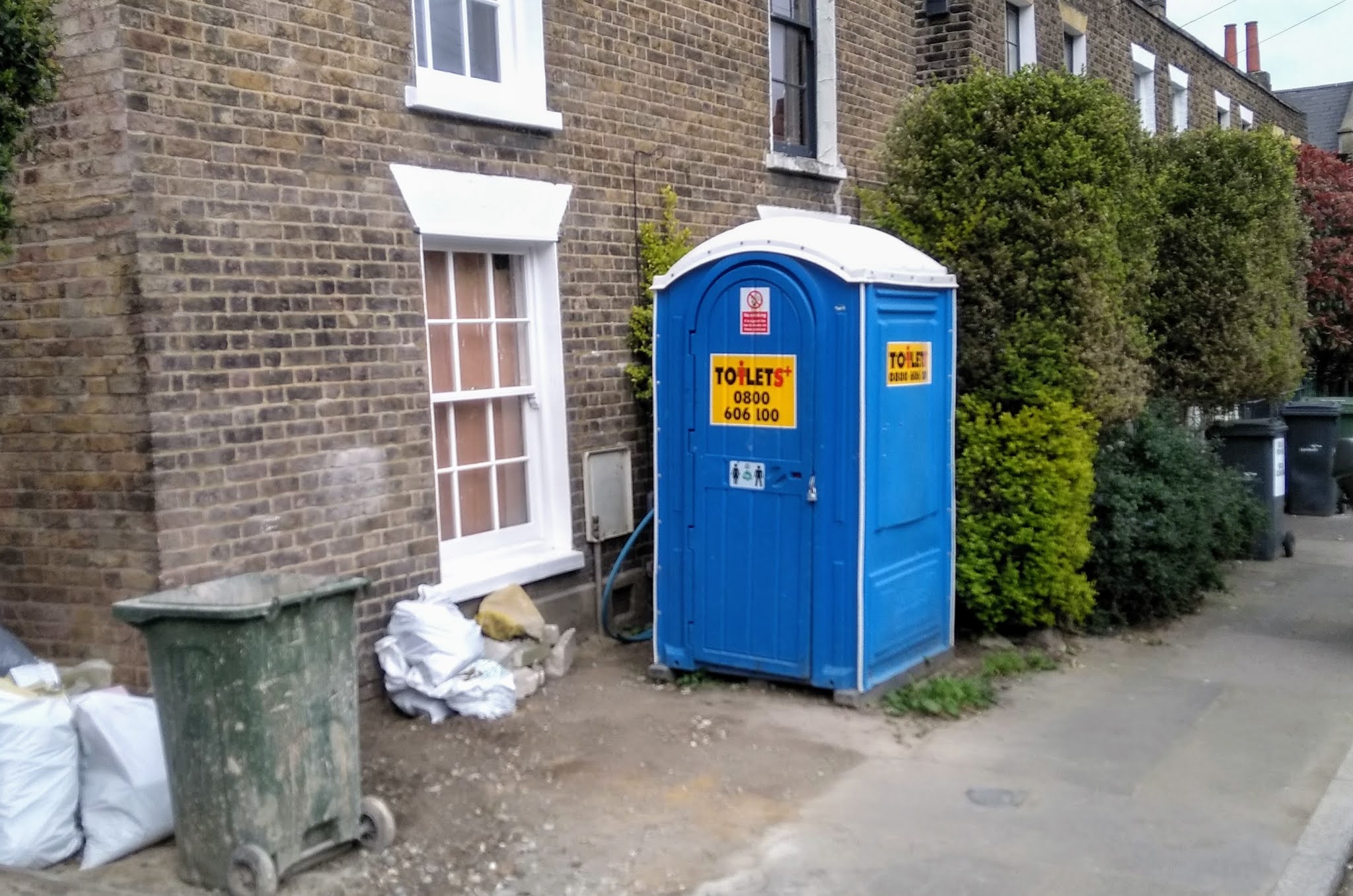
It's surely one of the most stinging ironies of these lockdown months. While the number of available public conveniences has reduced drastically as a result of austerity and Covid-19, there are actually many more toilets horribly visible to anyone who walks the streets of this or any other gentrified or gentrifying inner-London suburb.

Apart from the loos in the larger supermarkets, which are often as not out of order, I can only think of one public toilet in this postcode that is reliably open during the hours of daylight. 

Remember those first hot weeks of the first lockdown when parks - and especially Clapham Common - began to reek, not just of the normal dog-shit but of something more acrid? Beer and prosecco-tinged urine. It got to the point where the council had to provide portaloos.


But padlocked, private versions of these same, sentry-box sized erections were already popping up all around us. 

Thanks to the phenomenon noted in much of the media, the bored super-rich all seemed to get the same idea - use their lockdown time and loose change to effect complete gutting and refurbs of their metropolitan properties. 

So you suddenly see lots of those blue or yellow plastic boxes outside every house that is having its innards replaced by something even more expensive.

Yes, I'm referring to those portaloos for builders that are now overflowing  (hope not literally) onto the residential pavements of South, North, East and West London. What's happened? In the past builders and decorators were quite happy to use the owner's loo when it was needed. And owners always used to let them do so, as well as offering them cups of tea and coffee, assuming there was a functioning kitchen.

But now, the entire family moves out to one of its other properties - maybe in the Cotswolds, or maybe somewhere more exotic.  So the builders have the place to themselves. Except, it seems, for the bathrooms. Perhaps the owners cannot bear the idea of not-quite-so-rich people using their gold-plated sanitary facilities. 

I can't help feeling slightly uneasy as I pass one of these private conveniences, which are sometimes only inches from a narrow pavement.  Or even on it. 

I side step, as if trying to observe social distancing: in doing so I often forget to look down and end up treading in the latest dog-do, miniature or massive. (Why do lockdown dog owners not seem to know about bagging the dirt? Another article there - but, no, don't worry,  that's one thing I can't face writing about.)

In theory the builder-bogs are emptied at least twice a week. I know this becuase I have watched the waste removal tankers pulling up across the road, to that house which has been undergoing god knows what improvements and additions for more than a year now. 

Even if you don't see this operation, you hear it as the powerful suction pumps blast into action. It's almost as noisily annoying as the dreaded leaf-blowers, which continue to shatter everyone's peace every Monday morning.

So, this is lockdown, Clapham style. Around five of the 120 or so houses in this streeet have had new super-basements excavated during the last year. There's hardly been a days when there have not been teams of workers arriving at 8am, followed soon after by the first deliveries of cement, sand, timber, steel, paving, glass, grass, porphyry washbasins and marble baths, Aga cookers, elizabethan bedsteads, Hollywood size tvs. You name it.

So, it's clear that London's wealthiest homeowners can assume they are exempt from all lockdown restrictions when it comes to building work. And are those builders also exempt? Have you ever seen a builder wearing a mask on site? Maybe they have the same immunity as professional footballers on the pitch.

I will stop moaning here and now, for a day or two. It was good to get that off my chest. I envy those workers the easy access to a toilet at work, as well as the many cigarettes they get through on the porches and open upper windows of thier clients' fourth of fifth homes. This is good: as I say in almost every posting, these days, at least these guys and (not so often) women have some paid work during lockdown. 

Thank you and good night. 

Wednesday, 3 March 2021

Developers seek permission to demolish historic Tearooms building

Is this the end for the building that once housed the famous Tearooms des Artistes?

This entry comes quite soon after the last one, which I hope is not too much of shock to my readership. The reasons for this hasty posting will become clear.

Passing the still intact Tearooms building at 697 Wandsworth Road for the thousandth time since lockdown, I noticed something distinctly sinister.

Tied to a signpost there's a laminated notice, stained by rain and rust, but still legible.

It was one of those Lambeth Council Planning Permission notices which, when you see them, you instantly know another beloved local feature will soon disappear to make way for yet another apartment block. 

The notice looked like it had been there for years, so I thought maybe those developers had had second thoughts.

No such luck. I took photos and read it at home, with a sinking heart. You can read the whole thing on the Lambeth Planning Applications database - including around 100 supplementary documents, as well as 8 comments (all in favour). If you don't have the time, here are a few crucial points:

"20/01227/FUL | Redevelopment of the site, involving refurbishment and extension of the existing building at no: 693-695 and replacement of no : 697 with 3 new storey building to create nine residential units (Use Class C3) and the retention of the Public House at no 693-695 at lower and ground floor levels, together with the provision of cycle and refuse stores, landscaping and courtyards. | 693 - 697 Wandsworth Road London SW8 3JF

To make this clear, the application relates to two buildings. 693-695 Wandsworth Road is the big old pub building on the corner of Wandsworth Road and North Street. 

In its final incarnation it was a nightspot, the Artesian Well, a place which specialised in lavish faux-Bohemian decor and (according to a friend, who went once) a clientele including many public school kids from Surrey who were competing for their Duke of Edinburgh's Award in decadence. But maybe this is unfair. It was certainly extremely popular right up its demise in 2014, seen by many as the interesting face of Clapham nightlife, as opposed to the meat-market reputation of the High Street clubs.

The second building, at 697, was the Tearooms des Artistes, a place which was known and loved by many from the early 80s through to its demise in around 2006, when it became a posher and more pricey bar called Lost Society, which lasted another few years. Since 2014 it's been left in the hands of Lowe property guardians, and looks little changed.  Well, at least it is providing some genuinely affordable housing.

I shared some of my own happy memories of this place a few years ago, and was delighted when several others added comments and  links to more info on this lost gem of south London's alternative hospitality spots.  Some great memories emerge, including the fact that the late Marc Bolan's pink Bentley was parked outside for a long period in the 90s. 

I have to thank Baz for some amazing info, including some history he found on the Wayback Machine web archive, which suggests the building went back to the 16th century, when it was a barn on the Clapham Manor estate (any further info on this would be amazing). Baz also built a site for the Tearooms, and some of his extremely evocative photos - can still be seen on the Wayback Machine, here - including bits of the ancient structure. Surely evidence enough to slap of high-grade listing on this building!

One attempt to redevelop was kicked out by Lambeth council in 2015. The new application, from April 2020, still awaits a decision.

The architects for the developer and would-be demolishers, Marston Properties Limited, are dismissive of the old building. It's useful to quote their reasons at length:

"At ground floor the fascia and shop front has been completely replaced with modern fabric of no visual or architectural merit. In the process, a large steel beam was inserted to open up the shopfront which was used as ‘Regional Tyre Services Ltd’ in the 1960s-70s, which has subsequently resulted in structural damage to the façade.

"There are no features of merit internally.

"At most the building makes a neutral contribution to the character of the conservation area. It’s (sic) relationship within the streetscape is awkward; it lacks connection with the terraces to the west and the former Artesian Well to the east. 

3.28 Given the assessment that the building is at best a neutral contributor with many detracting elements (shop front etc.), Heritage Collective concludes that overall the high-quality replacement building as proposed would represent an enhancement of the Conservation Area. 

Even if the Council remains unconvinced in this regard and retains the stance that the building is a positive contributor, its loss as proposed is acknowledged by the Officers to fall within the less than substantial harm category. 

3.29 In such cases a weighing exercise is required setting on the one hand the less than substantial harm and on the other the public benefits that flow from this scheme. In this case the benefits include the redevelopment of a poor quality redundant site, removal and replacement of harmful features, poor quality windows, railings etc., securing a beneficial and long term future for the site, the re-opening of a community facility (the pub), the provision of nine new high quality homes and the delivery of a highly efficient, sustainable new building..."

And so on, and on, and on. Thus do developers nail all opposition to the floor, thrashing them with fine phrases and vacuous arguments.

Not that the quoted "Heritage Collective" is a consultancy, not to be confused with an official heritage body.

Quite what a "neutral contributor" to the conservation area means is unclear to this writer at least. To us, and anyone who once visited the Tearooms at any point through its various phases, from hippyish vegetarian restaurant/wine bar/club to the après clubbing chill down nest of Sunday best in the 90s and 2000s, the sight of this unique place is a blessed reminder of a more interesting Clapham, before the anodyne clumps of tasteful luxury apartments started popping up like weeds.

The application was still active in January this year, when the architects submitted some modifications to their designs. All of these are available to view on the planning archive. According to the website the application expires on April 15. 

It's too late to submit objections, but I do wonder why the wealth of history associated with these buildings seems to be entirely ignored in this application. I wonder if any archaeologists have ever been there to look for some Tudor era oyster shells....
 

Monday, 15 February 2021

Eleven years on: where the hell did it all go wrong?

The lost murals of Mauleverer Road
Mauleverer Road, SW2, January 2021: remembering a lost paradise.

At the end of its tenth year, this old blog is still spinning, much to its creator's surprise. Maybe not  at quite its youthful 33 and a third rpm, but at least at one story per season. 

So after a prolonged winter interlude,  it's time to take stock. The question hovering just above this acrylic as opposed to woollen hat is: Why bother?

The first postings appeared in February 2010, when I had the unlikely job of teaching web-based journalism to undergraduates. It seemed a good idea to have a blog of my own to practise on, before I attempted to show them how to do it. Poor dears.

The blog began with a post about the difficulty of finding stories that anyone else would want to read. I think that was also my first big mistake - no-one is interested in the agonies of would-be writers, except perhaps other failing writers.

The second post described my joy at finding the community/arts radio station Resonance FM, just as I crested that hill on the M11 as you drive south back into London, and see all those distant towers.

The  eclecticism of that station on 104 fm leeched itself into the fabric of this blog. I started to write about the things I enjoyed, such as vinyl LPs, tape, 35mm film, print as opposed to Kindle,  bikes, charity shops, cheap cafes, live music in pubs and dodgy bars, crumbling houses and so on.

The absurdity of the project (original title, Old Bill's Analogue Blog) just made it more necessary to do. Write abut things I valued most, with the realisation that they were all under various forms of threat (except, ironically, vinyl records, which were suddenly the height of fashion).

Over the next decade, the blog became peppered with outbursts about the impact of the most insidious weapon of social change - gentrification - on all the most desirable aspects of life in a city. 

The many attendant insults to the senses that gentrification inflicts: ridiculously expensive bars and restaurants and "artisan" outlets replacing useful shops; the cramming of every residential street with massive, ugly, noisy, expensive cars (worst of all, the increasingly vile SUVs); the inevitable driving away of older communities, replacing them with a brash, young(ish), wealthy and seemingly rather selfish monoculture. 

So, what's changed? Have three (to me equally) catastrophic events - austerity, Brexit and pandemic - made gentrifiers hide in their expensively created cellars? 

Sadly not. They are just digging bigger, deeper cellars. 

I'm going to use this and the next few posts to check back on some of the places and events written about in recent years, starting with a shocker in 2015 that was an eye-opener: the destruction of the Mauleverer Road mural in Brixton.


This story still smoulders in the memory. Those wonderful painted walls of the old brewery were a highlight of the backroad cycle route from here to to the old Lambeth College on Brixton Hill, where I was taking a course. 

These paintings of a tropical garden of Eden, fountains, luscious plants, trees, even a stable  with beautiful horses, transformed what would otherwise be a perfectly normal south London residential street. 

Read the original posts for more on the creation of these murals. The story since then has been just as dismal as expected. Having destroyed the art, the developers appeared to leave the site fallow for about three years. Some plywood hoardings went up, and at one point a few planters were added with some sad plants withering and uncared for. 

Peaking through the  shutters, you could see a massive hole in the ground, which at one point seems to be full of water. 

Finally, building got going, and now the development is complete. Go and take a look if you want to see how clever modern architects and builders are: they have created a carbon copy (no, a 3d-printer style copy) of the Victorian terraced house opposite. Except that these are stripped all character. It looks as though it could be an ironic and cynical response to Turner Prize winner Rachel Whiteread, who cast the inside of an old house just before it was demolished for redevelopment in Mile End. 

There's also a near-identical terrace of new four-bedroom Victorian style houses on the other side of the site, fronting on Mandrell Road.

Nearly all of the houses have To Let or For Sale boards up. You can snap one of these four-bed, three bathroom clones up for a mere £1.44million. And as the estate agent's blurb points out, you are within easy reach of "The Village", Market Row, the Ritzy and other attractions of an area which is not actually named in this blurb (Brixton).

So, there you go - you lose a life-enhancing piece of public art but you gain strangely unreal seeming copies of your own house. You almost wonder if the occupants will be as immaculate as these buildings - like those computer-generated smart, smiling young people who populate architects' impressions of all new developments. 

The far end of Mauleverer Road was redeveloped in the 1980s, and it's fascinating to see the totally different styles of domestic architecture. 

My jaundiced view of the new houses was challenged last time I cycled through, when a group of cheerful young people were unloading their stuff from a big van and were clearly moving in. 

A lovely new home for someone, in a fascinating area of London. And at least they will be looking out at the real Victorian houses over the road. 

Over the next few weeks (or months) the plan is to revisit plenty of old places and topics this blog snooped around over the past decade. They might include:

  • The Tearooms des Artistes (RIP)
  • Peter the Greek's Lock-up treasure shop (RIP)
  • Lambeth Libraries (lost and found)
  • Nine Elms disease (there's no vaccine)
  • Er...lots of other things, with a south London bias.

Look on the bright side, it might never happen.


Monday, 24 August 2020

Leaf-blowers: one more reason why it's a bad idea to live in a wealthy area (especially if you're not wealthy yourself)

It's 9.30 on a Monday morning and all hell is breaking loose in one of the wealthiest corners of south west London.

Those people still "working from home" will be bashing their heads against their laptop screens. Even long-term freelancers, who should have become inured to the many minor disturbances, find this particular noise difficult to stomach. 

If this post is more disjointed than usual, it's because I'm being driven mad by intermittent assaults on my eardrums.

Every week, at about the same time, a pair of men working for a contractor spend 15 minutes or so blasting air onto the expensive paving stones outside a luxury "townhouse" development behind the block of flats I live in. 

There were a few leaves on the ground, six or maybe even seven, and they're chasing them, trying to corral them into a corner. Clouds of dust and grit are raised. 

One of them wears ear-mufflers - just as well because the noise this petrol-powered blower makes is awful, echoing around the brick-clad walls of this hidden enclave of luxury homes. It sounds like one of those unsilenced mopeds beloved of trainee bikers. But this one's going nowhere, except to the next gated development which has a contract with the same property management company. And all the noise and stink of two revving two-stroke engines remains within the high-walled confines of this generally quiet zone. 

For the rest of the morning we can hear their labours in the surrounding streets, as they move around the various gated "communities".

It's a sad refection on how easy it is for a privileged layabout like this writer to find an endless stream of things to complain about. Even in the depths of the worst global pandemic in 100 years, you find solace in moaning about trivial nuisances. But then it's the silly little things like this that finally break us.

The leafblower guy is cleaning the carefully calculated space outside these new houses, which used to be a wonderfully overgrown garden. The space is just big enough to allow a full-fat Range Rover execute a three point turn; assuming the person driving knows what they are doing. Sometimes they don't. So, more dreadful racket as the drivers mess up their turns.

But the leaf-blower men worry me most. At this time of year it's an unnecessary job, and it shatters everyone else's peace, as well as polluting the air.  If it had been necessary, say in October when there are plenty of leaves to shift, what's wrong with a broom? Can that be more tiring than having a howling motorbike engine strapped to your back?

But now come pangs of guilt, because, however much that noise and the stink of two-stroke exhaust gas annoys me, at least the man has a job, and is paid something for doing this. Compared to him or many of the other thousands of people working around here to keep things moving, I am wealthy, thanks chiefly to having moved in here five decades ago.

Whether the wealth-gap between me and the leafblower is bigger than the one between me and the owners of those houses, or the even more expensive houses along this street (£4 -5million, at a pinch) is open to debate. Whatever the answer, the property machine has to keep on polishing its many assets, and it does so around here with alarming amounts of energy.

Yes, lockdown or no lockdown, let us keep the economy moving on, like those leaves, whatever the costs.

To get away from the racket I move to the front of the flat. There's some really loud effing and blinding coming from the pimped-up house across the road. Since December they've had endless streams of builders coming in to do something to what used to be a perfectly pleasant front garden. We wondered - are they going for a new bigger, deeper basement? For weeks it seemed like it, as a temporary roof was erected.

As lockdown came into force, the inhabitants and their many showy automobiles, large and small but all very noisy - decamped, thank god, perhaps to some other home.

In their place came new teams of builders and scaffolders and decorators. The work has been constant now. Occasionally some sort of boss turns up in a big black shiny pick-up truck and shouts at everyone at the top of his voice.

A terrible silence reigns. He drives off in a huff. The next day different teams of builders and decorators turn up.

More recently, one of the occupants of the house, presumably the owner, returns in his monster two-seater sports car, which is parked on that now horribly bleak, entirely paved area. No doubt there will soon be a weekly visit from the blower-man, lest any fugitive leaves from next door's verdant front garden should dare to encroach upon this immaculate parking lot.

 (nb: owning noisy cars seems to be another trait of the super rich. They pay hundreds of thousands of pounds for "supercars" with huge engines tuned to make that fuck-you roar when they hit the gas. Which is often at 6.45am when they rush off to their personal parking spaces somewhere in the City or Canary Wharf).

A few days later, an enormous removals truck pulls up, double parked. Two men in red company t-shirts jump out and are almost immediately on their phones, as there's no-one there to let them in. They sit around for hours, their truck half-blocking the street.

Only very wealthy people can afford to hire so many workers, and not even to be there when they arrive, presumably paying them for those wasted hours.
Truck jams are an increasingly common sight in the
wealthy residential streets of SW4,
even during lockdown.

Similar scenes are being played out at other houses up and down this street at any given time, and throughout most of the "lockdown" period. Every day massive trucks arrive with building materials or huge skips to remove debris. 

Sometimes they meet head-on and a sort of macho trucker showdown ensues.  And all for what? Houses that were fully refurbished three or four years ago are undergoing another total gutting, to suit the whims of their latest owners.

But at least these guys have jobs.

I've had several decades of being the strange old recluse on the top floor. I could name hundreds more annoying things my wealthier neighbours do. But you would almost certainly dismiss them as the ravings of a deranged and bitter old fool. And you would be right!


Thursday, 21 May 2020

C*****m takes a well-deserved battering in local writer's twitter thread

The horror of Clapham Common on the first hot weekend of the year. To be fair, this was taken in May 2018, long before social distancing was an allowable phrase. I took this to illustrate yet another unpublished article on the strange behaviour of  the tribes of Clapham. 


After many weeks of lockdown trying to write a post explaining why lockdown might be a good thing for the dread postcode, SW4 - along comes a much more agile critic with a twitter thread that demolishes any of my remaining excuses for thinking it's OK to live here.

In an epic 17-post twitter thread yesterday, the Clapham-raised, Stockwell-based writer and podcaster Daniel Ruiz Tizon explained why he now avoids the place he so loved as a child.

And why these days, he says, "You cannot get me to #Clapham for love nor money and those that know me well, know not to ask to meet in SW4".

Like Daniel, I also loathe what the name "Clapham" now stands for in discussions about London suburbs (these discussions have been getting very heated on twitter of late).

It has long been a mockable address.  People have been joking about "Cla'am" for two decades or more now. I stopped rising to the bait in 2003, when those same people saw the values of their sensible homes in New Cross and Nunhead and Dalston soaring.

It got to the point in the early 2000s where I started to lie, rather than admit to living here. I would say "close to Lavender Hill". Sometimes more blatantly, by saying Battersea or Stockwell. In my defence I'd point out this flat is less 100 yards from the SW4/SW8 border. But that's like saying you're slightly pregnant.

Face it, hypocrite: you live in Clapham! And are you going to move? No, of course not. Like it or loathe it, I am rooted.

In fact a lot of this blog has been about trying to justify my presence here, even though I am now much more like one of those sad old relics living and dying in their bedsits back in 1985.

I agree with each of Daniel's points about the awfulness of Clapham now. I also agree that "No part of this city, or any city, should be exclusively white and middle class".

I agree that we've lost much of the diversity, the blessed shabbiness, the easy-come-easy-go transitory character Clapham had that made it attractive to all manner of migrants, external or internal.

I was about to argue that Clapham still has a lot of that diversity, it's just not quite so visible, and of course it has. There's still that patchwork of social housing; there are still the old grandees living on the North Side in their well-padded bohemian splendour.  With their views over a Common, often including the little camouflaged tents of migrant workers: late evening campfires, accordion bands, short stay visitors, sharing common turf with the crows. Park bench business dealings. Skunk smoke under the horse chestnut trees. Lone music students practising flugelhorn scales by the paddling pool.

There is still diversity here, but as in most of London's inner-zone residential areas, it's not the diversity you notice so much as the polarity.

There's a local photographer, Jim Grover, who has revealed some of richness of the Clapham demographic, right now. His work, inspired largely by the African-Caribbean congregations of his local church, tapping into the family histories of Jamaicans of the Windrush generation, or by the Jekyll/Hyde character of Clapham High Street, by day and by night.

Yes, here I am on the defensive again, sorry. The problem is that the most visible section of the population, especially in summer, are those youngish, well-off, white, "just-down-from-uni" types that Daniel complains of. The 2020s versions of the 1980s yuppies, of which I was one, if a distinctly shop-soiled example.

The worst time is early summer, when they (we) emerge all at once from their (our) flatshares like flying ants on National Flying Ant Day, to crowd the pavements of the "Old Town", pastel-shade tailored shorts, flip-flops, carefully casual cashmere jumpers, pink flesh turning red, oh Lord. This year, perhaps because of the press coverage of breaches of social distancing, they have been more noticeable than ever.

Poor old boring old Clapham Common. Come on, you can't blame it for the packs of loose-bowelled doggies on shared dogwalker leads who foul it so, nor for the hordes of keep-fit fanatics who will happily shower you with thier sweat if you get in their way.

But Daniel has much deeper reasons for the anger he feels towards SW4  as it is now. The gentrifiers have defiled the neighbourhood he grew up in. It is much more painful for him, than for a latecomer like myself.

I grew up in the leafy suburbs of Croydon, which in those days was categorically not in London. As a child of 7, I remember how the cityscape changed as we pulled out of Clapham Junction on the way to Victoria. The view across the smoking chimneys to the steep terraces on Latchmere Road, the then-new tower blocks of the Battersea council estates, and then the billowing clouds of steam above the power station: it might as well have been the title sequence for Coronation Street.

Yes, here I go, defending the place I arrived in almost by accident after a decade of moving around the postcodes north of the river, from NW1 to W9 to SW3 to E8. Despite claiming to hate everything Thatcher stood for, I too was lured into getting a mortgage, a foot on the ladder. My foot's still on the same rung of that ladder, but all around has changed beyond recognition.

As I peer out of the window so there's a god-awful howl reverberating off the houses, a black open-top Ferrari is hovering and revving up outside, a couple of thirty-something fellers in their designer shades, are braying away.  Lockdown? Wtf's that, matey?

Yep, OK. Clapham now. You win, Daniel.


Sunday, 5 April 2020

Here's a necessary corrective to most recent posts. I love everybody

Looking back at recent posts, you'd be forgiven for thinking: "What a miserable, ungrateful, embittered old sod the author must be".

So, before the plague arrived,  I started writing a post which tried to celebrate some of the good things experienced in 2019.  To recall a few joyful moments. Even the freeze-dried husk of a human resident in a rodent-infested top floor flat in one of the wealthiest streets in one of the most selfish postcodes (reportedly) in south west London, is still prone to the occasional moment of pleasure, excitement, rapture, ecstasy ....dare i say love?

Now from the perspective of a third week in isolation a long way from London, the city I enjoy slagging off but which I really love, without which I cannot live, and which I miss more acutely than anything. I will publish this silly post. 

Here it is (author ducks out before you, mythical reader, can absorb any of it):

London, March 9, 2020: Someone quoted Wordsworth on the radio:
"It is the first mild day of March....this one day we will give to idleness."

The words triggered conflicting feelings. A rush of forgotten pleasures, against a shudder of shame, the guilt of a human wallowing in self-pity.

What about the good things that have happened in the past 12 months? What about the cultural riches on your doorstep?

Many things have cheered the soul. They're not necessarily fodder for the culture pages of Time Out mag (does Time Out do culture any more, apart from food and drink culture?)

(But hats off to Time Out for having the wit to rename itself Time In in the first week of the plague - ed).

Let's face it, for a depressive geezer of pensionable age, you had some good times, sometimes.

1. The local pub
A place featured in at least a dozen unpublished blog entries, the Bread & Roses. And a couple of published ones, such as this one from last summer.

This trade union-owned pub half way down Clapham Manor Street is still a gem. The times I  have been there,  knocked out by the talent and energy of performers, when there've been as many musicians on stage as punters on the floor.

This saddens me. Why isn't this place packed out? There's theatre, music, comedy and DJ entertainment most nights of the week, so I guess overall they must be pulling in enough custom. (Well, that was before the lockdown of course. Ed.)

The pub, previously the Bowyer Arms, occupies an impressive Grade 2 listed building designed by Thomas Cubitt. It was bought by the Battersea and Wandsworth Trades Union Council in 1995, and is run on solid socialist principles alongside the great Workers Beer Company (which slakes the thirst of crowds at Glastonbury and other big events around the country, year after year).

There are great music pubs keeping the flame burning in Brixton, Camberwell, New Cross and beyond, but the fact there's one here in the heart of affluent SW4 is just such a good, surprising thing, it needs to be celebrated, as often as possible.

Can you imagine property agents boasting about a trade-union owned pub with live music two or three nights a week to potential buyers of nearby multi-million pound houses? Well, who knows, it's such a gem I think they might. I like to think they would.

Long live this beautiful bastion of fairness, humanitarian values, and a sometimes unfashionable commitment to making all forms of performing arts accessible to all.

2. Meeting Damo Suzuki last March: a brief account of this almost life-saving event, a book launch in a record shop near Brick Lane, was published here.

3. Lambeth Libraries events team

Against Lambeth council's atrocious library closure policies, the Libraries' events team have been putting on some wonderful events in the surviving branches, right across the borough.

Thanks for loads of great evenings in Brixton, South Lambeth and other libraries. One of the most memorable for me was last October, held at Clapham Library for Black History month.

This event - Sound Systems, DIY Culture and 100 Years of British Black Music - was chaired by the  excellent events organiser Tim O'Dell. It kicked off with discussion on the history of black musicians in the city, led by author Lloyd Bradley. His latest book - Sounds Like London – uncovers lots of previously unknown stuff about black jazz musicians in Britain way back in the 20s and 30s, and the huge influence they had.

He screened a wonderful short film, Half A Century Carnaby Street, made by Lucy Harrison in 2013, celebrating Columbo's nightclub at 50 Carnaby St which introduced London to the delights Jamaican sound systems back in the early 60s. Lucy Harrison even managed to stage a breif return to the address - now the basement of Ben Sherman store - several original DJs and their sound-system.

Things became more contemporary with the arrival of all-round local hero and globally influential Jamaican-born musician and producer Dennis Bovell, who grew up in Battersea. One of his bands, Roots Radics, helped create that unique dub poetry sound in long-term collaborations with Linton Kwesi Johnson.

Bovell also produced The Slits' first album, helping them make music that you could dance to while laying down new layers of spikey feminist attitudes.

He talked about all this stuff that night, answering questions, for example, how he got Janet Kay to hold that incredibly high note climax to her big hit, Silly Games - in the process of which he invented (and named) a new genre,  lovers rock, which was a successful export, even to Jamaica.

He talked about his musical education, from his dad, from Sunday trips to the church in Brixton, his love of  Jimi Hendrix, hours spent at the Dub Vendor, then hanging out in clubs in Soho including Columbo's where he met visiting Jamaican stars (including Marley). He took reggae to far flung places with his first band, Matumbi, his sound system,  Jah Sufferer, and a mobile record store based on a VW camper van.

This was just one of many great evening events, mainly free, in all the borough's remaining libraries, organised by a small but dedicated team. Salute them, now more than ever.

(In the current lock down situation, libraries are closed but the events team have organised a full programme of online events and services, check it out! Ed)

3. Midsummer, a rare meeting in a Lambeth theatre-pub
One of those rare occasions when worlds I imagined would always be separate came together, briefly but to good effect. An old friend, who I used to work alongside at a Wapping-based educational newspaper, is now an increasingly busy actor. Like me and many others she'd taken voluntary redundancy in 2006 and thrown herself into the work she'd always wanted to do: acting.

By a strange coincidence she took part in a "Page to Stage" reading of part of a pilot TV series written by Stockwell-based writer, performer and podcaster - not to mention national treasure - Daniel Ruiz Tizon.

I was going to describe Daniel as having a wonderfully dark comedic style, until I saw the Italian Vogue had already used those words to introduce their rather good interview of him back in 2018. What a star!

Apart from being south London's finest and most devastatingly dead-pan podcaster and all round social commentator and good human (check his twitter feed for proof of this) Daniel is also this moribund blog's only fan, and even its occasional unpaid publicist.

So, on that warm June evening, I not only met old workmates, but also Daniel, for the first time in the flesh. I can report that he sounded exactly like he sounds in his podcasts, and that he looks just like his photo. Good facts to report.

I witnessed a read-through of part of an embryonic sitcom. It was classic Ruiz Tizon and left me wanting more.

Each short piece performed at this event, upstairs in a pub at Lambeth North, was critiqued by a front-row panel of theatre types. Some were kind, others less so, Daniel and the three other writers took it all on the jaw. Then we all went back to the bar.

We exchanged a few words.  I should've bought him one of the many drinks I owe him. I did not. Short arms, they used to call me. Another time perhaps.

I've always loved Jah Wobble and I think he loves us all. Seen here playing at
 the Cropredy Festival, Oxfordshire, in 2005, Mr Wobble recently became a 
part-time Stockwell resident, praise the lord.  Photo credit: Brian Marks/
Wikimedia Commons Creative Commons Attribution 2.0 Generic
4. East end hero moves - temporarily? - into Stockwell
This truly happy piece of news hit me right at the end of the year, in an interview on BBC Radio London by Robert Elms.

Elms, a resolute north Londoner, managed not to sound too dismayed when top bass player, globally sought-after producer, ex-tube driver Jah Wobble, has found himself a gaff in Stockwell. He said they'd found a flat near the Wandsworth Road; it was ok, he said, nice and green.

At the time he was teaching "lonely old blokes" in the art and craft of dub music at an arts centre in Merton, as well as embarking on a new tour.

Now, who knows, maybe he's decamped to the Wobble family home back in Manchester. But how great to think that the musician and writer who finds divinity in Vauxhall Bridge should even temporarily be lodging not far away.

As any fan of the great man  will remember, the track on the Invaders of the Heart album, Take Me To God, expresses the bliss of religious experience in a way that only Mr Wobble could pull off so brilliantly. My favourite verse:

"I am limitless in space, time and matter
Simultaneously the planet Neptune
Part of the structural support to Vauxhall Bridge
I am your left breast
I am Stepney
I am Peru
I am divine and so are you.
I love everybody."

This is a turn-to song whenever things are really grim. (Like now! Ed.)

It always works. If you know his voice, if you know his bass playing, if you know the music of the Invaders of the Heart, then you'll understand. What a fabulous addition to the deep SW8 talent pool!